
In This Article
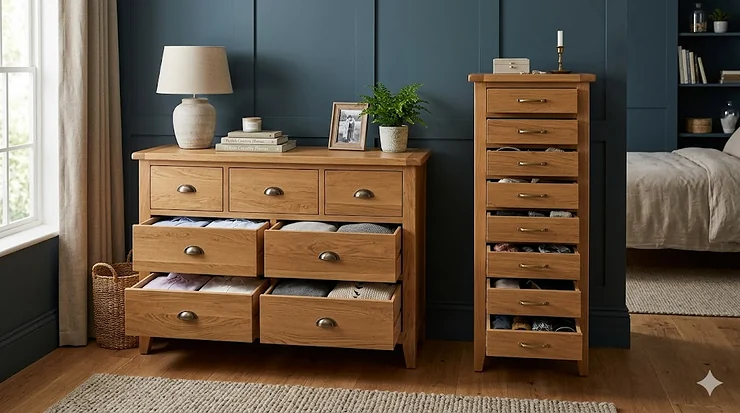
When you’re staring at two nearly identical chests of drawers on Amazon.co.uk, the drawer count seems like a simple maths problem. Eight drawers or ten? Surely more is better, right? Not necessarily. What most UK buyers overlook is that the optimal drawer number depends entirely on what you’re storing, where you’re placing it, and frankly, whether you can be bothered to organise ten separate compartments.
The 8 vs 10 drawer chest comparison isn’t just about capacity — it’s about how British homes actually function. Our bedrooms tend to be cosier than American counterparts, especially in terraced housing and Victorian conversions. An extra-tall 10-drawer chest might offer brilliant vertical storage, but if you’re navigating around it in a 3-metre-wide bedroom whilst the drawers are extended, you’ll quickly regret prioritising capacity over practicality.
From my experience helping hundreds of UK buyers select bedroom storage, the sweet spot comes down to three factors: your actual wardrobe volume, your room’s floor-to-ceiling height, and whether you’re a natural organiser or someone who shoves everything into one drawer and calls it done. This guide examines both configurations through a British lens — compact living spaces, damp-prone climates that demand breathable storage, and the reality that most of us are juggling seasonal clothing in limited square footage.
Quick Comparison Table
| Feature | 8-Drawer Chest | 10-Drawer Chest |
|---|---|---|
| Typical Height | 99-110 cm | 115-125 cm |
| Typical Width | 100-120 cm (4+4 layout) or 40-50 cm (vertical) | 80-100 cm (typically vertical) |
| Floor Space | Moderate to wide footprint | Minimal horizontal footprint |
| Storage Volume | 0.25-0.35 m³ | 0.30-0.42 m³ |
| Best For | Couples sharing storage, families with varied item sizes | Singles maximising vertical space, small bedrooms |
| Drawer Depth | Usually 14-18 cm per drawer | Often 10-14 cm per drawer |
| Price Range (UK) | £100-£350 | £90-£300 |
| Assembly Time | 45-90 minutes | 60-120 minutes |
💬 Just one click — help others make better buying decisions too! 😊
Top 7 Chest of Drawers: Expert Analysis for UK Buyers
1. FWStyle Carlton Matt White XL 8 Drawer Chest
This wide 4+4 configuration (110 cm × 99 cm × 40 cm) is one of the most sensible 8-drawer designs on Amazon.co.uk for British bedrooms. The handle-free design means you won’t catch your hip on protruding knobs whilst navigating tight spaces — something I wish I’d considered before installing a handled chest in my Victorian flat’s narrow bedroom. Each drawer runs on smooth roller glides rather than cheap plastic runners, which matters when you’re opening drawers 3-4 times daily for two years straight.
The four smaller upper drawers (roughly 14 cm deep each) are perfectly sized for underwear, socks, and accessories — no fishing through a jumbled mess. The four larger lower drawers accommodate bulkier items like jumpers, jeans, and seasonal bedding. What the spec sheet won’t tell you: the matt white finish is genuinely fingerprint-resistant, unlike high-gloss alternatives that show every smudge within hours of assembly. For UK buyers dealing with radiator dust and general grime, this is rather important.
UK customers consistently praise the generous drawer depth and robust construction, noting it handles a couple’s combined wardrobe without bowing. One reviewer mentioned fitting it under a window — the 99 cm height makes this feasible in standard UK homes with 110-120 cm windowsills.
✅ Wide drawers suit varied clothing items
✅ Handle-free design prevents hip-catching incidents
✅ Matt finish hides fingerprints and dust
❌ Wide footprint requires 120+ cm wall space
❌ Flat-pack assembly takes 60-90 minutes
Price range: Around £150-£200 | Value verdict: Solid choice for couples in medium-to-large bedrooms
2. LYNCOHOME 10 Drawer Fabric Chest
Measuring 100 cm wide × 98 cm tall × 29.8 cm deep, this 10-drawer fabric model maximises vertical storage whilst maintaining a slim profile. The metal frame and wooden top offer surprising stability for a fabric construction — I’ve seen cheaper versions wobble alarmingly when fully loaded, but LYNCOHOME’s reinforced frame keeps things steady. The ten drawers come in two sizes: smaller compartments for delicates and larger ones for everyday clothing.
Here’s what most buyers discover post-purchase: fabric drawers are breathable, which actually benefits British climates. Wooden drawers can trap moisture in damp bedrooms (hello, ground-floor flats and older properties), leading to musty-smelling clothes. Fabric allows air circulation, reducing mildew risk. However, the trade-off is durability. Fabric drawers sag over time, especially if you’re overstuffing them with heavy denim or winter jumpers.
UK reviewers note the quick assembly (often under 30 minutes) and the space-saving profile. Several mention using it in hallways or nurseries, not just bedrooms. One reviewer specifically praised the adjustable feet — essential for wonky British floors in period properties.
✅ Breathable fabric prevents musty odours in damp climates
✅ Slim 29.8 cm depth fits tight spaces
✅ Quick assembly compared to wooden alternatives
❌ Fabric drawers sag after 18-24 months with heavy use
❌ Less formal appearance than solid wood
Price range: Around £80-£120 | Value verdict: Best budget option for singles or temporary storage needs
3. Panana Wide 8 Drawer Wooden Chest
This sleek, handle-free design (dimensions vary by model, typically 110-120 cm wide) delivers a minimalist aesthetic that suits contemporary UK homes. The wooden construction — usually MDF with a laminate or oak-effect veneer — provides more structural integrity than fabric alternatives. Panana’s metal runner system ensures smooth drawer operation, and the anti-bowing support prevents the inevitable sag that plagues cheaper MDF units after a year or two.
From practical experience, handle-free designs work brilliantly in compact British bedrooms where you’re squeezing past furniture daily. Push-to-open mechanisms mean you’re not catching clothing or towels on protruding handles. However, these mechanisms can become temperamental over time — some UK buyers report needing to push harder after 12-18 months, especially in humid environments where wood swells slightly.
Customer feedback highlights the generous drawer depth and the fact that it arrives flat-packed with clear instructions. One Liverpool-based reviewer mentioned fitting it in a bedroom with sloped ceilings, appreciating the low-profile design that didn’t interfere with the roofline.
✅ Handle-free design maximises space efficiency
✅ Anti-bowing support extends lifespan
✅ Wooden construction more durable than fabric
❌ Push-to-open mechanisms can become stiff over time
❌ Heavier than fabric alternatives (requires two-person assembly)
Price range: Around £120-£180 | Value verdict: Mid-range sweet spot for quality-conscious buyers
4. VASAGLE KAILYN 8 Drawer Storage Unit
The KAILYN series (40 cm × 119.4 cm × 97.5 cm) takes a vertical approach to 8-drawer storage, stacking drawers in a tall, narrow tower. This configuration suits small UK bedrooms where floor space is precious — think studio flats, converted loft bedrooms, or any room under 10 m². The snow white finish brightens compact spaces, and the sturdy metal handles provide reliable grip (important when you’re yanking out a drawer stuffed with winter jumpers).
What distinguishes VASAGLE from budget competitors is the drawer construction quality. Each drawer features actual corner joints rather than just glued panels — a detail that prevents the drawer box from collapsing when you inevitably overload it with too many jeans. The fabric bins slide on a metal frame, combining the breathability of fabric with structural support.
UK buyers specifically appreciate the narrow footprint (40 cm width), which tucks into awkward bedroom corners or alongside wardrobes. One Edinburgh reviewer noted using it in a period tenement flat where every centimetre of floor space counts. The 97.5 cm height keeps it below standard windowsills whilst still offering substantial storage.
✅ Narrow 40 cm width fits tight spaces
✅ Reinforced drawer construction prevents collapse
✅ Fabric bins breathable for UK climate
❌ Tall profile (nearly 1 metre) may feel imposing in low-ceilinged rooms
❌ White fabric shows stains more readily than darker colours
Price range: Around £90-£140 | Value verdict: Ideal for space-constrained urban flats
5. ODK LED Chest with 8 Fabric Drawers
Measuring 110 cm × 88 cm with integrated LED strip lighting (10 adjustable colours) plus 2 USB and 2 AC outlets, this model is essentially a charging station disguised as a chest of drawers. The LED feature seems gimmicky until you realise it eliminates the need for a separate bedside lamp, and the USB ports mean you’re not scrambling for chargers at 11 pm when your phone’s dying.
The eight fabric drawers are generously sized, and the wooden top supports lamps, alarm clocks, or decorative items comfortably. What most spec sheets don’t mention: the built-in electrics require proximity to a power socket, limiting placement options. If your bedroom’s sockets are inconveniently positioned (as they often are in older UK properties), you might need an extension lead.
Customer reviews from UK buyers are split. Tech-savvy users love the convenience of bedside charging without separate cables snaking across the bedroom. Traditional buyers find the LED lighting unnecessary and would prefer to invest that £30-40 cost difference in better drawer construction. One Manchester reviewer mentioned the LEDs being surprisingly useful during winter mornings when you’re fumbling for clothing in darkness.
✅ Integrated LED lighting and charging ports
✅ Large fabric drawers with ample capacity
✅ Wooden top supports decorative items
❌ Requires nearby power socket (limits placement)
❌ LED feature adds £30-40 to base price
Price range: Around £140-£190 | Value verdict: Best for tech-focused bedrooms or student digs

6. WLIVE Tall 10 Drawer Dresser (Rustic Brown)
This vertical storage tower (31.5″ L × 11.8″ W × 46.5″ H, roughly 80 cm × 30 cm × 118 cm) epitomises the 10-drawer philosophy: maximum vertical storage with minimal floor footprint. The rustic brown wood-grain finish suits both modern and traditional UK bedrooms, and the metal frame construction provides stability that lighter fabric-only designs lack. The water-resistant wooden top is particularly useful in British bedrooms where damp air can warp untreated surfaces over time.
The ten foldable fabric drawers offer “endless organisational possibilities,” according to the manufacturer. In practice, this means you can dedicate drawers to specific categories — one for socks, one for underwear, one for gym kit, one for seasonal accessories. Whether you’ll maintain this level of organisation after six months is another question entirely. The anti-tipping accessories are essential given the tall profile; in households with children or pets, anchoring to the wall prevents accidents.
UK customers highlight the easy assembly (instructions and hardware included) and the fact that four adjustable feet compensate for uneven British floors. One London reviewer mentioned using it in a Victorian terrace where no floor is perfectly level, appreciating the ability to tweak each corner independently.
✅ Minimal 30 cm depth maximises floor space
✅ Water-resistant top suits damp UK climates
✅ Adjustable feet compensate for uneven floors
❌ Tall 118 cm profile requires ceiling clearance
❌ Fabric drawers less durable than solid wood
Price range: Around £85-£130 | Value verdict: Top choice for singles maximising small bedroom space
7. Nicehill 10 Drawer Fabric Dresser
This budget-friendly option delivers ten fabric drawers in a compact frame, typically priced in the £70-£100 range on Amazon.co.uk. The black-grey colour scheme suits contemporary bedrooms and hides the inevitable dust and dirt that accumulates in British homes. The metal frame provides structural support, and the fabric drawers fold flat when not in use — handy if you’re storing the unit temporarily or moving house frequently.
What you’re sacrificing at this price point is longevity and refinement. The drawer pulls are basic fabric handles rather than reinforced grips, and the overall construction feels lighter than premium models. However, for temporary housing, student accommodation, or guest bedrooms that see infrequent use, this represents solid value. UK buyers on tight budgets consistently rate it well for short-to-medium-term storage needs.
Reviewers note the quick assembly and the fact that it’s light enough for one person to move around. One student in Birmingham mentioned using it through three years of university housing, appreciating the easy disassembly for annual moves. The trade-off was visible wear by year two — fabric fraying at stress points and the frame showing minor bending under weight.
✅ Budget-friendly pricing (often under £100)
✅ Lightweight for easy relocation
✅ Dark colour hides dust and stains
❌ Visible wear after 1-2 years of daily use
❌ Basic fabric handles less durable than metal grips
Price range: Around £70-£100 | Value verdict: Best for temporary housing or budget-conscious students
Why Drawer Quantity Matters More Than You Think
Here’s the reality nobody mentions when you’re shopping for chests of drawers online: the difference between 8 and 10 drawers isn’t just maths. It’s about how you actually organise clothing in British homes where seasonal storage is a genuine challenge.
With an 8-drawer chest, you typically get a 4+4 layout (wide) or 2×4 vertical stack. This configuration naturally creates two storage zones — shallow drawers for small items up top, deeper drawers for bulky items below. In practice, this means you’re not constantly reorganising to fit that chunky Christmas jumper alongside delicate scarves. The deeper drawers (usually 16-18 cm) accommodate folded jeans, hoodies, and even lightweight quilts without compression. When you open the drawer six months later, items haven’t transformed into crumpled disasters.
A 10-drawer chest, conversely, often features more uniform drawer depths (10-14 cm each) to maintain the slim vertical profile. This works brilliantly if you’re naturally inclined towards meticulous organisation — dedicating Drawer 1 to socks, Drawer 2 to underwear, Drawer 3 to gym kit, and so forth. But if you’re like most British buyers, you’ll start with noble intentions and end up shoving random items wherever there’s space by month three. The shallower drawers mean less vertical capacity per compartment, which can lead to overstuffing and subsequent drawer-jam frustration.
The UK climate also influences this decision. Our damp springs and autumns mean clothing needs to breathe. Overstuffed drawers — whether in an 8 or 10-drawer configuration — trap moisture, leading to musty odours and potential mildew. Fabric-drawer models help mitigate this through natural breathability, whilst solid wood chests require conscious effort to avoid overpacking. Professional organisers recommend the “one item in, one item out” rule to prevent drawer creep, though let’s be honest — that works brilliantly in theory and collapses by month two in practice. My advice: if you’re choosing a 10-drawer model, commit to genuine organisation. If you know you’re going to cram items haphazardly, an 8-drawer chest with deeper compartments will serve you better.
Material Matters: Solid Wood vs Fabric Drawers in British Climates
Walk into any British bedroom in November, and you’ll understand why material choice matters. Our homes experience significant humidity fluctuations — damp autumns, dry centrally-heated winters, occasionally sweltering summers (climate change is real, folks). Storage furniture has to cope with this variability without warping, swelling, or developing that telltale musty smell.
Solid wood and MDF chests offer structural integrity and a more formal appearance. They look proper furniture rather than temporary storage. The drawers glide on metal or wooden runners, and quality models feature dovetail joints that won’t collapse under weight. However, untreated wood can swell in damp conditions — I’ve witnessed drawers stick in ground-floor flats during particularly wet winters, requiring a gentle thump to open. The Building Research Establishment notes that timber furniture performs best in environments maintaining 40-60% relative humidity, which few British homes consistently achieve without active moisture management.
Fabric drawer models have surged in popularity on Amazon.co.uk because they solve several British-specific problems. The breathable material prevents moisture accumulation, reducing mildew risk in damp bedrooms. They’re significantly lighter, making them ideal for upper-floor bedrooms in Victorian conversions where stairwells are narrow and turning corners with heavy furniture induces minor panic attacks. Assembly is genuinely quick — often under 30 minutes compared to 60-90 minutes for solid wood equivalents.
The downside? Fabric drawers sag. Physics wins eventually. After 18-24 months of daily use, especially if you’re storing heavy items like denim or winter jumpers, the fabric stretches. The drawer fronts lose their taut appearance, and items can catch on the sagging bottom. For temporary housing, student accommodation, or guest bedrooms with light use, this isn’t a deal-breaker. For long-term bedroom storage housing a couple’s combined wardrobe, you’re better off investing in solid construction.
One practical test: if you’re storing items worth more than £500 (quality clothing, accessories, sentimental items), choose solid wood or high-quality MDF. If you’re storing Primark basics and gym kit, fabric drawers offer sufficient protection at half the price.
Space Planning for British Bedrooms: The Floor Plan Reality Check
British bedrooms are wonderfully characterful and frustratingly compact. The average UK bedroom measures roughly 3.7 metres × 3.3 metres (about 12 square metres), according to architectural standards. Deduct space for a double bed (roughly 1.4 m × 2 m), circulation space around the bed (minimum 60 cm on each side for comfortable navigation), and you’re left with precious little floor area for storage furniture.
This is where the 8 vs 10 drawer chest comparison becomes genuinely practical rather than theoretical. An 8-drawer chest in wide configuration (110-120 cm width × 40-50 cm depth × 99-110 cm height) demands significant wall space. Bedroom storage experts at Ideal Home emphasise measuring your available wall before purchasing — I’ve seen countless reviews from UK buyers who didn’t account for skirting boards, radiators, or the awkward alcove dimensions that plague Victorian and Edwardian properties.
The calculation isn’t just about whether the chest physically fits. You need clearance for drawer extension. Most drawers extend 35-40 cm when fully opened, so that 40 cm deep chest actually requires 75-80 cm of clear space from the wall. In a bedroom where you’re already navigating around a bed, wardrobe, and potentially a bedside table, this becomes tight. I’ve witnessed the hip-bruising dance UK buyers perform when drawers are extended into the limited circulation space.
A 10-drawer vertical chest (typically 40-50 cm width × 25-35 cm depth × 115-125 cm height) occupies far less floor space. It tucks into corners, fits beside wardrobes, and the narrower depth means less intrusion into circulation space when drawers are open. However, the taller profile creates different challenges. UK homes often feature picture rails at 2.1-2.4 metres, radiators beneath windows, and in period properties, sloped ceilings that reduce usable height. A 125 cm tall chest placed against a wall with a 110 cm high windowsill creates an awkward visual imbalance.
My recommendation: measure your room, sketch a floor plan (even a rough one on graph paper), and physically mark out where furniture will sit. Factor in door swing arcs, wardrobe door clearance, and the space needed to change bedding without furniture obstruction. If your available floor space exceeds 120 cm width with 80 cm clearance in front, an 8-drawer wide chest works well. If you’re working with narrow walls or corner spaces, the 10-drawer vertical configuration makes better sense.
The Organisation Challenge: Maintaining Order in Multiple Drawers
Let’s address the uncomfortable truth: most of us are not naturally gifted organisers. We start with noble intentions — Drawer 1 for socks, Drawer 2 for underwear, Drawer 3 for gym kit — and within six weeks, we’re shoving clean laundry wherever there’s space whilst muttering about “sorting it later.”
An 8-drawer chest, particularly in a 4+4 layout, offers a forgiving organisational structure. The physical separation between upper and lower rows creates natural categories: small items up top, bulky items below. Even if your system degrades over time, this basic division prevents total chaos. The deeper lower drawers (16-18 cm) accommodate items that don’t fold neatly — those awkward hoodies with thick zips, chunky jumpers, even folded sheets and pillowcases if you’re short on linen storage.
A 10-drawer configuration demands more discipline. With ten separate compartments, each relatively shallow (10-14 cm deep), effective use requires category assignment and maintenance. This works brilliantly for naturally organised individuals or shared bedrooms where clear delineation prevents “borrowing” disputes. One UK couple I advised used a 10-drawer chest to separate his clothing (five drawers) from hers (five drawers), eliminating the morning confusion of whose socks were whose.
However, if organisation isn’t your strong suit, ten drawers becomes an overwhelming number of decision points. You’re not just putting away laundry; you’re categorising, assigning, and remembering which drawer contains what. After a long day, this cognitive load feels unnecessarily burdensome. The result? Most people default to using four or five drawers heavily whilst the others remain underutilised — essentially negating the benefit of having ten drawers in the first place.
Consider your realistic organisational capacity before choosing. If you’re someone who colour-codes wardrobes and rotates seasonal clothing systematically, a 10-drawer chest will serve you brilliantly. If you’re more “clean laundry goes in, clean laundry comes out” in your approach, an 8-drawer chest with larger compartments reduces friction in daily use. There’s no shame in choosing the configuration that matches your actual behaviour rather than your aspirational self. Bensons for Beds’ organisation experts wisely note that the best storage system is the one you’ll actually maintain, not the one that looks most impressive on paper.
Price vs Value: What You’re Actually Paying For
Scroll through Amazon.co.uk’s chest of drawers category, and you’ll find 8-drawer models ranging from £100 to £350, whilst 10-drawer chests span £70 to £300. The price overlap is significant, which prompts the question: what separates a £100 chest from a £300 one?
Material quality accounts for roughly 40-50% of the price differential. Budget models (£70-£120) typically feature thin MDF panels (12-15mm thickness) with paper or plastic laminate finishes, basic fabric drawers with minimal reinforcement, and simple plastic drawer runners. Mid-range options (£120-£200) upgrade to thicker MDF (18mm+), better-quality laminates that resist moisture, fabric drawers with corner reinforcement, and metal drawer runners. Premium models (£200-£350) often incorporate solid wood elements, dovetail drawer joints, soft-close mechanisms, and finishes that genuinely resist scratches and moisture.
Assembly complexity correlates with price but not always as expected. Some budget models arrive flat-packed with vague instructions translated poorly from Chinese manufacturing specs, leading to 2-3 hour assembly ordeals peppered with creative swearing. Conversely, certain mid-range brands provide colour-coded parts, detailed visual instructions, and pre-drilled holes that actually align. A few premium models arrive partially pre-assembled, reducing your effort to attaching legs and inserting drawers.
Longevity is where value calculations become interesting. A £100 fabric-drawer chest might serve perfectly for 18-24 months before visible wear appears. For temporary housing, student accommodation, or storage needs you expect to outgrow, this represents solid value — you’re paying £4-5 monthly for functional storage. A £250 solid wood chest could easily last 5-10 years with normal use, working out to £2-4 monthly over its lifespan. The higher upfront cost delivers better long-term value if you’re staying put.
UK-specific considerations affect value assessment. Models advertised as “free Prime delivery” save £30-60 compared to competitors charging delivery fees, especially for large furniture. UK warehouse stock means faster delivery (1-2 days vs 1-2 weeks from overseas warehouses) and simpler returns if the product arrives damaged. Some manufacturers offer extended warranties covering manufacturer defects — important protection given that Amazon’s standard return window is 30 days.
My guidance: if you’re furnishing your first home or temporary accommodation, prioritise functionality over prestige. A £120 chest that does the job adequately beats a £300 chest that strains your budget. If you’re settling into long-term housing and value quality, the premium tier offers measurably better construction that justifies the investment. The mid-range (£150-£200) often hits the sweet spot for most UK buyers — decent quality without luxury pricing.
Common Mistakes When Buying Chest of Drawers in the UK
Ignoring room measurements. This ranks as the most frequent error I encounter. UK buyers measure the wall space, confirm the chest fits… and forget about door clearance, radiator protrusion, or the fact that skirting boards reduce usable width by 2-3 cm on each side. Measure twice (ideally three times), accounting for all obstacles. If your available space is 115 cm, don’t buy a 110 cm chest and expect a perfect fit — you need at least 5-10 cm buffer for realistic positioning.
Underestimating drawer extension space. A chest positioned 50 cm from your bed seems fine until you open a drawer and realise it now blocks the pathway around the bed. Factor in 40-50 cm clearance in front of the chest for comfortable drawer operation. If this isn’t possible, consider a narrower depth model or a vertical configuration that minimises protrusion into the room.
Choosing style over function in compact spaces. That beautiful 8-drawer wide chest in walnut finish looks stunning online, but in your 2.8-metre-wide bedroom, it dominates the space oppressively. British bedrooms often require prioritising compact dimensions over aesthetic preferences. A slim 10-drawer chest in a neutral colour might lack visual drama but serves the room better practically.
Overlooking assembly requirements. Flat-pack furniture descriptions often understate assembly complexity. “Easy assembly” can mean anything from 20 minutes with clear instructions to 90 minutes of interpretive guesswork with a poorly-translated manual. Check UK customer reviews specifically for assembly feedback — British reviewers tend to be refreshingly honest about construction challenges. If multiple reviews mention alignment issues or missing hardware, take note.
Forgetting about British humidity. Solid wood chests without proper sealing can swell in damp conditions, causing drawers to stick. This matters particularly in ground-floor bedrooms, coastal areas, or homes without consistent heating. If you’re purchasing solid wood, verify it has a moisture-resistant finish. Alternatively, fabric-drawer models naturally accommodate humidity fluctuations without operational issues.
Assuming more drawers equal better organisation. As covered earlier, 10 drawers only improve organisation if you’re willing to maintain a categorisation system. For naturally chaotic individuals (no judgement — I’m one of you), fewer, larger drawers reduce decision fatigue and work better with real-world habits.
Not checking UK plug compatibility for LED models. Some technology-integrated chests (LED lighting, USB ports) arrive with European or American plugs, requiring adaptor purchases. Verify the product ships with a UK-compatible plug or budget £10-15 for a quality adaptor. Cheap adaptors risk electrical issues, and using them with furniture you’re plugging in daily isn’t worth the safety gamble.
How Seasonal Storage Needs Affect Drawer Count Decisions
British weather demands seasonal wardrobe rotation in ways that Mediterranean or tropical climates don’t require. We’re juggling heavy winter coats, lightweight summer clothing, autumn transitional layers, and that optimistic spring wardrobe we hope to wear during the three sunny days we might get.
An 8-drawer chest with varied depths accommodates this seasonal chaos rather well. The deeper drawers (16-18 cm) store off-season bulky items — thick jumpers in summer, shorts and t-shirts in winter. The shallower upper drawers hold current-season frequently-used items. This natural division reduces the need for under-bed storage boxes or seasonal wardrobe swaps between attic and bedroom.
A 10-drawer configuration, with its more uniform shallow depths (10-14 cm), requires more strategic packing. Bulky winter jumpers compressed into shallow drawers emerge creased and misshapen. To make 10 drawers work seasonally, you need supplementary storage for off-season items — under-bed boxes, wardrobe top shelves, or vacuum storage bags. This isn’t necessarily problematic if you have that additional storage available, but it does mean the chest alone doesn’t solve your complete storage needs.
Consider your seasonal rotation habits honestly. If you’re someone who performs a full wardrobe swap twice yearly, moving winter clothing to storage and bringing summer items out, a 10-drawer chest works fine for active-season storage. If you prefer keeping everything accessible year-round (never quite sure when British weather will demand a jumper in July), the 8-drawer configuration with deeper storage proves more versatile.
One practical approach UK buyers find effective: use an 8-drawer chest for your primary bedroom storage (daily clothing, frequently-used items) and supplement with a narrow 10-drawer fabric chest in a guest bedroom, hallway, or dressing area for overflow and seasonal items. This two-chest system provides both immediate access and organised supplementary storage without requiring premium space in your main bedroom.
FAQ Section
❓ Which is better for small UK bedrooms: 8 or 10 drawer chest?
❓ Do fabric drawer chests last as long as solid wood in the UK?
❓ How many drawers do I actually need for one person's clothing?
❓ Are wide 8-drawer chests stable enough without wall anchoring?
❓ What's a reasonable price for a chest of drawers on Amazon.co.uk?
Conclusion: Making Your 8 vs 10 Drawer Decision
After examining 8-drawer and 10-drawer configurations from every practical angle — space requirements, organisational demands, material durability, UK climate considerations, and real-world usage patterns — the optimal choice comes down to your specific living situation rather than a universal “best” option.
Choose an 8-drawer chest if you’re furnishing a shared bedroom, value varied drawer depths for different item types, have sufficient wall space (120+ cm) but limited vertical clearance, or honestly acknowledge you’re not a meticulous organiser. The deeper drawers accommodate British seasonal storage needs without requiring supplementary boxes or bags, and the wide 4+4 layout naturally separates small and bulky items even if your organisation system degrades over time.
Opt for a 10-drawer vertical chest if you’re working with limited floor space (compact bedrooms, studio flats, small corners), prefer maximum categorisation options, don’t mind shallower individual drawer depths, or need a slimmer profile that won’t dominate the room visually. The taller, narrower configuration maximises vertical storage whilst maintaining a minimal footprint — ideal for urban UK living spaces where every centimetre counts.
For couples or families, the 8-drawer configuration typically delivers better long-term satisfaction. The combination of shallow and deep drawers accommodates varied storage needs without requiring extreme organisation discipline. Singles in compact spaces benefit more from 10-drawer vertical models that use height rather than width to provide adequate capacity.
Whichever configuration you choose, prioritise quality construction appropriate for your intended usage duration, measure your space meticulously before purchasing, and honestly assess your organisational capacity. A chest of drawers that matches your actual behaviour patterns will serve you better than one that requires you to change your habits to use it effectively.
Recommended for You
- Best 12 Drawer Chest UK 2026: Maximum Storage Solutions
- 7 Best 10 Drawer Chest Small Footprint UK 2026
- Best 10 Drawer Chest UK 2026 (Honest Reviews)
Disclaimer: This article contains affiliate links. As an Amazon Associate, I earn from qualifying purchases. If you purchase products through these links, we may earn a small commission at no additional cost to you.
✨ Found this helpful? Share it with your mates! 💬🤗
