
In This Article
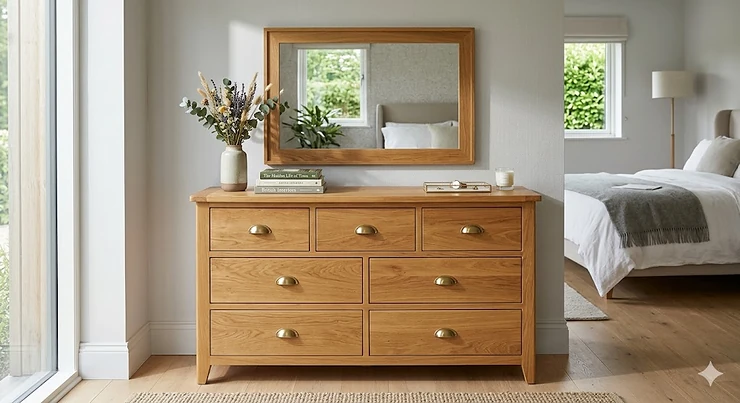
Walking into a bedroom where everything just works together—that’s the feeling a proper dresser and mirror set delivers. Rather than hunting for a mirror that vaguely matches your chest of drawers or settling for mismatched wood tones that make your room feel like a furniture showroom clearance section, a coordinated set brings instant harmony to your sleeping space.
In British homes where bedrooms tend to run smaller than their American counterparts, this coordination matters even more. A well-chosen dresser and mirror set maximises your limited space whilst creating the illusion of more square footage through strategic reflection. The mirror bounces natural light around those north-facing rooms we’re all too familiar with in the UK, making dreary November mornings feel slightly less grim.
What most buyers overlook when shopping for bedroom furniture is that a dresser and mirror set isn’t just about aesthetics—it’s about creating a functional grooming station without dedicating precious floor space to a separate dressing table. For those living in terraced houses, conversion flats, or modern new builds where every centimetre counts, this dual-purpose approach makes brilliant practical sense. The dresser provides ample storage for clothing, accessories, and personal items, whilst the mirror positioned above transforms the entire unit into a daily-use station for getting ready.
This comprehensive guide examines seven outstanding dresser and mirror set options available on Amazon.co.uk in 2026, covering everything from budget-friendly mirrored designs around £150 to premium solid oak combinations in the £600-£800 range. We’ll explore what actually matters when choosing these sets for British homes, cut through the marketing nonsense, and help you find the perfect match for your bedroom—whether you’re furnishing a student flat in Manchester, a Victorian semi in Bristol, or a modern apartment in Edinburgh.
Quick Comparison: Top Dresser and Mirror Sets at a Glance
| Product Type | Price Range | Best For | Key Feature |
|---|---|---|---|
| IKEA MALM 6-Drawer with Mirror | £180-£220 | Compact spaces, Scandinavian style | Integrated pull-up mirror design |
| Mirrored 4-Drawer Tiffany Style | £350-£450 | Glamorous bedrooms, light enhancement | Bevelled mirror panels, crystal handles |
| Solid Oak Traditional Set | £600-£800 | Long-term investment, classic interiors | Dovetail joints, 20+ year durability |
| High Gloss White Modern Set | £250-£350 | Contemporary homes, easy maintenance | Wipe-clean surface, sleek aesthetic |
| Rustic Pine Farmhouse Set | £400-£550 | Country style, eco-conscious buyers | FSC-certified wood, chunky construction |
| Grey Wash Tallboy with Mirror | £300-£450 | Vertical storage needs, neutral schemes | Space-saving tall design, soft-close drawers |
| Champagne Mirrored Luxury Set | £500-£700 | Statement pieces, hotel-inspired rooms | Art deco influence, curved drawer fronts |
💬 Just one click — help others make better buying decisions too! 😊
Top 7 Dresser and Mirror Set Options: Expert Analysis
1. IKEA MALM 6-Drawer Chest with Integrated Mirror
The IKEA MALM 6-Drawer Chest with Mirror represents Swedish design efficiency at its most practical. This isn’t the fanciest option you’ll find, but it’s absolutely brilliant for what it does: providing substantial storage (six deep drawers) topped with a clever pull-up mirror concealed in the top surface. Dimensions of 40×123 cm make it perfectly suited for narrow British bedrooms, fitting neatly against most walls without dominating the space.
What sets this apart is the integrated mirror mechanism—you lift the top drawer front to reveal a full mirror behind it, which then stays propped open whilst you’re getting ready. For UK buyers in flats where wall-mounting isn’t always permitted (or desirable), this built-in approach solves the mirror placement problem elegantly. The white and mirror glass finish reflects light effectively, crucial during our dim winter mornings when every lumen counts.
UK reviewers consistently praise the assembly process (straightforward, despite the typical IKEA instruction booklet density) and the drawer depth. One aspect worth noting: the top two drawers run slightly shallower than the lower four, which some find limiting for bulkier items but others appreciate for organising smaller accessories.
Pros:
✅ Space-efficient vertical design ideal for compact UK bedrooms
✅ Integrated mirror eliminates wall-mounting concerns
✅ Deep lower drawers accommodate substantial clothing storage
Cons:
❌ Top drawers shallower than expected
❌ White finish shows marks in high-traffic households
The MALM typically sits in the £180-£220 range on Amazon.co.uk (prices fluctuate), representing remarkable value for a complete dresser and mirror solution. For first-time buyers, student accommodation, or guest rooms, this delivers exactly what’s needed without unnecessary embellishment.
2. Mirrored 4-Drawer Tiffany Style Chest with Coordinating Mirror
The Mirrored 4-Drawer Tiffany Style Set brings proper glamour to bedroom furniture, featuring bevelled mirror panelling across all drawer fronts and a substantial coordinating wall mirror with matching silver-painted frame details. This isn’t subtle furniture—it’s statement pieces that transform ordinary bedrooms into spaces that feel rather more special than they probably deserve to be.
What UK buyers particularly appreciate is how the mirrored surfaces combat our chronically grey skies. Position this chest near a window (even a north-facing one), and the bevelled panels catch and multiply whatever natural light manages to penetrate British cloud cover. The effect genuinely makes rooms feel larger and brighter—not marketing hyperbole, but actual optical physics working in your favour.
Construction uses MDF with mirrored glass overlay, crystal-effect handles adding to the art deco aesthetic. The four-drawer configuration provides decent storage (approximately 80cm width × 40cm depth × 80cm height for typical models), though you’re trading some capacity for the visual impact. The separate wall mirror typically measures around 60×80 cm, substantial enough to serve as a proper dressing mirror.
Customer feedback from UK buyers highlights assembly as moderately challenging (two people recommended) but manageable. The mirrored finish requires regular cleaning to maintain its sparkle—fingerprints and dust show mercilessly—so factor in weekly wipe-downs with glass cleaner if you’re house-proud.
Pros:
✅ Dramatically brightens dark British bedrooms
✅ Creates luxurious hotel-style aesthetic
✅ Versatile styling works with modern, vintage, or shabby chic interiors
Cons:
❌ High-maintenance cleaning requirements
❌ Shows every fingerprint and dust particle
Expect to invest around £350-£450 for quality examples on Amazon.co.uk. This price point reflects the materials and construction complexity—mirrored furniture legitimately costs more to produce than standard finishes. For bedrooms that feel perpetually gloomy or where you’re compensating for limited window size, the investment makes practical sense beyond mere aesthetics.
3. Solid Oak Traditional Dresser with Matching Frame Mirror
For those prioritising furniture that’ll still look distinguished when you’re showing your grandchildren around your home in 2050, a Solid Oak Traditional Set represents proper long-term thinking. These typically feature dovetail drawer construction, chunky oak frames with visible grain patterns, and coordinating mirrors framed in matching solid oak with traditional bracket designs.
The quality difference between solid oak and veneered alternatives becomes apparent within months of ownership. Solid oak handles the daily abuse of British family life—damp towels temporarily dumped on top, children yanking drawers open, the occasional knock from the hoover—without showing distress. The wood actually improves with age, developing a patina that cheaper materials simply cannot replicate.
Typical dimensions run around 120-150cm width × 45-50cm depth × 85-95cm height for the dresser, with mirrors ranging from 90-120cm width. This substantial footprint suits larger bedrooms but might overwhelm compact spaces. UK buyers should measure carefully—Victorian and Edwardian properties often have deceptively sized bedrooms that look spacious empty but fill quickly once furniture arrives.
Construction details matter enormously at this price point. Look for dovetail joints on drawers (not just staples or dowels), solid oak drawer bases (not MDF), and full-extension drawer runners with soft-close mechanisms. UK retailers like Oak Furniture Land and Barker and Stonehouse specialise in these specifications, though availability on Amazon.co.uk varies by season and manufacturer.
Pros:
✅ Generational durability—genuinely will last 20+ years
✅ Solid construction handles British family life abuse
✅ Appreciates aesthetically as wood develops patina
Cons:
❌ Significant upfront investment (£600-£800 range)
❌ Heavy weight complicates room rearrangement or house moves
These sets command £600-£800 on Amazon.co.uk when available, though specialist oak furniture retailers often stock broader selections. For buyers planning to stay put for a decade or more, the cost-per-year calculation actually favours solid oak over replacing cheaper alternatives every 5-7 years.
4. High Gloss White Modern Dresser and Mirror Combination
The High Gloss White Modern Set epitomises contemporary bedroom furniture design—clean lines, handleless drawer fronts (push-to-open mechanisms), and that brilliant white finish that feels simultaneously Scandinavian minimalist and boutique hotel luxurious. These sets typically include a wide dresser (130-150cm) with 4-6 drawers and a frameless rectangular mirror with bevelled edges.
What makes high gloss white particularly suited to UK conditions is maintenance simplicity. Unlike traditional wood finishes that require careful treatment, high gloss surfaces tolerate our damp climate beautifully and clean with nothing more exotic than a damp microfibre cloth. Marks, fingerprints, and the inevitable tea splashes (we all know someone who puts their mug down without looking) wipe away instantly.
The glossy finish reflects light differently than mirrors—more subtle, less intense—creating ambient brightness throughout the room rather than directed reflection. For bedrooms with multiple light sources (overhead, bedside lamps, natural window light), this distributed reflection makes the entire space feel more open.
Construction typically uses MDF cores with high-gloss lacquer or acrylic finishes. Quality examples feature soft-close drawer mechanisms and ball-bearing runners—essential components that separate furniture lasting 10+ years from pieces that’ll frustrate you within 18 months. UK buyers should verify these specifications before purchasing.
Pros:
✅ Supremely easy cleaning—ideal for busy households
✅ Contemporary aesthetic suits modern UK new builds
✅ Light-reflecting properties enhance room brightness
Cons:
❌ High gloss shows scratches more readily than matte finishes
❌ Push-to-open mechanisms can be overly sensitive initially
Pricing on Amazon.co.uk typically ranges £250-£350 for quality sets. This mid-range positioning offers excellent value—you’re getting genuinely functional furniture with contemporary styling without stretching to premium solid wood prices. For young professionals furnishing their first owned property or anyone preferring low-maintenance modern aesthetics, these sets deliver precisely what’s needed.
5. Rustic Pine Farmhouse Style Dresser with Coordinating Mirror
The Rustic Pine Farmhouse Set brings that cottagecore aesthetic everyone’s been obsessing over, featuring chunky pine construction with visible knots and grain variation, antique-style handles (often in aged brass or pewter finishes), and coordinating mirrors framed in matching distressed pine. This furniture doesn’t pretend to be perfect—the appeal lies precisely in those natural wood characteristics that make each piece unique.
For eco-conscious UK buyers, pine sets often carry FSC (Forest Stewardship Council) certification, indicating responsibly managed forest sources. Post-Brexit, UKCA marking ensures compliance with British safety standards. These certifications matter increasingly to buyers prioritising sustainable purchasing decisions.
Construction uses solid pine throughout (not pine veneer over cheaper cores), with traditional joinery techniques like mortise-and-tenon or dowel joints. The rustic finish—often called “distressed” or “weathered”—cleverly disguises the inevitable knocks and marks that accumulate over years of use. What would ruin a high gloss finish simply blends into the intentionally imperfect aesthetic of rustic pine.
Typical dimensions run 120-140cm width × 40-50cm depth × 80-90cm height for dressers, with mirrors around 80-100cm width. The chunky construction adds visual weight that suits period properties beautifully—Victorian terraces, Edwardian semis, converted barns—but might feel too heavy for sleek modern flats.
UK buyers particularly value how pine furniture complements British country aesthetics. Whether you’re in an actual Cotswolds cottage or a suburban semi aspiring to that look, rustic pine delivers authentic warmth that engineered alternatives struggle to match.
Pros:
✅ FSC-certified options available for environmentally conscious buyers
✅ Distressed finish disguises inevitable wear and tear
✅ Authentic warmth suits British period properties perfectly
Cons:
❌ Pine’s softer wood density more susceptible to dents than oak
❌ Rustic aesthetic might clash with ultra-modern interiors
Expect to invest £400-£550 for quality rustic pine sets on Amazon.co.uk. This positions pine as a mid-to-upper tier option—more than IKEA basics, less than solid oak heirlooms. For buyers wanting character furniture that’ll serve reliably for 10-15 years whilst supporting sustainable forestry, rustic pine represents sound value.
6. Grey Wash Tallboy Dresser with Coordinating Wall Mirror
The Grey Wash Tallboy Set solves a specifically British problem: bedrooms with limited floor space but decent ceiling height. Rather than sprawling horizontally like traditional dressers, tallboys build vertically—typically 5-7 narrow drawers stacked high, paired with tall rectangular mirrors that emphasise the vertical lines. Dimensions often run just 60-80cm wide but reach 110-130cm height, making them perfect for alcoves, chimney breasts, or narrow walls between windows and doors.
The grey wash finish—somewhere between traditional dark wood and stark white—has become remarkably popular in UK interiors over the past few years. It’s neutral enough to work with virtually any colour scheme whilst feeling more sophisticated than basic white. The “wash” effect (where grain shows through semi-transparent grey stain) adds visual interest without demanding attention.
Construction typically combines solid wood frames with MDF drawer boxes, finished with grey-tinted lacquer or water-based stain. Quality examples include soft-close drawer runners (absolutely essential when you’ve got 6-7 drawers stacked vertically—slam one closed from the top and the whole unit shudders) and anti-tip brackets for wall anchoring. That last point matters enormously in UK households with children; according to the Child Accident Prevention Trust, furniture tip-over incidents cause serious injuries every year, making proper wall anchoring non-negotiable.
The vertical format works brilliantly in terraced houses where bedrooms often measure just 3×3 metres. A standard wide dresser would dominate such spaces, but a tallboy tucks neatly into corners whilst actually providing comparable storage volume.
Pros:
✅ Space-saving vertical design perfect for compact UK bedrooms
✅ Grey wash finish coordinates with nearly any colour scheme
✅ Tall mirrors create illusion of height in low-ceilinged rooms
Cons:
❌ Narrow drawers less suitable for bulky items like jumpers
❌ Must be wall-anchored for safety—rented accommodation might complicate this
Amazon.co.uk pricing for quality grey wash tallboy sets typically ranges £300-£450. This represents fair value for the specialised design—you’re paying for the engineering that makes vertical storage work properly rather than topple over. For British homes where floor space remains at a premium (basically everywhere except the Scottish Highlands), tallboys deliver practical solutions that standard dressers cannot.
7. Champagne Mirrored Luxury Dresser Set with Art Deco Styling
The Champagne Mirrored Luxury Set occupies the aspirational end of the market, featuring curved drawer fronts, champagne-toned mirrored surfaces with subtle gold undertones, ornate handles (often crystal or brushed gold), and substantial coordinating mirrors with bevelled edges. This furniture channels 1920s art deco glamour filtered through contemporary manufacturing—think Great Gatsby meets boutique hotels.
What justifies the premium pricing (typically £500-£700 on Amazon.co.uk) is construction quality and visual impact. These aren’t just flat mirrors stuck on MDF boxes. Quality examples feature curved drawer fronts (significantly more complex to manufacture), serpentine side profiles, and mirrored panels with proper bevelling that creates those signature light-catching edges.
The champagne finish—warmer than silver, more subtle than gold—works remarkably well in British bedrooms where you’re often dealing with mixed metal fixtures (chrome taps in the ensuite, brass picture frames inherited from relatives, steel radiators). The champagne tone somehow coordinates with everything whilst feeling more special than basic mirror.
UK buyers in period properties (Victorian, Edwardian, 1930s semis) find these sets complement original features beautifully. The art deco styling echoes the geometry of period cornicing and ceiling roses without directly copying them. In modern new builds, these sets create instant character that developer-spec neutral walls desperately lack.
Expect substantial pieces—dressers often measure 100-120cm width × 45-50cm depth × 85-95cm height, with mirrors ranging 70-90cm width. The curved profiles add visual bulk beyond basic dimensions, so measure your available space carefully and account for door swing clearances.
Pros:
✅ Hotel-inspired luxury aesthetic transforms ordinary bedrooms
✅ Champagne finish coordinates with mixed metal fixtures
✅ Curved profiles and bevelled edges create genuine art deco character
Cons:
❌ Premium pricing (£500-£700 range) requires serious budget commitment
❌ Ornate styling might overwhelm small bedrooms or minimalist schemes
These sets represent considered purchases rather than impulse buys. For buyers wanting bedroom furniture that genuinely impresses—whether you’re hosting guests, renting out on Airbnb, or simply treating yourself to something lovely—champagne mirrored sets deliver visual impact that simpler alternatives cannot match. The price reflects genuine manufacturing complexity rather than arbitrary markup.
Creating Your Perfect Bedroom Grooming Station
Setting up a dresser and mirror set as a functional grooming station requires more than just positioning furniture against a wall and hoping for the best. Here’s how to optimise your setup for daily use in typical British bedroom conditions.
Lighting Considerations: Natural light in UK bedrooms fluctuates wildly depending on season and orientation. South-facing rooms flood with light during summer afternoons but dim significantly by 4 PM in December. Position your dresser where morning light (when you’re most likely getting ready for work or school) hits the mirror directly. For north-facing rooms or basement flats, accept that you’ll need supplementary lighting year-round.
Consider installing wall-mounted swing-arm lights either side of the mirror, positioned at face height (approximately 150-165cm from floor level). This eliminates the harsh shadows created by overhead ceiling lights, particularly important when applying makeup or assessing outfit choices. Battery-powered LED mirror lights now available on Amazon.co.uk work brilliantly in rental properties where permanent installation isn’t permitted.
Storage Optimisation: Most UK buyers underestimate how quickly dresser drawers fill. A seemingly generous 6-drawer chest disappears fast once you’re storing jumpers, t-shirts, underwear, accessories, and the random accumulation every bedroom attracts. Organise by usage frequency—daily essentials in the top drawers, seasonal or occasional items lower down. Drawer dividers (simple cardboard boxes work perfectly) prevent the “everything’s jumbled together” chaos that makes finding specific items frustrating on rushed mornings.
For damp British conditions, avoid storing woolens or delicates in bottom drawers near floor level, particularly in ground floor bedrooms. Rising damp and poor air circulation affect lower storage first. Use moisture-absorbing sachets in drawers where you store leather accessories or items sensitive to humidity.
Height Adjustments: Standard dresser heights (80-95cm) work for most adults, but if you’re significantly taller or shorter, mirror positioning becomes crucial. The mirror should show your face when you’re standing naturally—no stooping or stretching required. Freestanding mirrors can be adjusted easily; wall-mounted mirrors require careful height calculation before installation. Measure from floor to eye level, then position the mirror centre point at that height.
Case Study: Matching Sets to British Home Types
Understanding how different dresser and mirror sets suit various UK property types helps narrow your choices significantly. Here’s how three typical British households might approach this furniture decision.
Lucy’s Manchester Flat: Lucy rents a conversion flat in a Victorian terrace—bedroom measures approximately 3.2 × 2.8 metres with 2.6-metre ceilings and a single sash window facing east. Available wall space between the window and door totals just 1.8 metres. Budget: £300 maximum.
Ideal choice: Grey wash tallboy (60-70cm wide) maximises vertical space without overwhelming the limited floor area. The tall narrow mirror creates vertical lines that make the low ceiling feel higher. The grey finish coordinates with her existing IKEA furniture whilst feeling more sophisticated. East-facing morning light means she doesn’t need elaborate lighting solutions. Total investment: approximately £320 including delivery.
James and Sarah’s Bristol Semi: A 1930s semi-detached in suburban Bristol features a 4 × 3.5-metre main bedroom with bay window and picture rail. They’ve recently redecorated in neutral tones with brass fixtures and botanical prints. They want furniture that’ll last through their young children’s childhood and beyond. Budget: £700.
Ideal choice: Solid oak traditional set provides the longevity they’re seeking whilst complementing the period property character. The brass drawer handles coordinate with their existing fixtures. Substantial dimensions suit the generous bedroom size without looking lost. The investment stretches their budget but delivers 20+ years of use, making it economically sensible long-term. Total investment: approximately £680 with current Amazon.co.uk pricing.
Priya’s Edinburgh Studio: A modern new-build studio flat in Edinburgh features a sleeping area measuring just 2.5 × 2.3 metres with floor-to-ceiling windows providing brilliant light but limited wall space. Priya wants contemporary styling that makes the compact space feel larger. Budget: £250.
Ideal choice: IKEA MALM with integrated mirror eliminates the need for wall mounting (problematic with the floor-to-ceiling windows) whilst providing substantial storage in minimal footprint (40cm depth). The white finish reflects Edinburgh’s often-spectacular northern light without competing with the contemporary architecture. The clever integrated mirror design solves storage and grooming station requirements in one compact unit. Total investment: approximately £200, well within budget.
How to Choose the Right Dresser and Mirror Set for Your UK Bedroom
Selecting bedroom furniture that’ll genuinely suit your needs requires honest assessment of several factors beyond “does it look nice in the photos?” Here’s the practical framework for making this decision properly.
Measure Absolutely Everything: British bedrooms vary enormously in dimensions—Victorian conversions might offer 4×4 metre luxurious spaces, whilst modern new-builds often squeeze bedrooms into barely-compliant 2.8×2.8 metre boxes. Measure your available wall space accounting for door swing, radiator positioning, and socket placement. Factor in at least 70cm clearance in front of the dresser for comfortable drawer access when you’re standing there getting ready.
Assess Your Storage Needs Honestly: Count how many drawers you currently use (or wish you had). The average British adult requires approximately 6-8 dresser drawers for clothing storage, assuming you’ve got a wardrobe for hanging items. Couples sharing a bedroom should plan for 10-12 drawers minimum unless you’ve got exceptional built-in storage. Children’s bedrooms might need fewer initially but consider growth—that toddler will eventually become a teenager requiring substantially more storage.
Consider Room Orientation and Light: North-facing bedrooms benefit enormously from mirrored or light-reflecting finishes (white, grey wash, actual mirrors) that multiply whatever light penetrates British clouds. South-facing rooms can accommodate darker woods like oak or walnut without feeling oppressive. East-facing bedrooms receive morning light (ideal for getting-ready stations), whilst west-facing rooms stay brighter in evenings (better suited for reading nooks than grooming areas).
Match Your Maintenance Commitment: High gloss finishes and mirrored surfaces look spectacular when spotlessly clean but show every fingerprint and dust particle. If you’re realistically going to manage weekly cleaning, brilliant. If not, rustic pine or grey wash finishes disguise imperfections far more forgivingly. British households with children should factor in approximately 3-4 weekly wipe-downs for mirrored furniture versus monthly dusting for traditional wood finishes. Which? provides comprehensive furniture care guidance to help British consumers maintain their investments properly.
Think Long-Term: Cheap furniture tempts with low upfront costs but typically requires replacement within 5-7 years. Quality pieces (solid wood, proper joinery, metal drawer runners) serve reliably for 15-20+ years. Calculate cost-per-year rather than just sticker price. A £700 solid oak set used for 20 years costs £35 annually. A £200 budget set replaced every 6 years actually costs £33 annually—barely cheaper whilst generating substantially more waste and hassle.
Verify UK Compatibility: Products marketed on Amazon.co.uk sometimes ship from EU or international suppliers. Verify that dimensions use metric measurements (centimetres, not inches), construction complies with UKCA standards set by the UK Government, and estimated delivery comes from UK warehouses (avoiding post-Brexit customs delays). Check whether assembly instructions include metric tools (British buyers typically own metric Allen keys and screwdrivers, not imperial equivalents).
Test Drawer Mechanisms Virtually: Since you’re buying online, scrutinise product descriptions and reviews for drawer mechanism details. Ball-bearing runners (smooth, full-extension access) beat basic roller mechanisms (rough, partial extension) dramatically. Soft-close mechanisms prevent slamming (crucial in flats with thin walls and considerate neighbours). These components determine whether your furniture delights or frustrates you daily for years.
Common Mistakes When Buying Bedroom Furniture in the UK
British buyers repeatedly make several avoidable errors when purchasing dresser and mirror sets. Here’s what trips people up most frequently.
Ignoring Assembly Requirements: Many Amazon.co.uk furniture listings state “assembly required” without specifying complexity. The IKEA MALM requires perhaps 60-90 minutes with two people and basic tools. Ornate mirrored sets might demand 3-4 hours, two adults, and considerable patience. UK buyers in flats without lifts should consider delivery logistics—getting a large flatpack up three flights of narrow Victorian stairs requires planning and possibly extra muscle. Some buyers simply don’t fancy assembling furniture and should factor in assembly services (often available through Amazon for £50-£100 additional).
Overlooking British Building Peculiarities: Period properties feature uneven floors, walls slightly off-square, and skirting boards that protrude 2-3cm from walls. That dresser sitting flush against the wall in product photos might gap noticeably when positioned against your wonky Victorian walls. Freestanding furniture typically accommodates these quirks better than built-in alternatives. Keep spirit levels handy during installation and don’t assume furniture sits perfectly flat just because it’s new.
Underestimating British Damp: Ground floor bedrooms in older properties face perpetual damp challenges, particularly in coastal areas or regions with high rainfall (basically, most of Britain). Solid wood furniture tolerates British damp conditions far better than particleboard or MDF cores. Mirrored furniture with sealed edges handles moisture better than exposed MDF edges that absorb humidity and swell. For problematic rooms, consider dehumidifiers and ensure bedroom ventilation meets modern standards.
Buying Without Measuring Doorways: This sounds obvious until you’re standing in your hallway with a delivery driver, a enormous flatpack, and a door frame measuring 75cm when you need 80cm clearance. Measure your door frames, stairwell widths, and any tight corners between front door and bedroom. If the packaged furniture won’t fit through, you’re either assembling in the hallway (rarely ideal) or refusing delivery and managing returns (time-consuming and frustrating).
Choosing Style Over Function: That ornate champagne mirrored dresser looks stunning in promotional photos shot in a warehouse-sized loft conversion. In your 3×3 metre bedroom, it might overwhelm the entire space. British bedrooms generally benefit from restraint—simpler furniture in rooms that already feature period details (cornicing, picture rails, fireplaces) prevents visual chaos. Modern homes with minimal architectural features can accommodate bolder furniture statements.
Neglecting Drawer Organisation from Day One: Empty drawers invite chaos. Establish organisation systems immediately—even simple cardboard dividers prevent the “everything’s jumbled together” mess that makes rushed mornings stressful. UK households can source drawer organisers from Poundland, IKEA, or Amazon.co.uk for minimal investment that delivers outsized daily convenience. Sort by category (underwear, socks, t-shirts, accessories) rather than randomly filling drawers and hoping memory serves when you’re hunting for specific items at 6:45 AM.
Dresser and Mirror Sets vs. Separate Purchases
Should you buy a coordinated dresser and mirror set or purchase components separately? Each approach offers distinct advantages depending on your circumstances.
Coordinated Sets—The Case For:
Visual cohesion arrives guaranteed when you buy matched pieces designed together. Finishes align precisely—oak tones match, mirror frames coordinate with dresser details, proportions balance deliberately. For buyers lacking confidence in interior design decisions, sets eliminate guesswork and prevent the mismatched look that plagues many British bedrooms assembled piecemeal over years.
Time efficiency matters considerably. One purchase decision, one delivery, one assembly session (or service booking). Particularly valuable for busy professionals, new homeowners managing multiple simultaneous furniture purchases, or anyone who’d rather avoid the “research fatigue” that comes from endlessly comparing individual mirror options against dresser styles.
Sets often provide better value than equivalent components purchased separately. Manufacturers bundle pricing advantageously, and Amazon.co.uk frequently offers better deals on complete sets than individual pieces. This applies particularly to mid-range options (£250-£450) where economies of scale benefit buyers directly.
Separate Purchases—The Case For:
Flexibility allows mixing price points strategically. Perhaps you’re willing to invest £500 in an exceptional solid oak dresser that’ll last decades, but happy with a £80 IKEA mirror that can be upgraded later without major expense. Or vice versa—splurge on a stunning antique mirror, pair it with a serviceable modern dresser.
Unique character emerges when you’re not constrained by manufacturer pairings. Vintage mirrors from charity shops, architectural salvage yards, or eBay often outshine mass-produced alternatives whilst costing substantially less. Pairing a reclaimed Victorian mirror with a simple modern dresser creates visual interest that perfectly matched sets rarely achieve.
Space optimisation improves when you’re choosing components independently. If your bedroom wall measures exactly 110cm between window and door, you can find a dresser that fits precisely rather than accepting whatever width comes in the manufacturer’s coordinated set. British bedrooms with awkward alcoves, chimney breasts, or unusual layouts often benefit from this tailored approach.
The Practical Recommendation:
For most UK buyers furnishing bedrooms in standard properties, coordinated sets deliver superior results with less hassle. The time invested researching individual components, ensuring finishes coordinate, and managing separate deliveries rarely justifies the modest cost savings or creative flexibility gained. Exception: if you’re particularly design-confident, working with unusual spaces, or intentionally creating eclectic interiors, separate purchases offer rewarding creative freedom.
Long-Term Care and Maintenance in British Conditions
British climate conditions—persistent damp, temperature fluctuations, limited sunlight—demand specific furniture care approaches. Here’s how to maintain dresser and mirror sets for maximum longevity.
Combating British Damp: Even modern homes with adequate ventilation experience humidity fluctuations. Solid wood furniture responds by expanding and contracting seasonally—normal behaviour that doesn’t indicate quality problems. Maintain consistent bedroom temperatures (18-20°C) and ventilate regularly (open windows 10-15 minutes daily, even in winter) to minimise extreme fluctuations.
For damp-prone ground floor bedrooms or period properties with ongoing moisture issues, position furniture at least 5cm from external walls to allow air circulation. Use moisture-absorbing products (silica gel sachets, calcium chloride containers) inside bottom drawers where dampness accumulates first. Never store leather or suede directly against drawer bases in problematic rooms—use acid-free tissue paper as protective barriers.
Wood Furniture Maintenance: Solid wood (oak, pine, walnut) benefits from annual treatment with appropriate products. Wax polishes (traditional beeswax formulations work beautifully) protect surfaces whilst enhancing grain appearance. Apply thin coats with soft cloths, buff to subtle sheen. Avoid silicone-based polishes that create buildup over time. For daily cleaning, barely-damp microfibre cloths remove dust without introducing excess moisture.
Oiled finishes (Danish oil, tung oil) require reapplication every 12-18 months in British conditions. Clean thoroughly, apply thin oil coats with lint-free cloths, allow proper drying time between applications. This maintenance prevents the dried-out appearance some wood furniture develops after years in centrally heated British homes.
Mirrored Finish Care: Glass cleaner and microfibre cloths maintain mirrored surfaces effectively. UK buyers should avoid ammonia-based cleaners on mirrors with painted or metallic backing (common in cheaper alternatives)—these corrode backing materials over time. White vinegar diluted 1:1 with water provides gentler cleaning that’s equally effective.
For bevelled mirror edges, use cotton swabs to clean crevices where dust accumulates. These details distinguish well-maintained mirrored furniture from neglected pieces. Weekly cleaning prevents buildup that becomes increasingly difficult to remove.
Hardware Tightening: Drawer handles and runners loosen gradually through regular use. Check connections every 6 months, tightening screws and bolts as needed. British homes with wooden floors (particularly old properties with flexible boards) experience more furniture movement than concrete-floor modern flats, making this maintenance more critical.
Soft-close mechanisms occasionally require adjustment—consult manufacturer instructions (usually available as PDFs online even for older furniture). These adjustments prevent the “drawer won’t close properly” frustration that develops when mechanisms drift out of alignment.
Mirror Stability: Wall-mounted mirrors require annual checks that hanging hardware remains secure, particularly in British period properties where plaster integrity varies. Original Victorian or Edwardian plaster might not hold modern wall fixings reliably; use appropriate cavity wall anchors or locate studs/joists for secure mounting. The weight of substantial mirrors (5-10kg commonly) demands proper installation—bodged mounting fails eventually, usually at 3 AM with spectacular crashing effects.
Understanding British Furniture Regulations and Standards
UK furniture regulations ensure safety and quality, though post-Brexit changes mean some requirements now differ from EU standards.
UKCA Marking: Products placed on the British market require UKCA (UK Conformity Assessed) marking, replacing the CE marking used previously. This confirms compliance with British safety regulations covering flammability, structural stability, and material safety. Furniture sold on Amazon.co.uk should display UKCA marking or documentation—verify this in product listings or ask sellers directly.
Furniture and Furnishings Regulations: The Furniture and Furnishings (Fire) (Safety) Regulations 1988 apply to upholstered furniture but also affect some bedroom furniture if foam padding is present (upholstered benches, padded headboards). Dressers and mirrors typically aren’t affected unless integrated with upholstered components.
Consumer Rights Act 2015: This provides UK buyers with strong protections when purchasing furniture. Products must be “of satisfactory quality, fit for purpose, and as described.” If dresser drawers jam, mirror glass contains defects, or finishes peel prematurely, UK buyers can demand repair, replacement, or refund. The Citizens Advice Bureau provides detailed guidance on your furniture rights. Rights extend for up to six years (five in Scotland) for quality issues that should reasonably last longer.
For Amazon.co.uk purchases specifically, the Distance Selling Regulations grant 14-day cooling-off periods allowing returns for any reason. This protects buyers who discover furniture doesn’t suit their space despite careful measurement—though return shipping costs for large items can be substantial.
British Standards (BS) for Furniture: While not legally mandatory, British Standards provide quality benchmarks. BS EN 16139:2013 covers domestic seating and storage furniture. Reputable manufacturers often cite BS compliance in specifications, indicating testing for strength, durability, and safety that exceeds minimum legal requirements.
Frequently Asked Questions
❓ Are mirrored dressers more expensive to maintain than wood finishes?
❓ How do I prevent dresser drawers from sticking in damp British weather?
❓ Can I mount heavy mirrors on plasterboard walls in modern UK homes?
❓ What dresser dimensions work best for small UK bedrooms under 3×3 metres?
❓ Should I buy solid oak furniture or save money with veneer alternatives?
Conclusion: Finding Your Perfect Match
Choosing a dresser and mirror set for your British bedroom ultimately balances aesthetic preferences, practical requirements, and budget realities. The coordinated approach these sets provide solves multiple problems simultaneously—storage needs, grooming station functionality, and visual cohesion—whilst optimising the limited space most UK bedrooms offer.
The seven options examined here represent the spectrum available on Amazon.co.uk in 2026: from the brilliantly practical IKEA MALM around £200 delivering exceptional value for compact spaces, through mid-range offerings like grey wash tallboys (£300-£450) and high gloss white modern sets (£250-£350) that suit contemporary British homes perfectly, to premium investments including solid oak traditional combinations (£600-£800) and champagne mirrored luxury sets (£500-£700) that transform ordinary bedrooms into genuinely special spaces.
What matters most is honest assessment of your actual requirements rather than aspirational thinking. That stunning champagne mirrored set might look spectacular in photos, but if you’re realistically not going to maintain the cleaning schedule it demands, simpler alternatives serve you better. Similarly, stretching budget for solid oak makes brilliant sense if you’re settling into a forever home, but represents questionable value if you’re renting short-term or planning house moves.
British homes present specific challenges—smaller bedrooms than international standards, persistent damp in older properties, limited natural light during lengthy winters—that make furniture choices more consequential than they might be elsewhere. The dresser and mirror sets that succeed in UK conditions share certain characteristics: dimensions suited to compact spaces, finishes that tolerate British weather, and construction quality that justifies the investment through years of reliable service.
Ultimately, the best dresser and mirror set is the one you’ll still appreciate in five years when the initial excitement fades and you’re simply grateful for furniture that works properly, looks decent, and hasn’t required replacement yet. Choose accordingly.
Recommended for You
- 7 Best Space Saving Dresser with Mirror UK Small Bedrooms 2026
- 7 Best Dresser with Attached Mirror UK 2026
- Best Tall Chest of Drawers 8+ Drawers UK 2026
Disclaimer: This article contains affiliate links. As an Amazon Associate, I earn from qualifying purchases. If you purchase products through these links, we may earn a small commission at no additional cost to you.
✨ Found this helpful? Share it with your mates! 💬🤗
