
In This Article
There’s a moment every British homeowner knows well. You reach into the wardrobe for that beloved cashmere jumper, pull it out, and find a hole the size of a 10p piece staring back at you. Clothes moths. The silent, infuriating scourge of British bedrooms, thriving in exactly the kind of dark, damp, undisturbed corners that characterise storage in our smaller homes and terraced houses.

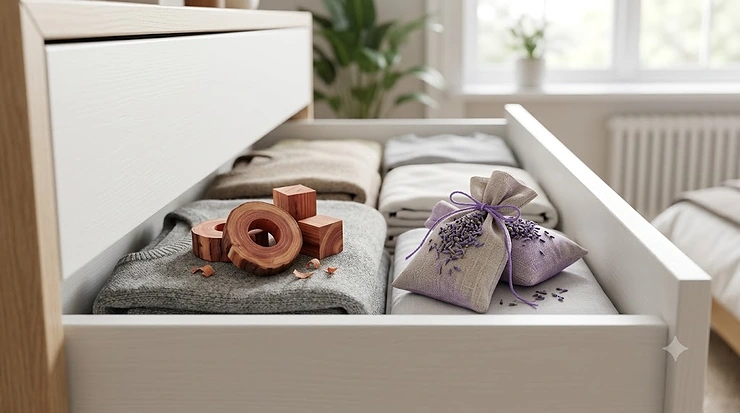
Enter the age-old debate: cedar vs lavender drawer fresheners. Both are natural. Both are chemical-free. Both have devoted fans who will argue their case with the sort of quiet conviction usually reserved for debates about whether the kettle or the teabag goes in first. But which actually works — and which merely smells like it’s doing something?
In short, cedar and lavender drawer fresheners are natural, fragrance-based products placed inside drawers and wardrobes to repel clothes moths, deter larvae, and keep stored garments smelling fresh without synthetic chemicals. Cedar works primarily through volatile aromatic oils toxic to moth larvae; lavender acts as a pheromone-masking repellent that discourages adult moths from laying eggs in the first place.
The honest answer? Both have merit, but for entirely different reasons — and in Britain’s characteristically damp climate, where clothes moths (Tineola bisselliella) are increasingly active year-round, understanding which to use and when matters more than most people realise.
This guide cuts through the marketing noise. We’ve researched seven real products available on Amazon.co.uk, compared their practical performance, and put together the clearest framework we can to help you make a genuinely informed choice.
Quick Comparison: Cedar vs Lavender Drawer Fresheners at a Glance
| Feature | Cedar | Lavender |
|---|---|---|
| Primary action | Kills/repels larvae via volatile oils | Repels adult moths via pheromone masking |
| Scent longevity | 12–24 months (if sanded) | 3–6 months (needs refreshing) |
| Best fabric match | Wool, fur, heavy winter coats | Silk, cashmere, delicate linens |
| Moth lifecycle stage targeted | Larvae | Adults (egg-laying prevention) |
| Maintenance required | Sand every 3–4 months | Squeeze sachets monthly |
| Price range (Amazon.co.uk) | £6–£18 per pack | £5–£12 per pack |
| Chemical-free | ✅ Yes | ✅ Yes |
| Best for | Heavy-duty wardrobe storage | Bedroom drawers, lingerie, guest linen |
What this table reveals is something the product listings rarely tell you directly: cedar and lavender aren’t competing for the same job. Cedar targets larvae already present; lavender intercepts adult moths before they lay eggs. Using one without the other is a bit like fitting a lock on the back door while leaving the front wide open. The most robust approach, particularly in a British household with a mix of woollens, linens, and the occasional forgotten cashmere, is to use both in combination.
💬 Just one click — help others make better buying decisions too! 😊
✨ Don’t Miss These Exclusive Deals!
🔍 Take your clothes protection to the next level with these carefully selected natural drawer fresheners. Click on any highlighted product to check current pricing and availability on Amazon.co.uk.
Top 7 Cedar vs Lavender Drawer Fresheners: Expert Analysis
1. Inovida Lavender Bags for Wardrobes & Drawers (20 Pack)
Inovida’s lavender sachet set is one of the most popular natural drawer fresheners on Amazon.co.uk, and it’s earned that reputation honestly. Each of the 20 purple organza bags is filled with real, gently dried Lavandula angustifolia flowers — not fragrance oil sprayed onto filler material, which is a distinction worth knowing about.
The sachets measure approximately 7×9cm, small enough to tuck into a corner without taking up the space that British chest-of-drawer owners simply cannot spare. The scent is genuine and pleasantly floral rather than the synthetic sharpness you get from cheaper alternatives. That said, like all dried lavender products, the fragrance fades faster than you might hope — roughly three to four months before it needs refreshing. A gentle squeeze of the bag or a few drops of pure lavender oil will revive it, though do keep essential oil away from direct contact with silk or cashmere.
UK buyers appreciate that these are straightforwardly natural and require no reading of chemical labels before placing near children’s clothes. They work best as a preventative measure — popped into clean, freshly laundered drawers before moths have a chance to establish. If you’re already dealing with an active infestation, these won’t solve your problem alone; they’re a maintenance tool, not an exterminator.
✅ 100% dried lavender flowers, no synthetic fillers
✅ 20 sachets per pack — enough for most of a British semi-detached
✅ Calming scent suitable for bedroom drawers and children’s wardrobes
❌ Fragrance fades in 3–4 months; requires regular refreshing
❌ No larvae-killing capability — purely repellent in action
Price range: Under £10 | Value verdict: Excellent for regular maintenance and preventative use. Prime-eligible for next-day delivery.
2. ZIDINA Lavender Bags for Wardrobes (28 Pack)
If Inovida is the reliable workhorse, ZIDINA is the slightly more generous neighbour who always brings extra biscuits. The 28-pack gives UK households enough coverage for wardrobes, chest of drawers, linen cupboards, and the under-bed storage bags that British flats increasingly require. The sachets are slightly larger than Inovida’s, with a drawstring cotton pouch design that many UK buyers prefer for its more tactile, handmade feel.
ZIDINA uses dried lavender sourced from what the brand describes as organically grown fields, though they’re somewhat cagey about provenance. The scent is strong on opening and settles to a pleasant ambient level within a few days — unlike some cheaper brands that blitz you with fragrance oil then fade completely within six weeks.
What makes ZIDINA worth considering specifically for UK homes is the pack size. British terraced houses and Victorian-conversion flats tend to have more storage spaces per square metre than their continental counterparts — useful little nooks, oddly shaped cupboards, shoe cabinets near the front door. Having 28 sachets means you can cover the lot without placing a second order halfway through the job.
UK customer reviews on Amazon.co.uk flag occasional variation in scent strength between packs, which is worth noting. It’s an inherent limitation of natural dried products — the harvest year and drying conditions affect potency. Order two packs if you’re covering a large home.
✅ 28 sachets — generous coverage for larger UK homes
✅ Clean cotton pouch design; no synthetic bag materials
✅ Consistent mid-level fragrance, not overwhelmingly sharp
❌ Scent strength can vary between batches
❌ Repellent only; no action against existing larvae
Price range: Around £8–£11 | Value verdict: Best for first-time buyers wanting broad coverage across multiple rooms.
3. Yizhet Cedarwood Moth Repellent Set (51 Pcs — Blocks, Balls, Discs, Rings)
Now for the cedar camp. Yizhet’s 51-piece set is a proper toolkit rather than a single-format product, and that versatility is its defining strength. The set includes cedar blocks, balls, discs, and hanging rings — each suited to a slightly different use case. The rings loop over wardrobe rails for hanging garments. The discs sit flat in drawers. The blocks are best for shoe boxes and underbed storage. It’s thoughtful product design that actually maps to how British people organise their clothing storage.
Cedarwood’s moth-repelling mechanism is meaningfully different from lavender’s. The aromatic oils in red cedar — primarily cedrol and thujopsene — are toxic to moth larvae at the stage when they’re actively feeding through your fibres. A 2017 study found that just a 1% concentration of cedar oil killed moth larvae and inhibited egg hatching, with cedar chips reducing adult moth lifespan by 50%. That’s not a folk remedy. That’s chemistry doing actual work.
The catch? Cedar’s oils deplete over time. You’ll need to lightly sand the surface of the blocks every three to four months to expose fresh wood underneath and restore potency. Think of it as MOT-ing your moth defence — a minor inconvenience that UK buyers with good storage habits manage easily, though those who prefer completely passive solutions may find it slightly irksome.
✅ 51 pieces across 4 formats — covers every storage scenario
✅ Proven larva-killing chemistry; longer-lasting than lavender alone
✅ No chemicals, synthetics, or residues on fabrics
❌ Requires sanding every 3–4 months to maintain effectiveness
❌ Woody scent doesn’t suit everyone as a bedroom fragrance
Price range: £8–£14 | Value verdict: Exceptional value for the size of the set. Best for wool and heavier garment storage.
4. Total Wardrobe Care Natural Drawer Freshener Sachets (4 Pack — UK-Made)
This one sits in a category of its own. Total Wardrobe Care is a British brand — genuinely handmade in the UK — and their sachets represent one of the few products in this space where you can feel confident about what’s actually in the bag. The blend combines May Chang, lavender essential oil, cedar wood, and rosemary in a natural stone powder base, working as both moth deterrent and drawer freshener in a single sachet.
The multi-ingredient approach is shrewd. As research on insect behaviour confirms, combining botanicals creates layered olfactory interference that’s harder for moths to navigate around than a single-note repellent. May Chang in particular — a citrus-scented essential oil from the Chinese litsea cubeba fruit — has genuine documented repellent activity and provides a brightness to the scent profile that pure cedar or pure lavender alone can lack.
At four sachets per pack, this is the most premium option on this list by unit price. However, for UK buyers with a specific linen cupboard, a chest of drawers with treasured items, or one wardrobe dedicated to expensive woollens, paying a bit more for a small-batch, British-made product with provenance transparency is genuinely worthwhile. UK customer reviews are enthusiastic about the fragrance quality and consistently note it as a gift-worthy product.
✅ British-made with traceable essential oil ingredients
✅ Multi-botanical blend: stronger deterrent than single-note products
✅ Elegant presentation — genuinely suitable as a gift
❌ Higher price per unit than mass-produced alternatives
❌ Only 4 sachets per pack — requires multiple purchases for whole-home coverage
Price range: Around £10–£14 for 4 sachets | Value verdict: Premium but justified for quality-conscious buyers. Prime-eligible on Amazon.co.uk.
5. 100% Natural Cedarwood Hanging Blocks for Wardrobe & Drawer (24 Pack)
Straightforward, effective, and priced for real households rather than lifestyle blogs. This 24-pack of cedarwood hanging blocks offers the kind of coverage that actually makes a dent in a British home’s moth-risk areas: the master bedroom wardrobe, the spare room built-in, the coat cupboard in the hallway, and the inevitable pile of jumpers in the airing cupboard. Each block has a pre-drilled hole for a hanging hook, making them suited to rail-hanging as well as drawer placement.
The cedar quality here is solid rather than spectacular. The blocks are genuine aromatic red cedar — you’ll know immediately on opening the pack — though they’re cut and finished with less precision than specialist brands. In practice, this matters very little: the oil content and aromatic intensity are comparable to pricier options, and the 24-unit count means you’re not rationing blocks anxiously across your home.
For families in British semi-detacheds or terraced houses where storage is spread across multiple small spaces, this kind of bulk pack makes genuine economic sense. At under £15 for 24 blocks, the cost per unit is among the lowest on this list for genuine cedar products. Just remember the sanding maintenance — skip it and you’ll find these blocks silently lose their effectiveness over a British summer.
✅ 24 blocks — thorough whole-home coverage
✅ Pre-drilled holes for hanging versatility
✅ Strong initial cedar scent; good aromatic potency
❌ Finish quality is functional rather than refined
❌ Requires regular sanding to maintain scent and effectiveness
Price range: Under £15 | Value verdict: Best budget cedar option for whole-home coverage. Check for Prime delivery eligibility.
6. SCENTORINI Dried Lavender Bags (8 × 30g Bags)
SCENTORINI takes a slightly different approach to most lavender sachet brands: rather than 20 small bags, they offer eight substantially larger 30g pouches. This matters more than it sounds. The greater volume of dried lavender per bag means a stronger, more sustained scent release — particularly relevant in the first two months when protection is most important.
These bags are particularly well-suited to larger storage areas: the kind of big Victorian wardrobe you find in older British homes, or the awkward built-in cupboard in a converted Victorian terrace that’s really just a bricked-up fireplace with a rail across it. For smaller modern drawers in a new-build flat, one sachet will cover the space easily; for those cavernous older wardrobes, the larger format earns its place.
UK buyers generally rate SCENTORINI highly for scent quality and comment favourably on the presentation — the bags arrive in clean packaging that makes them an easy gifting option. The 30g fill also means the sachets respond well to refreshing: a firm squeeze every few weeks releases a noticeable fragrance boost, and a few drops of pure lavender oil extends their useful life considerably. For those who find the 20-tiny-bags approach fiddly, this larger format is a genuinely more practical choice.
✅ Larger 30g sachets — stronger, more sustained scent release
✅ Better suited to larger British wardrobes and linen cupboards
✅ Good presentation; suitable as a household gift
❌ Fewer sachets per pack (8 vs 20); less coverage flexibility
❌ Repellent only — no action against larvae
Price range: Around £8–£12 | Value verdict: Best for larger wardrobes and buyers who prefer less-frequent maintenance.
7. ecoKiwi Cedar & Lavender Combined Sachets (20 Pack)
Here’s the one that sidesteps the cedar vs lavender debate entirely by combining both. ecoKiwi’s 20-pack sachets blend cedar chips and dried lavender in a single breathable bag, offering both pheromone-masking repellent action (lavender’s forte) and larval deterrence (cedar’s speciality) without the need to manage two separate products.
In practice, the compromise has trade-offs. The cedar content per sachet is lower than a dedicated cedar block, and the lavender concentration is lighter than a dedicated lavender sachet. But for buyers who want a simple, single-product solution for a guest bedroom or holiday wardrobe they won’t think about much between visits, this is the most practical option on the list. Open the drawer, pop in a sachet, close the drawer, forget about it for three months. Very British efficiency.
UK customers note that the cedar scent tends to dominate the first month, gradually shifting to a more lavender-forward fragrance as the cedar oils deplete faster than the dried flowers. This is a natural progression rather than a quality failing, though it’s worth knowing. The sachets also come with hanging hooks, making them versatile for rail and drawer use — useful for UK wardrobes where space is always at a premium.
✅ Dual-action: both lavender repellent and cedar larvae deterrent
✅ Single-product convenience; minimal maintenance required
✅ Hanging hooks included — rail and drawer compatible
❌ Less potent in each action than dedicated single-ingredient products
❌ Cedar scent fades earlier than standalone cedar blocks
Price range: Around £9–£13 | Value verdict: Best all-in-one option for low-maintenance users and holiday or guest wardrobes.
How Moth Repellents Actually Work: The Science Behind the Scents
Before you commit to either camp in the cedar vs lavender drawer fresheners debate, it’s worth understanding what’s actually happening inside your drawer when you pop one of these products in.
Clothes moths — specifically Tineola bisselliella, the common webbing clothes moth — have been a persistent problem in British homes for centuries. They prefer natural protein fibres: wool, cashmere, silk, and feathers. The larvae are the destructive stage; adult moths don’t actually eat fabric at all. What they do is find a nice dark, undisturbed spot in your drawers and lay eggs, which then hatch into ravenous larvae. British homes — with their older housing stock, varied storage conditions, and tendency toward the kind of cosy clutter that moths adore — are particular hospitable environments.
The way both cedar and lavender repel moths is more sophisticated than simply “smelling bad to insects.” The volatile oils in both plants create what researchers describe as olfactory masking — a layer of chemical noise that interferes with the pheromone signals female moths use to attract mates and identify egg-laying sites. Break the communication; break the breeding cycle.
Cedar goes further. Research confirms that cedarwood’s volatile oils are genuinely toxic to young moth larvae, disrupting their development at the stage when they’d otherwise be cheerfully tunnelling through your jumpers. Lavender, by contrast, works almost entirely at the adult stage — it discourages female moths from entering the space and laying eggs, but once eggs have hatched, dried lavender flowers won’t eliminate larvae already present.
This is why pest control specialists often recommend a layered approach. The Royal Horticultural Society notes that integrated pest management — combining mechanical controls (thorough vacuuming), physical barriers (sealed storage bags), and natural deterrents like cedar and lavender — gives far better results than any single method alone. In practice: cedar for your woolly jumpers stored long-term; lavender for the everyday bedroom drawer; and both together if you’ve had moth trouble before and aren’t willing to risk it again.
Real-World Scenarios: Which UK Buyer Needs What?
The London Flat Dweller
You live in a converted Victorian terrace in Zone 3. Your bedroom is small, your wardrobes are not, and you store roughly 11 months’ worth of clothing in approximately 2.4 cubic metres of space. Your cashmere is your pride and joy; your grandma’s pashmina is in there too. You don’t want to fuss.
Best choice: ZIDINA or Inovida lavender sachets for everyday freshness; add a set of Yizhet cedar blocks specifically for the section housing wool and cashmere. Replace the lavender every season; sand the cedar in spring.
The Suburban Family in a Semi-Detached
Three bedrooms, a linen cupboard on the landing, coats by the front door, and the inevitable junk stored in the under-stair cupboard. Moth risk is spread across the whole house. Budget matters.
Best choice: The 24-pack cedarwood hanging blocks for whole-home coverage at sensible cost. Top up with a 20-pack of Inovida lavender bags for the master bedroom where the good clothes live.
The Rural Cottage Owner
Stone walls, limited central heating, and the kind of genuine dampness that British coastal and upland areas produce reliably from October through April. Moths love damp. So do your clothes when stored without proper protection.
Best choice: Total Wardrobe Care sachets for quality assurance and multi-botanical coverage. The higher price per unit is justified when your stored garments include hand-knitted Aran jumpers and vintage Harris Tweed.
The Minimalist New-Build Resident
Everything has its place. You want one solution, low maintenance, and no complicated schedules. You check on your wardrobe quarterly at most.
Best choice: ecoKiwi Cedar & Lavender combined sachets. Pop them in and don’t think about them until the next equinox.
Practical Usage Guide: Getting the Most Out of Your Drawer Fresheners in British Conditions
Britain’s climate creates specific challenges that most product instructions — written for a generalised global audience — quietly ignore. Here’s what actually works in UK homes.
Step 1: Clean before you protect. Cedar and lavender deter moths; they don’t eliminate existing infestations. Wash or dry-clean all stored garments before placing fresheners. Any moth eggs already in your wardrobe will hatch regardless of what you put near them. A thorough vacuum of wardrobe corners and drawer bases is not optional if you’ve had moths before.
Step 2: Seal what you can. In British damp conditions — particularly in older properties and ground-floor flats — sealed storage bags or vacuum bags provide an additional physical barrier that no amount of cedar or lavender can replicate. Fresheners work best in already-ventilated, dry spaces rather than moisture-prone environments.
Step 3: Place strategically. Cedar blocks belong near the items at highest risk: wool, cashmere, fur, feathers. Lavender sachets are better suited to the corners of drawers and the middle shelves of wardrobes where adult moths are most likely to assess a space before laying. Don’t bundle both types together in one corner — distribute them to maximise coverage.
Step 4: Set a maintenance schedule. Sand cedar blocks in October and March — before and after the main moth season, which peaks in British homes from late spring through early autumn. Squeeze lavender sachets monthly and consider replacing them every six months. In a British autumn and winter, the combination of central heating cycling on and off and compressed damp air shortens the effective life of both products by roughly 20% compared to a drier continental climate.
Step 5: Don’t neglect high-risk zones. The coat cupboard by the front door, the airing cupboard near the boiler, and underbed storage bags are the areas UK households most commonly overlook. These spaces see exactly the kind of low-disturbance, slightly humid conditions that moths find irresistible.
Common Mistakes When Choosing Natural Drawer Fresheners
Mistake 1: Buying fresheners as an emergency measure. Neither cedar nor lavender kills an active infestation. If you’re finding holes in your clothes right now, you need a dedicated moth killer product alongside a freshener. These are preventative tools, not emergency treatments.
Mistake 2: Using old, depleted products and expecting results. A cedar block that hasn’t been sanded in two years has essentially no repellent potency left. An expired lavender sachet is just a small bag of grey dust. Check your products regularly. This is perhaps the most common mistake UK buyers make — buying the products once and assuming they last indefinitely.
Mistake 3: Ignoring the fabric type. Cedar oil in concentrated form can cause spotting on delicate fabrics. Always place cedar blocks and sachets near garments, not directly touching silk, satin, or fine cashmere. Dried lavender is generally safer for direct proximity to delicate fabrics, but keep essential oil top-ups away from them.
Mistake 4: Assuming natural means always safe. For households with young children or pets, always place cedar blocks out of reach. Cedar oil is mildly toxic if ingested. Lavender essential oil can also be an irritant for pets, particularly cats. The UK’s Veterinary Poisons Information Service notes that certain essential oils can cause adverse reactions in cats and dogs — a consideration worth taking seriously if your pet shares your bedroom.
Mistake 5: Buying without checking Amazon.co.uk availability. Several popular cedar and lavender brands visible on social media ship from US or European warehouses at significantly higher unit costs once shipping is added. Always verify Amazon.co.uk stock and check for Prime eligibility before purchasing — particularly for bulkier multi-pack products.
Cedar vs Lavender: A Head-to-Head Written Comparison
The comparison table earlier gives the headlines. Here’s what it actually means in practice.
Cedar is the more powerful of the two on an objective chemical basis. Its volatile oils — primarily cedrol and thujopsene — are genuinely toxic to moth larvae in a way that lavender’s linalool compounds are not. Studies comparing natural moth repellents consistently rank cedar ahead of lavender for raw efficacy, particularly for high-risk natural fibre garments like wool and fur. If you’re protecting expensive winter woollens in a British loft or understairs cupboard that rarely gets opened between seasons, cedar is the more reliable choice by a meaningful margin.
Lavender, however, wins on sensory experience, versatility, and suitability for delicate fabrics. The scent of a lavender sachet in a bedroom drawer is genuinely pleasant — calming, domestic, and distinctly British in the way that associations with English lavender fields simply are. It’s safe near silk, cashmere, and even children’s clothing in ways that concentrated cedar oil is not. And for everyday drawers that you open frequently — disturbing the space regularly, washing clothes on rotation — lavender’s role as an adult-moth deterrent is perfectly matched to the use case.
The real-world verdict? A hybrid approach wins every time. Use cedar for long-term heavy storage — winter coats, spare blankets, archived woollens. Use lavender for everyday bedroom drawers, linen closets, and anywhere you want a pleasant fragrance as part of the deal. Think of cedar as the security system and lavender as the ambient lighting: both contribute to a well-protected home, but they’re doing different jobs.
Features That Actually Matter (And Those That Don’t)
Features that genuinely matter:
🌿 Actual botanical content — Dried lavender flowers or genuine red cedar wood, not “lavender-scented” synthetic fillers. Check the product description and, where available, the ingredient list. The phrase “fragrance” in place of “essential oil” or “dried flowers” is a red flag.
📦 Pack size relative to your home — A 4-pack of premium sachets is excellent value for one drawer; it’s inadequate for a three-bedroom house. Match the product to your actual coverage need before purchasing.
🔄 Refreshability — Products you can revive extend their value significantly. Cedar blocks that can be sanded; lavender sachets that respond to essential oil top-ups. One-and-done products that you simply discard after a few months cost more in the long run.
Features that sound impressive but matter less:
❌ Elaborate packaging — Attractive boxes are a pleasure to receive but do nothing for moth prevention. The botanical content inside is what counts.
❌ Claims of “permanent” or “long-term” protection — No natural product genuinely protects indefinitely without maintenance. Any brand claiming otherwise is overstating the science.
❌ Multiple scent variants — For moth prevention specifically, only lavender and cedar have meaningful repellent chemistry. “Ocean breeze” or “spring meadow” scented sachets are air fresheners with no moth deterrent properties whatsoever.

FAQ
❓ How long do cedar drawer fresheners last in British homes?
❓ Are lavender sachets safe to use around children and pets?
❓ Which is better for cashmere protection: cedar or lavender?
❓ Can I use cedar and lavender drawer fresheners together?
❓ Do cedar and lavender fresheners work against clothes moths in the UK specifically?
Conclusion
The cedar vs lavender drawer fresheners debate is, in the end, something of a false choice. You don’t have to pick a side. Cedar brings the chemistry — aromatic oils that disrupt the moth life cycle at the larval stage, with proven longevity when properly maintained. Lavender brings the sensory intelligence — discouraging adult moths from entering in the first place, while making your bedroom drawers smell considerably more agreeable than a chemistry experiment.
For most British households, the pragmatic answer is to deploy both: cedar blocks in long-term storage areas where woollens and heavier garments live undisturbed, and lavender sachets in everyday bedroom drawers where daily rotation naturally disturbs moths anyway. Buy from brands with genuine botanical content, maintain them properly, and pair them with thorough regular cleaning of storage spaces.
The modest investment — typically under £20 to cover an entire British bedroom — is considerably more sensible than replacing a cashmere jumper.
✨ Don’t Miss These Exclusive Deals!
🔍 Check current availability and pricing on Amazon.co.uk for all seven products featured above. Use the highlighted product names throughout this article to browse directly. Orders over £25 qualify for free standard delivery; Amazon Prime members enjoy free next-day delivery to most UK addresses.
Recommended for You
- 7 Best English Lavender Sachets UK 2026: Fragrant Wardrobe Wins
- Best Lavender Sachets for Drawers UK 2026: 7 Expert-Tested Picks
- Renewable Cedar Inserts: 7 Best UK Picks for Natural Clothes Protection (2026)
Disclaimer: This article contains affiliate links. As an Amazon Associate, I earn from qualifying purchases. If you purchase products through these links, we may earn a small commission at no additional cost to you.
✨ Found this helpful? Share it with your mates! 💬🤗
