
In This Article
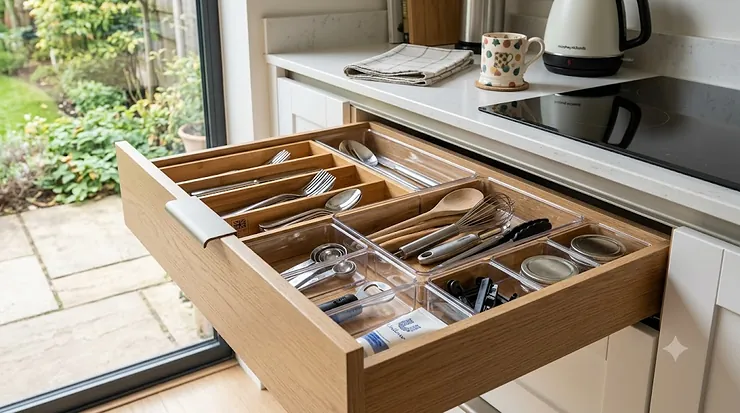
Every house has one. That drawer in the kitchen where the good scissors go to hide. The bedside one stuffed with dead phone chargers, a single AA battery, and a takeaway menu from a restaurant that closed in 2019. Essential drawer storage accessories are the small, unglamorous bits of kit — dividers, liners, trays, organiser boxes — that turn that drawer from a crime scene back into something you’d actually let a guest open.
In Britain, this matters more than it does elsewhere. Our homes are, on average, smaller than most of Europe’s, our terraces and flats weren’t built with walk-in wardrobes in mind, and a damp autumn can turn an unlined drawer faintly musty within weeks. A bit of bamboo and some non-adhesive paper sound like a trivial fix. They’re not. Get the right combination and a single drawer can swallow an entire category of clutter — cutlery, cosmetics, cables — and actually keep it there.
This guide rounds up seven genuinely available products on Amazon.co.uk, in budget, mid-range, and premium tiers, with honest commentary on who each one suits and where it falls short. No invented five-star raves, no American-style “THIS WILL CHANGE YOUR LIFE” nonsense — just a measured, occasionally sarcastic look at what’s worth your money.
Quick Comparison Table
| Product | Type | Best For | Price Range |
|---|---|---|---|
| SONGMICS Foldable Fabric Dividers (Set of 6) | Fabric organiser | Bedroom drawers, budget buyers | £15–£22 |
| Vtopmart 25-Pack Drawer Organisers | Plastic trays, 4 sizes | Bathroom, makeup, small flats | £18–£26 |
| Utoplike Bamboo Drawer Dividers (4-piece) | Adjustable wood | Mixed-use drawers, renters | £20–£28 |
| Lifewit Adjustable Kitchen Drawer Dividers | Plastic with foam ends | Kitchens, cutlery and utensils | £14–£20 |
| Joseph Joseph DrawerStore | Premium cutlery organiser | Kitchen upgrades, smaller drawers | £22–£35 |
| Pipishell Bamboo Drawer Dividers | Adjustable wood | Wardrobes, natural-material fans | £18–£26 |
| The Master Herbalist Scented Drawer Liners | Fragranced paper | Freshening, gifting, linen drawers | £9–£16 |
A glance down that price column tells its own story: you can sort an entire chest of drawers for under £40 if you stick to fabric and bamboo, or spend closer to £35 on a single premium kitchen organiser. Neither approach is “wrong” — it depends whether you’re solving a clutter problem or a kitchen-design one. Worth noting that none of these require any wiring, batteries, or UKCA-marked electrical certification, since we’re firmly in the realm of bamboo and bin liners here, not gadgets.
💬 Just one click — help others make better buying decisions too! 😊
✨ Don’t Miss These Exclusive Deals!
🔍 Take your drawer organisation to the next level with these carefully selected products. Click on any highlighted item to check current pricing and availability on Amazon.co.uk.
Top 7 Essential Drawer Storage Accessories: Expert Analysis
1. SONGMICS Foldable Fabric Drawer Dividers (Set of 6)
SONGMICS built a reputation on cheap-and-cheerful home storage, and this set is exactly that — six foldable fabric boxes designed to slot into a standard dresser drawer and corral socks, bras, ties, and the sort of scarves you only wear twice a winter. The fabric is stiffened with a cardboard-and-fibreboard frame, which sounds flimsy until you realise it’s the same construction trick IKEA uses in half its wardrobe inserts.
What most buyers overlook is that these are foldable — meaning they collapse flat for storage, which is handy if you’re the sort of British renter who moves flats every eighteen months and doesn’t want six rigid plastic boxes rattling around a moving van. In a typical British winter, fabric organisers like this also breathe better than sealed plastic, which matters in a drawer that’s prone to a bit of condensation against an exterior wall.
✅ Cheap, foldable, easy to wash
✅ Six compartments cover most categories
✅ Works in any standard dresser drawer
❌ Fabric sags slightly under heavier items
❌ Not suited to kitchen use (no spill resistance)
Verdict: around £15–£22 for the set — solidly in budget territory, and a sensible first purchase if you’re tackling a bedroom chest of drawers rather than a kitchen.
2. Vtopmart 25-Pack Drawer Organisers
This is less a single product and more an arsenal — 25 small plastic trays in four sizes, designed to be mixed and matched like Lego for whatever drawer you’re attacking. Bathroom cabinet full of half-used lip balms? Vanity drawer drowning in hair clips? This is the set that solves it by sheer numerical force.
The clear plastic construction means you can actually see what’s in each compartment without excavating, which sounds obvious until you’ve lived with opaque boxes for a few years. For UK flats — where bathroom drawers are often narrower than the American-market originals these trays were designed around — the smaller tray sizes tend to be more useful than the largest ones, so it’s worth measuring your drawer depth before assuming you’ll use every piece.
✅ Huge quantity for the price
✅ Clear plastic, easy to see contents
✅ Genuinely flexible — works in bathroom, office, or bedroom
❌ Largest trays may not fit narrower UK drawers
❌ Plastic can feel a touch utilitarian next to wooden furniture
Verdict: roughly £18–£26 — exceptional value per compartment, if a little less polished aesthetically than the bamboo options below.
3. Utoplike Bamboo Drawer Dividers (4-Piece, Spring-Loaded)
Now we’re into proper carpentry-adjacent territory. These four bamboo dividers extend and retract on an internal spring mechanism, wedging themselves against the sides of the drawer without screws, glue, or any damage to the furniture underneath — a genuinely useful feature if you’re renting and your deposit depends on the woodwork staying pristine.
The spring-loaded design means a single set adapts to drawers of slightly different widths, which matters in older British houses where “standard” drawer sizes are more of a suggestion than a rule, especially in Victorian and Edwardian furniture that’s been knocking about for a hundred years. The bamboo itself resists warping better than cheap softwood, though — and this is the bit the spec sheet won’t tell you — it can still expand fractionally in a particularly damp spell, so don’t force it into a drawer at the absolute maximum extension.
✅ No tools, no damage, renter-friendly
✅ Adjustable width suits irregular drawers
✅ Looks considerably nicer than plastic
❌ Slight risk of swelling in very humid rooms
❌ Pricier than equivalent plastic dividers
Verdict: around £20–£28 — a sensible mid-range step up if you want something that looks intentional rather than improvised.
4. Lifewit Adjustable Kitchen Drawer Dividers
Lifewit’s dividers are the kitchen-specific cousin of the bamboo set above — plastic strips with soft EVA foam ends, adjustable from roughly 16 to 22 inches, designed to slot vertically or horizontally into a cutlery or utensil drawer. The foam ends are the clever bit: they grip the drawer sides without scratching painted or veneered kitchen units, which is precisely the kind of detail that separates “designed by someone who cooks” from “designed by someone who’s never opened a drawer in anger.”
For British kitchens — often narrower than American ones, with units measured in centimetres rather than feet — the adjustable range here comfortably covers most standard 50–60cm cabinet widths. Reviewers in this category consistently flag easy installation as the standout, with the occasional complaint that the plastic itself feels a little lightweight for heavier cast-iron utensils.
✅ Specifically designed for kitchen drawers
✅ Foam ends protect cabinetry
✅ Adjustable to most standard UK kitchen widths
❌ Plastic construction feels less premium than bamboo
❌ Foam ends can mark very pale or matte kitchen finishes over time
Verdict: around £14–£20 — a practical, budget-conscious kitchen fix.
5. Joseph Joseph DrawerStore
Joseph Joseph is one of the few homeware brands that genuinely earned its premium reputation rather than buying it with marketing spend, and the DrawerStore is the product that built that reputation. It’s a stacking cutlery organiser specifically engineered to maximise capacity in shallow British kitchen drawers — the kind found in flats and older terraces where cupboard space is at a premium and every centimetre of drawer height counts.
The expert opinion here is straightforward: if you’re renovating a small kitchen, or you’ve simply had enough of cutlery trays that waste half the drawer’s depth on empty air above the forks, this is the one worth the extra spend. It’s a British design brand solving a distinctly British problem — shallow drawers — better than most of the imported alternatives on this list.
✅ Genuinely maximises shallow drawer space
✅ Well-known, trusted British design brand
✅ Stacks to suit cutlery volume, not just drawer size
❌ Noticeably pricier than generic alternatives
❌ Best suited to cutlery specifically, less flexible for mixed storage
Verdict: around £22–£35 — the premium pick, and arguably worth it for kitchens where every centimetre matters.
6. Pipishell Bamboo Drawer Dividers
Pipishell’s take on the adjustable bamboo divider sits close to the Utoplike set in concept but tends to run slightly longer in extension range, making it a better fit for wardrobe drawers and dressers rather than narrower kitchen units. If your priority is separating jumpers from t-shirts in a deep drawer rather than wrangling cutlery, this is the more natural fit of the two bamboo options here.
What most buyers overlook with bamboo dividers generally is humidity sensitivity — not a dealbreaker in most UK homes, but worth a thought if your bedroom is in a converted loft or anywhere prone to condensation in winter. A light wipe-down rather than a soaking wet cloth keeps the wood from swelling prematurely.
✅ Longer extension range suits deep wardrobe drawers
✅ No-tool, no-damage installation
✅ Natural material pairs well with wooden furniture
❌ Less ideal for shallow kitchen drawers
❌ Requires occasional care in damp rooms
Verdict: around £18–£26 — a strong alternative to the Utoplike set if your drawers run deeper than average.
7. The Master Herbalist Scented Drawer Liners
This is the category most Amazon comparison articles skip entirely, which is a shame because it solves a problem none of the dividers above touch: the faint, slightly stale smell that builds up in a drawer that’s rarely emptied. The Master Herbalist liners are made in Suffolk, infused with essential oils — lavender and fresh linen scents are the most popular — and designed to be trimmed to fit any drawer or shelf, non-adhesive, so they lift out cleanly when you eventually swap them.
The “made in the UK” detail matters more than it might seem. It means no import-duty surprises post-Brexit, straightforward returns under UK consumer law, and a fragrance formulation designed with British homes — generally cooler and more enclosed than, say, a centrally-heated American house — in mind, so the scent doesn’t overwhelm a small bedroom. The paper backing also does double duty as a thin protective layer over rough or unfinished drawer bases.
✅ Genuinely freshens without overpowering a small room
✅ Made in the UK, easy returns, no import complications
✅ Doubles as light protection for the drawer base
❌ Fragrance is noticeably strong straight out of the packet (settles after an hour)
❌ Non-adhesive means occasional repositioning
Verdict: around £9–£16 per pack — cheap enough to treat as a consumable, and the easiest single upgrade on this list.
Benefits vs Traditional Storage Methods
| Approach | Pros | Cons | Best For |
|---|---|---|---|
| No organisation (loose drawer) | Free, zero effort | Chaos, lost items, wasted space | Nobody, honestly |
| Cardboard shoeboxes | Free if you have them | Crushes over time, no adjustability | Very temporary fixes |
| Drawer dividers (bamboo/plastic) | Reusable, tidy, adjustable | Upfront cost, measuring required | Most UK households |
| Liners + dividers combined | Tidy and fresh-smelling, light protection | Slightly more setup time | Anyone keeping a drawer long-term |
The pattern in that table is fairly blunt: doing nothing costs nothing and achieves nothing, while shoeboxes are a stopgap dressed up as a solution. The combination of dividers and a liner is the only row that actually addresses both the spatial problem (where does everything go) and the sensory one (why does it smell faintly of old jumpers) — which is precisely why most of the seven products above pair dividers with at least one liner pack.
Setting Up Your Drawers Without Losing a Saturday
Here’s the bit Amazon’s product pages never tell you. Measure the drawer’s internal width and depth before ordering — not the furniture’s external dimensions, which is the single most common mistake buyers make with adjustable dividers. In Britain’s older housing stock, where furniture and fitted units can be decades old, internal drawer measurements vary more than manufacturers like to admit.
Once dividers are in, resist the urge to cram every compartment full on day one. Leave a little breathing room, particularly in fabric organisers like the SONGMICS set, since overfilling is what causes sagging within the first few months. If you’re using bamboo dividers in a bathroom or a ground-floor room prone to damp — common enough in Victorian terraces with solid (rather than cavity) walls — wipe down the wood every month or two rather than leaving it permanently exposed to condensation.
Scented liners should go in after the drawer is otherwise empty and clean, trimmed to size with ordinary scissors, and left to “breathe” for an hour out of the packaging before sliding them in — the fragrance is notably stronger fresh out of the wrapper and mellows quickly. Replace liners roughly every six months, or sooner in a kitchen drawer that sees more contact with food and hands.
Three Drawers, Three Lives: Real UK Storage Scenarios
The London flat-share. A one-bed conversion flat in Zone 2, communal kitchen, a single chest of drawers doing the work of an entire wardrobe. Here, the Vtopmart 25-pack earns its keep precisely because it’s modular — you can split trays between two flatmates’ sections of the same drawer without anyone’s hairbrush colonising someone else’s territory.
The Birmingham semi with kids. A family home with a kitchen drawer that’s permanently under siege from school stationery, spare keys, and the occasional confiscated toy. The Lifewit kitchen dividers, paired with a Joseph Joseph DrawerStore for the actual cutlery drawer next door, separates “kid chaos” from “adult cutlery” cleanly enough that nobody’s hunting for a fork behind a glitter pen.
The Cotswolds cottage, retired couple. Older property, deep original drawers, a preference for natural materials over plastic. The Pipishell bamboo dividers suit both the aesthetic and the longer drawer depth, and a pack of Master Herbalist lavender liners in the linen drawer does what air freshener never quite manages in a house with thick stone walls and limited ventilation.
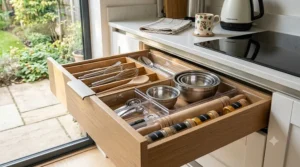
How to Choose Drawer Storage Accessories in the UK
- Measure first. Internal drawer width, depth, and height — not the furniture’s outer dimensions.
- Decide material by room. Bamboo suits bedrooms and wardrobes; plastic with foam ends suits kitchens, where moisture and food contact are higher.
- Account for damp. Older UK housing, particularly solid-wall Victorian terraces, runs more humid than newer builds — factor this into wood-vs-plastic decisions.
- Budget by drawer, not by house. A £15 fabric set might suit a bedroom chest while a £30 Joseph Joseph unit earns its place in a high-traffic kitchen drawer.
- Check returns policy. UK consumers buying online benefit from a 14-day cooling-off period under the Consumer Contracts Regulations, so there’s little risk in trying a set and returning it if the fit’s wrong.
- Don’t ignore liners. Dividers solve space; liners solve smell and light protection — most drawers benefit from both.
Common Mistakes When Buying Drawer Organisers
The most frequent error is buying dividers sized for the drawer’s external dimensions rather than its internal cavity, which results in a set that simply won’t extend far enough — a problem compounded in the UK by furniture with thick internal drawer walls that eat into usable space. The second is assuming one product solves every drawer in the house: a bathroom cabinet, a kitchen utensil drawer, and a bedroom dresser have wildly different demands, and treating them identically usually means buying the wrong thing twice.
A third, quieter mistake is skipping liners altogether on the assumption they’re purely decorative. In practice, a thin paper liner is the cheapest protection against a rough, unfinished drawer base scuffing delicate fabrics — something nobody thinks about until a good jumper picks up a snag from raw chipboard.
Long-Term Value and Care in UK Conditions
Bamboo dividers, properly cared for, tend to outlast plastic equivalents by a comfortable margin — three to five years isn’t an unreasonable expectation, against perhaps two to three for budget plastic trays that can grow brittle with age. Scented liners are the one genuinely consumable item on this list and should be budgeted as an ongoing cost of roughly £15–£20 a year if you’re refreshing two or three drawers twice annually.
The Association of Professional Declutterers & Organisers UK — a body listed by several UK local authorities as a recognised resource — notes that ongoing maintenance, not a single big tidy-up, is what actually keeps storage systems working long-term. That’s the unglamorous truth behind every product on this list: dividers don’t organise a drawer once and forget it, they just make the five-minute weekly reset considerably less painful.
What to Expect: Real-World Performance in British Conditions
Wood swells, plastic doesn’t, and fabric breathes — that’s roughly the entire physics lesson you need. In a centrally-heated modern flat, none of this matters much. In an older property with solid walls, single glazing, or a bathroom with poor extraction, bamboo dividers may need an occasional wipe-down and plastic organisers will outlast them with zero maintenance, full stop. None of the products reviewed here involve electrics, so UKCA marking and voltage compatibility — relevant for plug-in gadgets — simply don’t apply; this is refreshingly low-tech kit.
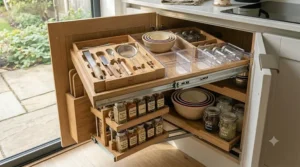
Frequently Asked Questions
❓ Do drawer dividers work in any size of drawer?
❓ How long do scented drawer liners last?
❓ Can I return drawer organisers if they don't fit?
❓ Are bamboo dividers suitable for damp UK bathrooms?
❓ What's the difference between drawer liners and drawer dividers?
Conclusion
None of this is complicated, which is rather the point. A handful of bamboo strips, a stack of plastic trays, and a packet of nicely scented paper will not, on their own, transform your life — but they will stop your cutlery drawer looking like a skip, and that’s a more honestly achievable goal anyway. Start with whichever drawer irritates you most, measure it properly, and pick from the tiers above rather than guessing.
✨ Don’t Miss These Exclusive Deals!
🔍 Take your drawer organisation to the next level with these carefully selected products. Click on any highlighted item to check current pricing and availability on Amazon.co.uk. These picks will help you find exactly what you need!
Recommended for You
- Cedar vs Lavender Drawer Fresheners: 7 Best UK Picks (2026)
- 7 Best English Lavender Sachets UK 2026: Fragrant Wardrobe Wins
- Best Lavender Sachets for Drawers UK 2026: 7 Expert-Tested Picks
Disclaimer: This article contains affiliate links. As an Amazon Associate, I earn from qualifying purchases. If you purchase products through these links, we may earn a small commission at no additional cost to you.
✨ Found this helpful? Share it with your mates! 💬🤗
