
In This Article
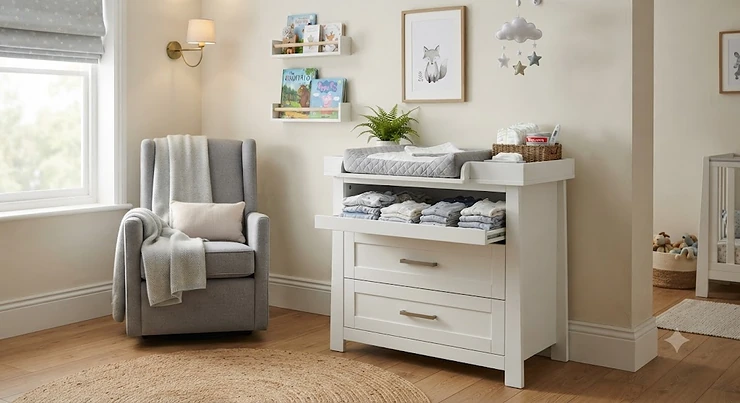
Nobody warns you, before the baby arrives, that you’re about to fall in love with furniture the way other people fall in love with cars. Suddenly you’re debating drawer runners like they’re horsepower, and a changing top with a raised lip feels like the single most romantic feature a piece of MDF has ever offered. Welcome to the strange, sleep-deprived world of choosing a chest of drawers with changing top nursery piece — arguably the single hardest-working item you’ll buy for the first year, and one of the few that’s still useful long after the nappies stop.

At its simplest, a chest of drawers with changing top nursery unit is exactly what it sounds like: a standard chest of drawers with a fitted or clip-on changing surface bolted to the top, turning one piece of furniture into two jobs. You get storage for nappies, vests, and the seventeen tiny socks that seem to breed overnight, plus a proper, raised, hip-height spot to change a squirming baby without folding yourself in half over a mat on the floor. Most versions let you unclip the changing top entirely once your child outgrows nappy changes, at which point the whole thing quietly demotes itself into a completely ordinary, perfectly respectable bedroom chest.
We’ve dug through real specifications, genuine UK retailer listings, and aggregated review sentiment for seven currently available products, spanning proper budget buys through to the kind of solid pine piece you’ll still own when your toddler is doing GCSEs. Every price mentioned below is a rough band, not gospel, because retailer pricing moves around constantly — always check current price before you commit your card details. And because we take child safety seriously here, it’s worth knowing upfront that UK nursery furniture sits under real regulatory scrutiny, including recent updates to the Furniture and Furnishings (Fire) (Safety) Regulations, which we’ll return to properly further down.
Quick Comparison: Chest of Drawers With Changing Top Nursery — At a Glance
| Unit | Material | Drawers | Changing Top | Best For |
|---|---|---|---|---|
| Tutti Bambini Rio | Solid pine | 3, soft-close | Removable | Premium build quality |
| CuddleCo Clara | Solid pine | 3 | Removable | Timeless, long-term look |
| Obaby Belton | Engineered wood | 3, 38L each | Attachable | Retro-modern styling |
| Obaby Maya | MDF | Drawers + cupboard | Attachable | Small nurseries |
| Ickle Bubba Snowdon | Engineered wood | 3, deep | Removable | Sleigh-style tradition |
| Babymore Universal | Engineered wood | 3, full-size | Removable | Tight budgets |
| WOLTU 4-Drawer | MDF + particleboard | 4 | Detachable | Amazon-direct convenience |
Look closely and a pattern jumps out fast: everything on this list, without exception, is built around the same core promise — buy once, change nappies for a year or so, then unclip the top and keep the drawers for the next decade. Where they actually differ is material honesty (solid pine versus engineered board), drawer count, and how fiddly the changing top attachment is, which matters more than you’d think at 2am with a screaming infant and a leaking nappy.
💬 Just one click — help others make better buying decisions too!😊
Top 7 Chests of Drawers With a Changing Top for the Nursery: Expert Analysis
Below are seven genuine products currently sold through UK retailers and Amazon.co.uk, covering solid wood investment pieces, MDF budget options, and everything sensible in between.
1. Tutti Bambini Rio Solid Wood Baby Changing Unit — best build quality for the money
Pick this one up in a showroom and the difference is immediate: it doesn’t wobble, creak, or feel like it’s apologising for existing. That’s what solid pine does that engineered board simply can’t.
Three deep drawers run on genuinely soft-close mechanisms, which sounds like a small thing until you’re closing a drawer one-handed at 3am with a baby balanced on your hip and you realise nothing has slammed. The chest top changer is sized for a standard changing mat, and the whole unit is finished in either crisp white or a moodier slate grey and oak combination that photographs like it belongs in a much pricier catalogue. Based on the spec comparison with the MDF pieces further down this list, what stands out is the sheer robustness — Tutti Bambini has been designing nursery furniture for over three decades, and it shows in the joinery rather than just the marketing copy.
Here’s what to weigh: solid pine costs more upfront, and reviewers consistently note that the finish, while lovely, does mark slightly more visibly than a lacquered MDF equivalent if you’re not careful with wet wipes. For families planning to keep this piece well beyond the nursery years, though, that trade-off tends to feel entirely worth it.
Pros:
- ✅ Genuine solid pine construction feels noticeably sturdier
- ✅ Soft-close drawers prevent 3am slamming and finger traps
- ✅ Removable top converts cleanly into a grown-up bedroom chest
Cons:
- ❌ Higher price point than engineered-wood alternatives
- ❌ Solid wood finish shows wipe-clean marks more readily
Expect a premium price band, roughly £220-£280 depending on colourway, so check current price before ordering given regular retailer promotions.

2. CuddleCo Clara 3 Drawer Dresser & Changer — best for a look that never dates
There’s a specific kind of nursery furniture that photographs beautifully on day one and still looks tasteful five years later, once the bunting’s come down and the room’s been repurposed. Clara is that furniture.
Built from solid pine with a classic curved silhouette, this three-drawer dresser carries a genuinely reassuring five-year warranty against manufacturing defects — longer than most rivals on this list — and comes with a wall strap kit included as standard rather than as an awkward afterthought. The changing top is rated to roughly 11kg, comfortably covering most babies up to around twelve months, and detaches cleanly once nappy days are done. What most buyers overlook about this model is that the “removable changing station” phrase undersells how genuinely tidy the conversion is; there’s no ugly bracket ghost left behind once the top comes off.
On paper this means you’re paying a mid-to-premium price for a piece explicitly designed to outlive its changing-table phase by years, not months. Aggregated review sentiment leans heavily positive on the styling and sturdiness, with the most common criticism being assembly time rather than any structural complaint.
Pros:
- ✅ Five-year manufacturer warranty, longer than most competitors
- ✅ Wall strap kit included rather than sold separately
- ✅ Clean conversion with no visible fixing marks once top is removed
Cons:
- ❌ Self-assembly can take longer than budget MDF alternatives
- ❌ Premium pine pricing sits above engineered-wood competitors
Typical pricing lands around £300-£350 at the time of research, so as ever, check current price before assuming that figure is fixed.
3. Obaby Belton Chest of Drawers with Changing Top — best retro-modern styling on a mid-range budget
Somewhere between “Scandinavian minimalism” and “your nan’s sideboard, but cooler,” the Belton range has carved out a genuinely distinctive aesthetic niche, and it does it without asking you to remortgage anything.
Three deep drawers offer a combined 38 litres of capacity each, with a slatted front design that coordinates neatly with the rest of Obaby’s Belton furniture collection if you’re building out a matching cot and wardrobe. The multi-top changer sits securely on top and accommodates a changing mat up to 50 x 85cm, suitable from birth to roughly twelve months. Reviewers consistently note that the smooth-running drawer glides feel more premium than the price tag suggests, which is exactly the kind of quiet overperformance you want from a mid-range purchase.
What the spec sheet won’t tell you, but the format and finish suggest, is that this piece works particularly well in nurseries going for a warmer, less clinically white look — the retro slatted detailing softens what could otherwise be a very boxy silhouette.
Pros:
- ✅ Distinctive slatted retro-modern design stands out from generic white boxes
- ✅ Generous 38L capacity per drawer for genuinely deep storage
- ✅ Coordinates with the wider Obaby Belton furniture range
Cons:
- ❌ Changing mat size limit (50 x 85cm) rules out oversized mats
- ❌ Engineered wood rather than solid timber construction
Expect a mid-range price, roughly £150-£190 at the time of research; check current price given Obaby’s frequent seasonal sales.
4. Obaby Maya Changing Unit — best for small or awkwardly shaped nurseries
Not every nursery is a Pinterest-board rectangle. Some are converted box rooms, some have a radiator exactly where the perfect dresser would go, and Maya was clearly designed with that reality in mind rather than an idealised showroom floor plan.
Inspired by Scandinavian design principles, this unit pairs open drawers with a full-height cupboard and adjustable shelf, giving you vertical storage rather than demanding extra floor width. Soft-close doors and recessed handles keep the whole thing snag-free for busy, one-handed parenting moments, and the wipe-clean MDF finish in crisp white handles the inevitable spills without drama. The top surface accommodates a changing mat up to 80 x 46.5cm, and lifts away entirely once changing days are over, leaving a genuinely stylish flat-top chest behind.
What most buyers overlook here is that the compact footprint doesn’t come at the cost of storage volume — the cupboard-plus-drawer combination actually holds more than a same-width, all-drawer unit, it just organises it differently. One aggregated review flagged a cracked side panel during changing-top installation, a reminder to handle assembly with a bit more care than the instructions might imply.
Pros:
- ✅ Vertical cupboard-plus-drawer layout suits compact nurseries
- ✅ Soft-close doors and recessed handles reduce snagging risk
- ✅ Larger 80 x 46.5cm changing mat capacity than several rivals
Cons:
- ❌ MDF construction is less robust than solid pine alternatives
- ❌ Occasional reports of panel cracking during top installation
Pricing generally sits in the £130-£170 range at the time of research, so check current price before ordering.
5. Ickle Bubba Snowdon 3-Drawer Baby Changing Unit & Dresser — best for a traditional sleigh-style nursery
If your mood board leans more heritage nursery than modern minimalist — think curved sleigh silhouettes and elegant handles rather than flat white panels — Snowdon is built specifically for you.
Three deep drawers sit beneath a changing station rated for mats up to 76 x 46cm, and the whole piece conforms to BS EN 12221:2008+A1:2013 for changing units and BS EN 14749:2016 for storage furniture, both directly relevant safety standards rather than vague marketing badges. A four-year warranty backs the build, and wall fixings are included in the box rather than sold as an accessory. Based on the spec comparison with plainer competitors, the elegant handle detailing and curved sleigh ends genuinely do photograph better in period-style or heritage-themed nurseries, where flat modern fronts can look slightly out of place.
Aggregated review sentiment is a genuine mixed bag here: many parents love the design and sturdiness, but a meaningful minority report assembly frustrations and the occasional damaged part on arrival, which is worth budgeting extra patience for on delivery day.
Pros:
- ✅ Meets both BS EN 12221 and BS EN 14749 safety standards explicitly
- ✅ Four-year warranty with wall fixings included
- ✅ Distinctive sleigh styling suits traditional nursery themes
Cons:
- ❌ Some reported assembly difficulty and quality-control inconsistency
- ❌ Traditional styling may clash with a minimalist Scandi nursery
Expect a mid-range price around £140-£180 at the time of research; check current price before buying since promotional pricing shifts often.
6. Babymore Universal Style Chest Drawers Nursery Changing Unit — best for genuinely tight budgets
Sometimes you just need the job done without the storytelling. Babymore’s Universal Chest Changer skips the heritage detailing and the premium timber, and simply delivers three full-sized drawers and a secure changing surface at a price that won’t make your eyes water in month one of parenthood.
The removable changer top is rated from birth up to roughly 12 months or 11kg, accommodates a changing mat up to 75 x 45cm, and lifts away cleanly once you’re done with it. Drawers glide on smooth runners, and the whole assembled unit measures a manageable 90 x 52 x 92cm, fitting comfortably into most standard box-room nurseries. What most buyers overlook about genuinely budget-tier nursery furniture is that “basic” doesn’t have to mean “flimsy” — this is a straightforward, honestly built piece rather than a compromised one.
Here’s what to weigh: you’re not getting soft-close mechanisms or a five-year warranty at this price point, and the finish is engineered wood rather than solid timber. For a first nursery on a genuinely constrained budget, though, it does the essential job without cutting corners on the changing surface itself.
Pros:
- ✅ Genuinely low entry price for three full-sized drawers
- ✅ Manageable footprint suits smaller box-room nurseries
- ✅ Straightforward removable top with clear weight rating
Cons:
- ❌ No soft-close drawer mechanism at this price tier
- ❌ Shorter warranty coverage than premium alternatives
At the budget end, expect a price generally under £120, making it one of the most accessible options here — check current price at the retailer directly.
7. WOLTU Baby Changing Table with 4 Drawers — best for Amazon-direct convenience and an extra drawer
For parents who’d rather order everything from a single Amazon basket at 11pm during a feed than hunt across specialist nursery retailers, WOLTU’s four-drawer unit is a genuinely practical, currently listed Amazon.co.uk option.
Constructed from FSC-certified wood with an MDF changing topper and particleboard chest, this is a detachable dual-mode design: the changing surface clips on using metal anti-slip hooks and detaches cleanly once your child outgrows nappies, leaving a standalone four-drawer cabinet. An anti-tip device on the back and rounded corners throughout address the two most common nursery furniture safety concerns directly, while the changing surface itself splits into two zones — a larger area for the actual change, a smaller one for wipes and cream within easy reach. On paper this means genuinely thoughtful engineering at a distinctly non-premium price.
What the spec sheet won’t tell you, but aggregated review sentiment does, is that durability feedback is mixed: several reviewers specifically flag the drawers feeling less sturdy than pricier alternatives, and one common complaint involves a drawer not closing fully after assembly. For everyday nappies-and-vests storage rather than heavy-duty use, most buyers still rate it as decent value.
Pros:
- ✅ Four drawers instead of the usual three for extra capacity
- ✅ FSC-certified wood and built-in anti-tip protection
- ✅ Directly available and easily ordered through Amazon.co.uk
Cons:
- ❌ Reviewers report mixed durability versus solid-wood rivals
- ❌ Occasional drawer alignment issues noted after assembly
Pricing typically falls under £150 at the time of research, and given frequent Amazon promotional pricing, check current price before ordering.
Setting Up Your Changing Station and Getting the Most From the First Year
Delivery day for flat-pack nursery furniture has a very particular energy: equal parts excitement and quiet dread about the instruction booklet. A little forward planning saves both.
Before assembly begins, decide on final placement first, not last — these units are genuinely heavy once built, and dragging a finished chest across a nursery floor to reach a plug socket is not a fun way to spend an evening. Always fit the supplied wall anchor straps as step one of “finished,” not an optional extra for “later,” since a toddler pulling themselves up on an open drawer is exactly the scenario these straps exist to prevent. Once assembled, load the bottom drawers with bulkier, less-frequently-needed items like spare bedding or next-size-up clothing, and keep the top drawer stocked with genuine grab-and-go essentials: nappies, wipes, and a spare vest, positioned so you’re never twisting or reaching mid-change.
A common early mistake is treating the changing top as permanently fixed and never checking the attachment brackets after the first few weeks of daily use — vibration from repeated changes can gradually loosen fittings, so a monthly once-over with a screwdriver is genuinely worth the ninety seconds it takes. Finally, resist the urge to overfill drawers in month one; babies grow through sizes faster than most new parents expect, and a slightly emptier drawer system now makes size-rotation far less of a Tetris puzzle in month four.
Real Nursery Scenarios: Matching the Right Combo to Your Space and Budget
Rather than a vague “it depends,” here are three concrete situations that map straight onto the products above.
The first-time parents furnishing an entire nursery from scratch on a tight budget: The Babymore Universal or WOLTU 4-Drawer make the most sense here. Both deliver a genuine changing surface and real storage without the premium pricing of solid pine, freeing up budget for the car seat and pram that also need buying before the due date arrives.
The parents building a considered, long-term nursery they intend to keep furniture from for years: Tutti Bambini Rio or CuddleCo Clara are the sensible picks. Solid pine construction and longer warranties mean these pieces genuinely function as furniture investments, not just temporary baby gear destined for resale on Facebook Marketplace within eighteen months.
The parents working with an awkward, smaller box-room nursery: The Obaby Maya’s vertical cupboard-and-drawer layout solves a genuinely different problem than sheer drawer count — it maximises storage per square foot of floor space rather than per pound spent, which matters far more when the room itself is the limiting factor.
Common Nursery Storage Problems and Practical Fixes
Even a well-chosen unit runs into real-world friction. Here’s how to solve the recurring ones.
Problem: the changing top wobbles slightly during use. This is almost always a loose bracket rather than a design flaw — recheck and re-tighten the fixing screws, particularly on units like the WOLTU or Babymore that use clip-on rather than fully integrated tops.
Problem: drawers stick or don’t glide smoothly. A build-up of dust or slight swelling from humidity is the usual culprit; a light rub of candle wax or a specific drawer-runner lubricant along the runners solves this in minutes without needing tools.
Problem: the unit feels genuinely too small within six months. This usually means drawer organisation, not overall capacity, is the real issue — adjustable dividers, as recommended by several professional nursery organisers, transform a single cavernous drawer into two or three properly usable compartments.
Problem: nervousness about tip-over risk once your baby starts pulling up on furniture. Fit the supplied anti-tip wall straps immediately if you haven’t already, and consider it non-negotiable rather than optional — the Child Accident Prevention Trust publishes clear, practical guidance on preventing exactly this kind of accident at home.
✨ Ready to Sort Your Nursery Storage?
🔍 Compare the seven units above, click through to check current pricing, and pick the one that matches your actual room and budget rather than just the prettiest product photo.
Changing Table Chest of Drawers Combos: Matching Secondary Search Terms to Real Buying Questions
Changing Table Chest of Drawers Combo: What You’re Actually Buying
A changing table chest of drawers combo is precisely the category this whole guide covers: one piece of furniture serving two distinct jobs simultaneously. The honest trade-off is that a combo unit is rarely as spacious for changing as a dedicated standalone changing table, but it earns that space back many times over in floor-plan efficiency, which matters enormously in a typical UK box-room nursery.
Nursery Furniture Chest of Drawers Amazon: What to Check Before You Click Buy
Shopping for nursery furniture chest of drawers Amazon listings specifically means paying closer attention to seller information than you might for a book or a phone case — check whether the listing is fulfilled and sold directly (as with the WOLTU pick above) versus a third-party marketplace seller, since return policies and assembly support can genuinely differ between the two.
White Chest of Drawers Nursery: Why This Colour Dominates the Category
A white chest of drawers nursery piece remains the overwhelming market default for good reason: it photographs brightly in low-light rooms, coordinates with literally any nursery colour scheme you choose later, and, crucially, resells far more easily second-hand than a bold colourway once your family’s needs change.
2-in-1 Nursery Furniture: The Real Meaning Behind the Marketing Term
When retailers describe 2-in-1 nursery furniture, they’re almost always referring to exactly this changing-top-plus-chest structure, though occasionally the term stretches to cover a chest that also converts into a wardrobe base. Always check the specific product description rather than assuming, since “2-in-1” isn’t a strictly regulated term.
Nappy Changing Station: Getting the Height and Layout Right
A genuinely comfortable nappy changing station sits at a height that avoids repeated bending, typically around 85-95cm depending on your own height, and most of the units reviewed above land comfortably within that range, sparing your lower back through months of frequent nappy changes.
Convertible Baby Furniture: How Long “Convertible” Really Lasts
The phrase convertible baby furniture technically describes any piece designed to change function as your child grows, and for chest-of-drawers changing units specifically, that conversion typically happens once around the twelve-month mark, after which the drawers themselves can realistically serve a child’s bedroom storage needs well into their school years.
What Is a Chest of Drawers With Changing Top?
A chest of drawers with changing top is a piece of nursery furniture combining standard drawer storage with a raised, securely fitted surface designed for nappy changes, typically suitable from birth up to around twelve months or 11kg. The changing top is usually removable or detachable, allowing the same unit to continue serving as ordinary bedroom storage long after nappy-changing days end.
Physically, most units on the UK market share a broadly similar structure: three or four drawers, a wooden or engineered-board carcass, and a changing surface with raised sides or barriers to help prevent a baby rolling off during a change. As reviewed above, construction ranges from genuinely solid pine through to more budget-friendly MDF and particleboard, with the material choice driving much of the price difference between otherwise similarly specified units.
How to Choose a Chest of Drawers With Changing Top for Your Nursery
- Measure your actual nursery space before falling for a photo. A unit that looks compact online can still dominate a genuinely small box room; check both width and the clearance needed to open drawers fully.
- Decide whether solid wood or engineered board matters to you. Solid pine, as seen on the Tutti Bambini Rio and CuddleCo Clara, costs more but tends to outlast MDF alternatives by a considerable margin.
- Check the changing mat size compatibility. Units vary from roughly 50 x 85cm through to 80 x 46.5cm, so confirm your intended mat actually fits securely within the raised edges.
- Confirm the removable top mechanism genuinely converts cleanly. Look specifically for reviews mentioning visible marks or leftover brackets after removal, not just the marketing claim itself.
- Prioritise recognised safety standards. BS EN 12221 for changing units and BS EN 14749 for storage furniture are the two relevant British standards; the Furniture Industry Research Association publishes clear guidance on how these apply to childcare products sold in the UK.
- Check whether wall-fixing straps are included or sold separately. Several units bundle this safety essential; others treat it as an optional extra worth budgeting for regardless.
- Read aggregated review sentiment for assembly experience specifically. A unit’s overall star rating rarely reflects how painful or straightforward the actual flat-pack build turns out to be, and that’s often the detail parents remember most vividly.
Chest of Drawers With Changing Top vs a Standalone Changing Table
The core trade-off here is floor space versus dedicated changing surface area. A combo unit, by definition, compresses two functions into one footprint, which suits the vast majority of UK nurseries where square footage is the scarcest resource in the room.
A standalone changing table, by contrast, typically offers a more generous, purpose-built changing surface, sometimes with open shelving beneath rather than closed drawers, but it demands its own dedicated floor space in addition to whatever storage furniture you buy separately. In practice, most UK families choose the combo route specifically because it avoids buying, fitting, and eventually disposing of two separate large items, and because every product reviewed above is explicitly designed to transition seamlessly into standalone storage once the changing phase ends. For families with genuinely generous nursery space and a preference for keeping changing and storage functions physically separate, a standalone table remains a perfectly reasonable alternative, just a less space-efficient one.
What to Expect: Real-World Use From Newborn to Toddler
In practice, a chest of drawers with changing top earns its keep hardest in the first six months, when nappy changes happen roughly eight to ten times a day and having everything within one-handed reach genuinely changes the rhythm of your day. By around nine to twelve months, most babies become considerably more mobile and wriggly during changes, at which point the raised barrier edges on units like the Ickle Bubba Snowdon and WOLTU genuinely start proving their worth over a flat-topped alternative.
Once the changing top comes off, expect a noticeably calmer second act: the same drawers that held nappies and vests smoothly transition into holding pyjamas, books, and eventually school uniforms, with solid pine units like the Tutti Bambini Rio and CuddleCo Clara showing the least visible wear by this stage compared with budget MDF equivalents.
Safety, Regulations and UK Compliance Guide
This is the section worth reading properly rather than skimming, because nursery furniture safety in the UK isn’t just marketing language, it’s genuinely regulated. All the units above should meet BS EN 14749 for general storage furniture stability and, where relevant, BS EN 12221 specifically covering baby changing units, both directly referenced by manufacturers like Ickle Bubba on their product pages.
Beyond drawer and changing-surface standards, the UK’s furniture fire safety framework has recently been updated: the 2025 amendment to the Furniture and Furnishings (Fire) (Safety) Regulations specifically addresses how these rules apply to furniture including items used by babies, so it’s worth a quick read if you’re buying anything upholstered alongside your chest of drawers. On the physical safety side, always fit the supplied anti-tip wall straps as a first step, never leave a baby unattended on the changing surface even briefly, and never allow more than one drawer open at a time, since an open drawer becomes an unintended step for a climbing toddler within what feels like weeks of them learning to pull themselves up.
Long-Term Cost & Value Analysis
The sticker price only tells part of the story. Budget MDF units like the Babymore Universal or WOLTU 4-Drawer typically cost under £150, but tend to show wear on drawer runners and surface finishes somewhat sooner than solid timber alternatives, particularly under the daily hammering of toddler use in years two and three.
Solid pine pieces like the Tutti Bambini Rio and CuddleCo Clara cost meaningfully more upfront, often £100-£150 more than the budget tier, but genuinely justify that gap if you’re planning to keep the unit as bedroom furniture well beyond the nursery years rather than selling it on once nappies stop. Factoring in a realistic five-to-eight-year ownership window, the total cost per year of use often narrows considerably between budget and premium tiers, making the “which is actually cheaper” question far less obvious than the upfront price tags alone would suggest.

Frequently Asked Questions
❓ Is a chest of drawers with changing top safe for a newborn?
❓ How long can you use the changing top before it needs removing?
❓ Can the changing top be added later if I buy the chest of drawers separately?
❓ Is solid wood genuinely worth the extra cost over MDF?
❓ What size changing mat fits these units?
Conclusion
Choosing the right chest of drawers with changing top nursery piece really comes down to being honest about two things: how long you actually want this furniture to last, and how much floor space your nursery genuinely has to spare. A tight budget and a small box room point firmly toward the Babymore Universal or Obaby Maya; a longer-term investment mindset points just as firmly toward the Tutti Bambini Rio or CuddleCo Clara.
Whichever you choose, prioritise the fundamentals over the finish: confirm the relevant BS EN safety standards, fit the wall straps on day one rather than “eventually,” and check the changing mat size actually matches what you’re planning to use. Beyond that, this is genuinely one of the rare nursery purchases where getting it right the first time pays you back for years, long after the changing top itself has been quietly unclipped and put away.
Recommended for You
- Large Chest of Drawers Teenage Room: 7 Picks for 2026
- Chest of Drawers for Teenage Bedroom: 7 Picks That Survive 2026
- Best Narrow Chest of Drawers 3 Drawer UK 2026: 7 Expert Picks
Disclaimer: This article contains affiliate links. As an Amazon Associate, I earn from qualifying purchases. If you purchase products through these links, we may earn a small commission at no additional cost to you.
✨ Found this helpful? Share it with your friends! 💬🤗
