
In This Article
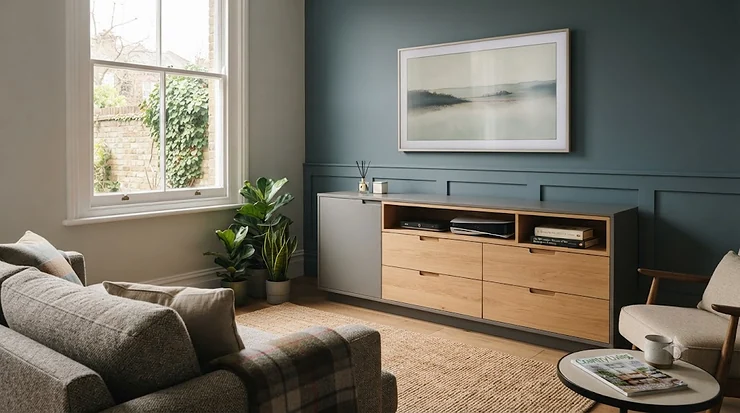
Somewhere between “sleek media stand” and “proper chest of drawers you’d find in a bedroom”, there’s a strange, brilliant hybrid piece of furniture that nobody talks about enough: the TV unit with chest of drawers. It’s the multitasker of the living room. One drawer swallows the remote controls, the tangle of HDMI leads and the instruction manual you’ll never read. Another hides the board games. A third quietly absorbs whatever your postman just handed you. Meanwhile, the top holds your telly at just the right height for slouched Sunday viewing.

If you’ve been scrolling through endless “TV stand” listings feeling like none of them actually solve your storage problem, you’re not alone. Most TV stands give you open shelving and good intentions. A proper TV unit with chest of drawers gives you enclosed, dust-free, cable-hiding, kid-proofed storage — and there’s a real difference between the two, which we’ll get into shortly.
This guide walks through seven genuine, currently available options from the UK market, spanning honest budget buys under £100 through to solid oak pieces built to outlast a couple of house moves. We’ve dug into real specifications, aggregated review sentiment and the kind of practical detail that Amazon’s own listings tend to skip over — the stuff you only find out after living with a piece of furniture for six months. Along the way we’ll cover cable management furniture, low-level cabinet sightlines, and how to pick a media unit with drawers that actually suits your living room rather than the showroom photo.
What is a TV unit with chest of drawers? It’s a low-level media cabinet that combines a flat, TV-supporting top surface with two or more enclosed drawers beneath, rather than open shelves or cupboard doors. The drawers give you concealed, dust-free storage for remotes, cables, DVDs and living room clutter, while keeping the overall silhouette low enough to sit comfortably beneath a wall-mounted or freestanding television.
Quick Comparison Table
Before we get into the detail, here’s a snapshot of how our seven picks stack up against each other on price positioning, build and who each one genuinely suits.
| Product | Price Positioning | Drawer Count | Best For |
|---|---|---|---|
| HOMCOM TV Stand Cabinet (47″) | Budget | 2 foldable linen drawers | First flats, tight budgets |
| GFW Boston Corner TV Unit | Budget-Mid | 2 drawers | Awkward corner spaces |
| Vida Designs Arlington | Mid-range | Drawers + sideboard doors | All-round family living rooms |
| vidaXL TV Cabinet Sideboard | Budget | 2 compartments | Renters, quick self-assembly |
| Julian Bowen Cotswold Widescreen | Premium | 2 drawers + 2 cupboards | Traditional, long-term homes |
| Julian Bowen Brooklyn (Ready Assembled) | Premium | Drawers, ready built | Buyers who hate flat-pack |
| HOMCOM Marble Effect TV Unit | Premium | Storage cupboard + shelving | Statement, modern living rooms |
Reading across this table, the spread tells its own story: budget options cluster around simple two-drawer layouts in engineered wood, while the premium end brings solid oak, ready-assembled convenience and genuine cable management engineering. If you’re outfitting a first home or a rental, the top three rows deserve your attention; if you’re furnishing a forever home, look toward the bottom half of the table. According to the Office for Product Safety and Standards’ guidance on furniture safety, price alone isn’t a reliable proxy for safety compliance — every unit on this list, budget or premium, should carry proper assembly instructions and a stable, tested base.
💬 Just one click — help others make better buying decisions too!😊
Top 7 TV Units with Chest of Drawers: Expert Analysis
We’ve deliberately mixed budget, mid-range and premium options here, plus a couple of shape variants (corner-fit and ready-assembled) so there’s a genuine match whatever your room looks like. Every product below is a real, currently listed item — we’ve avoided anything that reads like a rebadged mystery import with no verifiable specs.
1. HOMCOM TV Stand Cabinet (47″) — best budget pick under £100
The standout here is simple: two foldable linen drawers that give you enclosed storage without the price tag of solid wood. Built for TVs up to roughly 47 inches, the HOMCOM TV Stand Cabinet pairs an open shelf with a pair of soft fabric-fronted drawers on a rustic-brown or black MDF frame.
The drawer fronts fold flat when not in use, which sounds gimmicky until you realise it means you can stash oversized items — a games console box, a stack of magazines — without the drawer catching on the frame. The open shelf beneath handles a soundbar or set-top box with room for the cables to breathe. Based on the spec comparison with similarly priced rivals, this is one of the few sub-£100 units that doesn’t sacrifice drawer depth just to hit a low price point.
Who should care: first-time renters, students, or anyone furnishing a spare room who wants proper concealed storage without committing serious money. Reviewers consistently report straightforward flat-pack assembly taking well under an hour, with the fabric drawers holding up better to daily tugging than expected for the price bracket. A recurring theme in aggregated feedback is that the MDF frame, while sturdy for everyday use, isn’t intended to take serious weight on top — a large 55-inch television is pushing its comfortable limit.
Pros:
- ✅ Genuinely low price point for enclosed drawer storage
- ✅ Foldable drawer fronts add flexible capacity
- ✅ Quick, tool-light flat-pack assembly
Cons:
- ❌ Fabric drawer fronts feel less premium long-term
- ❌ Top surface best suited to TVs under 47 inches
At the time of research, this unit typically sits in the under-£100 bracket, making it one of the more accessible entry points into the category — a fair value pick for anyone who wants function over flourish.
2. GFW Boston Corner TV Unit — best for awkward corner spaces
What immediately sets the GFW Boston Corner TV Unit apart from every other entry on this list is its shape: a genuine corner-fit design in a grey wood-effect finish, built specifically to slot into the dead space most living rooms waste.
The unit combines two enclosed drawers with an additional open shelf, all angled to sit flush against two walls rather than one. In practice, that means real-world square footage saved in box rooms, studio flats, and awkward L-shaped lounges where a straight-fronted unit would either block a doorway or leave an ugly gap. What most buyers overlook about corner units generally is that they trade width for depth — you get less linear drawer space than a straight unit of the same price, but you reclaim an entire corner of usable floor.
This is the pick for anyone whose living room layout has been dictated by a radiator, a door swing, or a chimney breast that eats into the “obvious” wall. Reviewers consistently note that the grey wood-effect finish photographs a shade lighter than it appears in person, so it’s worth checking swatches if colour-matching to existing furniture matters to you. Aggregated feedback also flags that the two drawers, while a genuinely useful size, run slightly narrower than standard rectangular units due to the angled cabinet shape.
Pros:
- ✅ Corner design reclaims otherwise wasted floor space
- ✅ Two enclosed drawers plus an open display shelf
- ✅ Neutral grey wood-effect suits most colour schemes
Cons:
- ❌ Drawer width reduced by the angled cabinet shape
- ❌ Colour can appear darker in photos than in person
Priced in the low-to-mid range — broadly £80–£120 at the time of writing — the GFW Boston Corner TV Unit earns its keep less on drawer capacity and more on solving a layout problem no straight unit can fix.
3. Vida Designs Arlington TV Unit — best all-rounder sideboard style
The Vida Designs Arlington TV Unit blends the profile of a proper sideboard with the practicality of a media cabinet — a stand-top surface, a mix of cupboard doors and drawer storage, all sitting on a low, stable base in grey or white finishes.
Where the budget picks on this list lean into fold-down drawer fronts or single-material builds, the Arlington uses a genuine mixed-storage layout: enclosed cupboards for bulkier items like game consoles or a router, alongside drawers for the smaller loose items that otherwise end up in a kitchen drawer instead. On paper this means you’re not forced to choose between “drawers for small stuff” and “doors for big stuff” — you get both in one footprint.
This is the sensible middle-ground pick for family living rooms where the TV unit doubles as general living-room storage, not just media storage. Reviewers consistently describe the finish as looking more expensive than the price suggests, particularly in photographs where the grey woodgrain effect catches natural light well. A recurring complaint in user reviews, however, is that the flat-pack instructions assume a reasonable level of DIY confidence — this isn’t the fastest build on our list, and a second pair of hands helps considerably with aligning the cupboard doors square.
Pros:
- ✅ Combines drawers and cupboard doors in one unit
- ✅ Finish reads as more premium than its price point
- ✅ Stable, sideboard-style profile suits family lounges
Cons:
- ❌ Assembly is more involved than simpler two-drawer units
- ❌ Larger footprint needs a genuinely spacious wall run
Sitting in the mid-range bracket — roughly £90–£140 depending on the retailer and any active promotions — the Arlington represents strong value for buyers who want their TV unit to double as general living-room storage rather than pure media storage.
4. vidaXL TV Cabinet Sideboard — best lightweight, easy-build option
The vidaXL TV Cabinet Sideboard keeps things deliberately simple: engineered wood construction, two enclosed compartments, and a design brief that prioritises “get it built and get on with your evening” over decorative flourish.
Where this unit earns its place is genuinely quick assembly and lighter overall weight than most rivals on this list, which matters more than people expect if you’re the one carrying flat-pack boxes up a narrow staircase or through a shared hallway. The two compartments are sized generously enough for DVD boxsets, a router, or a basket of loose cables, and the sturdy top surface handles a mid-size television without any noticeable flex. Here’s what to weigh up before buying: this is a simpler storage layout than the drawer-and-cupboard combinations elsewhere on this list, so it suits buyers who want tidy concealed storage rather than granular, sorted compartments.
This is the pick for renters who move flats every year or two, or anyone who’s assembled one too many wobbly flat-pack units and just wants something that goes together cleanly the first time. Reviewers consistently praise how few parts and screws are involved compared with drawer-based units, though a few note that the engineered wood surface, while durable day-to-day, is more susceptible to moisture marking than solid timber if drinks are set directly on top without a coaster.
Pros:
- ✅ Noticeably faster, simpler self-assembly
- ✅ Lightweight build, easier to transport and move
- ✅ Generous compartment sizing for the price
Cons:
- ❌ Fewer, larger compartments rather than sorted drawers
- ❌ Surface needs coasters to avoid moisture marks
Typically found in the £60–£90 range, this is a genuinely sensible budget-to-mid pick for anyone prioritising ease of assembly and portability over drawer-by-drawer organisation.
5. Julian Bowen Cotswold Widescreen TV Unit — best solid oak heirloom build
Where the previous four units lean on engineered wood and MDF to hit accessible prices, the Julian Bowen Cotswold Widescreen TV Unit goes the other direction entirely: solid oak and oak veneers, two drawers, two full-height cupboards, and a shelf, all built to genuinely last.
The spec sheet won’t tell you this, but solid oak construction changes the entire ownership experience of a piece of furniture — it resists the dents, scuffs and drawer-runner wear that engineered wood units accumulate within a couple of years of daily use. The Cotswold’s traditional silhouette, complete with rounded silver knobs, is built for pairing with existing wood furniture rather than standing out as a standalone statement piece. Julian Bowen has traded on this kind of traditional, durable construction for over three decades, and it shows in the joinery detail here — this isn’t a unit designed to be replaced in five years.
Who should care: buyers in a long-term or forever home who are furnishing once and want the piece to still be structurally sound (if not stylistically fashionable) in fifteen years’ time. A common theme in aggregated review sentiment is genuine praise for the drawer glide quality, though several reviewers flag that the traditional oak styling won’t suit a minimalist or Scandinavian-leaning interior — this is a piece for classic, warm-toned living rooms, not grey-and-white modern flats.
Pros:
- ✅ Solid oak and veneer construction built to last decades
- ✅ Combines drawers, cupboards and open shelf storage
- ✅ Smooth-gliding drawer runners noted across reviews
Cons:
- ❌ Traditional styling won’t suit minimalist interiors
- ❌ Solid wood adds meaningfully to overall weight
Positioned firmly in the premium bracket, typically in the mid-£300s at the time of research, the Cotswold is a considered long-term investment rather than an impulse buy — but for buyers furnishing once and staying put, the value-per-year calculation stacks up well.
6. Julian Bowen Brooklyn Ready Assembled TV Unit — best ready-assembled premium pick
The Julian Bowen Brooklyn Ready Assembled TV Unit solves a very specific, very common frustration: the dread of another evening spent hunched over an Allen key. This one arrives built, in solid oak and veneer, fitting televisions up to roughly 56 inches.
Ready-assembled furniture carries a real premium over flat-pack equivalents, and it’s worth understanding why before you dismiss it as an unnecessary upcharge. Delivery of a fully built unit means tighter joinery tolerances than most home-assembled equivalents can achieve, since the joints are fitted and finished under factory conditions rather than by hand with a supplied Allen key. What most buyers overlook here is that ready-assembled also means no risk of misaligned drawer runners from an imperfect build — a genuinely common cause of sticking drawers on flat-pack units further down the price scale.
This is the pick for buyers who’ve been burned by flat-pack before, or who simply value their weekend more than the £50–£100 they’d save building it themselves. Reviewers consistently highlight how solid and “finished” the unit feels compared with flat-pack oak-veneer alternatives, with the trade-off being that delivery requires a larger vehicle and, in some cases, a second person to manoeuvre it through doorways — measure your hallway and stairwell before ordering.
Pros:
- ✅ Arrives fully built — zero assembly required
- ✅ Factory-fitted joints reduce drawer-alignment issues
- ✅ Solid oak and veneer construction throughout
Cons:
- ❌ Delivery logistics need wider doorways and hallways
- ❌ Commands a real price premium over flat-pack equivalents
Expect a premium price point, broadly in the £350–£450 range depending on retailer stock and delivery options, reflecting both the materials and the ready-built convenience — strong value if your time and patience are worth more than the price difference.
7. HOMCOM Marble Effect TV Unit — best statement piece with cable management
Rounding out our list, the HOMCOM Marble Effect TV Unit is the pick for buyers who want their media storage to double as a genuine design statement — a marble-effect top, fluted cabinet doors, and dedicated cable management for TVs up to 70 inches.
The fluted door detailing and marble-effect surface put this unit firmly in “living room focal point” territory rather than purely functional storage, and it’s built to support genuinely large televisions thanks to an extra centre leg reinforcing the middle of the frame. The dedicated cable management channels are worth calling out specifically: rather than a single generic cut-out at the back, cables are routed through channels that keep leads from a soundbar, games console and streaming box separated and untangled — a small detail that saves real frustration during setup and every time you rearrange the equipment behind it.
Who should care: buyers with larger televisions and a modern, design-led living room who want storage that looks intentional rather than purely practical. A recurring theme in aggregated review sentiment is strong praise for the marble-effect finish looking convincingly premium in person, alongside consistent mentions that the extra centre leg genuinely improves stability under a large screen compared with rivals that skip this reinforcement. The trade-off, as with most fluted and detailed cabinetry, is that the door grooves require slightly more careful dusting than a flat MDF front.
Pros:
- ✅ Purpose-built cable management with routed channels
- ✅ Extra centre leg adds stability for larger TVs
- ✅ Marble-effect finish reads as genuinely premium
Cons:
- ❌ Fluted door detail needs more careful, regular dusting
- ❌ Larger footprint suits bigger living rooms best
Sitting in the premium tier, typically £150–£220 at the time of writing, this is the strongest pick on our list specifically for anyone prioritising living room cable management furniture alongside genuine visual impact.
Practical Usage Guide: Setting Up Your New TV Unit
Getting a TV unit with chest of drawers into your living room is only half the job — how you set it up in the first 30 days determines whether it becomes genuinely useful storage or just another surface that clutter migrates toward.
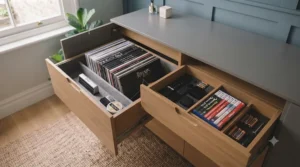
Start with the drawers, not the top. Before the television goes anywhere near the unit, decide what belongs in each drawer and stick to it: one for remotes and small electronics, one for cables and chargers, one for media or games. This sounds obvious, but most of the “my drawers are a mess within a month” complaints in aggregated reviews trace back to skipping this step entirely. Next, route your cables before you push the unit against the wall — feeding an HDMI lead or power cable through a cable-management cut-out after the unit is already in position, fully loaded and flush to the skirting board, is a genuinely miserable ten minutes you can avoid with two minutes of forward planning.
A common first-30-days mistake is overloading the top surface immediately — ornaments, a plant, a second smaller screen — before checking the unit’s actual weight rating for its top surface, which is typically lower than people assume for MDF and engineered wood builds. Finally, if you have young children or pets, this is the moment to fit an anti-tip wall strap, not six months down the line once the unit is fully loaded and awkward to move. Maintenance from here is minimal: a monthly wipe of drawer runners with a dry cloth prevents the dust build-up that eventually causes sticking, and checking cupboard door hinges every few months catches any loosening before it becomes a genuine repair job.
Real-World Scenarios: Which TV Unit Suits Your Living Room?
The first-flat renter. Picture someone in their mid-twenties, moving into a one-bedroom rental with a strict no-drilling clause in the tenancy agreement and a budget that’s already stretched by the deposit. For this scenario, the HOMCOM TV Stand Cabinet (47″) or the vidaXL TV Cabinet Sideboard make the most sense — both are light enough to move without professional help at the end of a tenancy, and neither represents a devastating loss if it picks up a scuff during the next flat-share move.
The growing family. Now picture a household with two young children, a dog, and a living room that doubles as a homework space, a playroom and a place to actually relax in the evening. Durability and stability matter more here than styling. The Vida Designs Arlington or Julian Bowen Cotswold Widescreen both offer the enclosed storage needed to keep small toys and choking-hazard items out of reach, combined with the sturdier build quality that survives daily climbing attempts better than budget MDF units.
The downsizer with an awkward room. Finally, consider someone moving from a house into a smaller flat, bringing a large television but working with an oddly shaped living room where every straight wall is interrupted by a door or window. The GFW Boston Corner TV Unit solves this specific problem better than anything else on our list, reclaiming corner space that a straight-fronted unit simply can’t use.
How to Choose a TV Unit with Chest of Drawers
Picking the right unit comes down to seven practical checks, in roughly this order of priority:
- Measure your TV, not just your wall. Add at least 5–10cm of clearance on either side of your television’s actual width to avoid a cramped, unstable-looking setup.
- Check the weight rating of the top surface. Larger, heavier televisions need units rated to comfortably exceed the TV’s actual weight, not just match it.
- Count the drawers you’ll genuinely use. Two well-sized drawers beat four cramped ones — be honest about what you’re actually storing.
- Confirm cable management provisions. Look for routed channels or cut-outs rather than a single generic hole, particularly if you’re running a soundbar and games console alongside the TV.
- Match the material to your household. Solid wood suits long-term, low-traffic homes; engineered wood and MDF suit renters and households likely to move again within a few years.
- Consider room shape before room style. A corner unit might solve more problems than a beautiful straight-fronted piece that simply doesn’t fit your layout.
- Factor in assembly realistically. If flat-pack construction genuinely isn’t for you, a ready-assembled option justifies its premium in saved frustration alone.
Common Mistakes When Buying a TV Unit with Chest of Drawers
The single most common mistake is buying on width alone and ignoring depth — a unit that’s the perfect length for your wall but too shallow can leave a large modern television dangerously overhanging the front edge. A close second is underestimating how much you’ll actually store: buyers consistently under-plan drawer capacity, then find themselves cramming cables, remotes, coasters and miscellaneous clutter into two drawers designed for one category of item.
Another recurring issue is skipping the anti-tip strap entirely, particularly in homes without young children yet, only to retrofit one later once a toddler starts pulling themselves up on the furniture. Buyers also frequently overlook delivery logistics for ready-assembled units — measuring the final position but not the doorways, stairwells and hallway turns the unit needs to travel through to get there. Finally, colour-matching from a product photo alone is a frequent regret; wood-effect and marble-effect finishes in particular can render several shades lighter or darker in person than they appear on a screen, so checking a physical swatch or in-person sample where possible avoids a colour-clash surprise on delivery day.
✨ Don’t Miss These Exclusive Deals!
🔍 Take your living room storage to the next level with these carefully selected TV units. Click on any highlighted pick above to check current pricing and availability on Amazon UK. These units will help you create the tidy, organised media storage solution your household actually needs!
TV Unit with Chest of Drawers vs Traditional Sideboard
On paper, these two categories overlap enough to confuse most shoppers, but the differences matter once you’re living with either one day to day. A traditional sideboard is typically taller, built primarily for dining rooms and hallways, with cupboard doors dominating the storage and drawers playing a secondary role. A TV unit with chest of drawers, by contrast, is deliberately lower — built to sit comfortably beneath eye level when seated, with drawers doing more of the storage work and the whole silhouette optimised for a television to sit on top.
Height is the decisive factor in most real-world decisions. Sit on your sofa and look at where a screen would need to sit for comfortable viewing without craning your neck up or down — that measurement rules out most sideboards, which tend to run 75–90cm tall against a TV unit’s more typical 40–55cm profile. Cable management is the second major differentiator: sideboards are rarely designed with a television’s cabling in mind, so you’ll often be drilling or routing cables yourself, whereas most purpose-built TV units include cut-outs or channels as standard. Where a sideboard does win out is in cupboard-door capacity for bulkier items like crockery or linens — if general household storage matters more to you than optimised media storage, a sideboard-TV-unit hybrid like the Vida Designs Arlington offers a genuine middle ground between the two categories.
Media Storage Solutions for Small Living Rooms
Small living rooms punish poor furniture choices more than any other room in the house, and media storage is often the worst offender — a bulky, open-shelved unit can make an already tight space feel genuinely cluttered within weeks. The core principle for a small-room media storage solution is enclosed rather than open storage: every item behind a drawer front or cupboard door is one less visual distraction competing for attention in a compact space.
Corner-fit units like the GFW Boston Corner TV Unit deserve particular consideration here, since they reclaim floor space that would otherwise sit empty, effectively adding usable square footage without adding to the room’s visual footprint. Lighter-coloured finishes also genuinely help smaller rooms feel larger — a pale oak or white-finish unit reflects more available light than a dark walnut equivalent, which matters more in north-facing or box-window rooms than most buyers initially consider. Finally, resist the temptation to buy the largest unit that technically fits; in a small room, a slightly undersized unit with well-organised drawers consistently outperforms an oversized one that dominates the space and makes the room feel smaller than it actually is.
Low-Level TV Cabinet with Drawers: Height, Sightlines & Room Fit
The defining feature of a genuinely well-chosen low-level TV cabinet with drawers is that you barely notice the furniture itself — only the television seems to float at the right height. Getting there requires a bit of measuring most buyers skip entirely: sit in your usual viewing spot, measure the height from the floor to your eye line, and work backwards to find a cabinet height that places the television’s centre roughly at or slightly below that mark.
Most low-level units in this category sit between 40cm and 55cm tall, which suits standard sofa heights reasonably well, but taller sofas or armchairs can push the ideal cabinet height lower than the market default. Here’s what the spec sheet won’t tell you: a cabinet that’s technically “low-level” on paper can still create neck strain if your seating is unusually low or unusually high relative to the room’s typical proportions, so it’s worth a genuine tape-measure check rather than trusting a generic height. Reviewers consistently note that units with adjustable feet — several of the seven featured here included — offer a useful few centimetres of fine-tuning to correct for uneven flooring or an imperfect initial height match, which is worth checking for specifically if your room has older, less level floorboards.
Living Room Cable Management Furniture: Taming the Wire Jungle
Cable clutter is the single most avoidable annoyance in modern living rooms, and it’s almost entirely a furniture-selection problem rather than an inevitability. The difference between a TV unit with a single generic cable hole and genuine living room cable management furniture — like the routed channels on the HOMCOM Marble Effect TV Unit — comes down to whether your soundbar, games console and streaming stick cables stay separated and identifiable, or turn into an indistinguishable knot within a month.
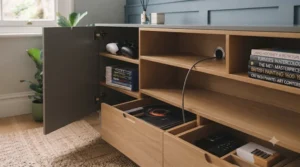
Before buying, count your actual devices: a TV, soundbar, games console and streaming box is already four separate cable runs, and a unit with a single small cut-out will struggle to route that many leads cleanly. Look specifically for units offering either multiple cut-outs or a routed channel system rather than one central hole, since the latter forces every cable through the same pinch point regardless of which piece of equipment it belongs to. Once the unit is in place, a handful of reusable cable ties or a simple drawer-mounted cable box (many buyers repurpose one of the unit’s own drawers for this) keeps everything organised behind the scenes — genuinely useful advice that no Amazon product listing tends to mention, since it’s about how you use the furniture rather than the furniture itself.
Safety, Materials & Regulations Guide
Nearly every unit on this list is built from either MDF, engineered wood, or solid oak — and the differences matter for both durability and safety expectations. As Wikipedia’s overview of medium-density fibreboard explains, MDF is produced by breaking wood residuals down into fine fibre, then binding and pressing them under heat into dense, uniform panels. In practical terms, that makes MDF denser and more consistent than basic particleboard, though it remains more susceptible to moisture damage than solid timber — worth bearing in mind if your unit will sit anywhere near a radiator, a window prone to condensation, or a regularly-watered houseplant.
Stability matters just as much as material choice, particularly in households with young children. RoSPA’s guidance on flat-screen TV safety notes that it has recorded reported fatalities involving televisions falling on babies and young children, and its advice is unambiguous: freestanding televisions should sit on a wide, stable base, ideally reinforced with an anti-tip strap securing the unit to the wall. This applies regardless of price point — a premium solid oak unit and a budget MDF one both need securing if there’s any chance of a child pulling themselves up on the furniture. Finally, when it’s time to move house or simply retire an old unit, most UK councils offer a straightforward route: you can arrange a special collection for large waste items through your local council, with many offering free reuse collections for furniture still in good condition rather than sending it straight to landfill.
Long-Term Cost & Maintenance
The sticker price only tells part of the ownership story. A £70 budget unit that needs replacing within three years due to sagging drawer runners or a warped top surface can end up costing more over a decade than a £350 solid oak piece that’s still going strong. Working out genuine cost-per-year means dividing the purchase price by realistic expected lifespan: engineered wood and MDF units typically deliver five to eight years of solid daily use before wear becomes noticeable, while solid oak pieces like the Julian Bowen Cotswold Widescreen can realistically outlast several house moves, often remaining fully functional for fifteen years or more.
Maintenance costs stay genuinely low across the whole category regardless of material — an occasional wipe-down, periodic hinge and runner checks, and avoiding direct sunlight exposure (which fades finishes unevenly over time) covers the vast majority of upkeep. The main variable cost to plan for is drawer runner replacement on budget units after several years of heavy use, a straightforward and inexpensive DIY fix that extends the unit’s useful life considerably. Taking all of this into account, buyers furnishing a genuinely long-term home often find the higher upfront cost of a solid wood piece pays for itself in avoided replacement cycles, while renters and short-term occupants are usually better served financially by the lower upfront cost of a budget unit they don’t expect to keep for a decade regardless.
FAQ
❓ What's the difference between a TV stand and a TV unit with chest of drawers?
❓ How tall should a low-level TV cabinet with drawers be?
❓ Can a TV unit with chest of drawers hold a large 65-inch TV?
❓ Do I need to secure a TV unit to the wall?
❓ Is MDF or solid oak better for a media unit with drawers?
Conclusion
A TV unit with chest of drawers earns its keep in a way a plain stand simply can’t — it’s the difference between a living room that looks tidy because everything’s hidden away, and one that just looks cluttered no matter how often you tidy up. Whether you land on the budget-friendly HOMCOM TV Stand Cabinet, the corner-solving GFW Boston, or the built-to-last Julian Bowen Cotswold Widescreen, the right choice ultimately comes down to matching material, size and drawer layout to how your household actually lives — not just how the photos look on a product page.
Take the time to measure properly, think honestly about how much you’ll store, and factor in whether you’re furnishing for the next two years or the next fifteen. Get those decisions right, and any of the seven genuine options covered here should serve your living room well for years to come.
Recommended for You
- Wide Sideboard Chest of Drawers: 7 Best Picks for 2026 UK Homes
- Sideboard With Drawers: 7 Best Buys for UK Homes in 2026
- Shoe Storage Chest of Drawers Hallway: 7 Best UK Picks (2026)
Disclaimer: This article contains affiliate links. As an Amazon Associate, I earn from qualifying purchases. If you purchase products through these links, we may earn a small commission at no additional cost to you.
✨ Found this helpful? Share it with your friends! 💬🤗
