
In This Article
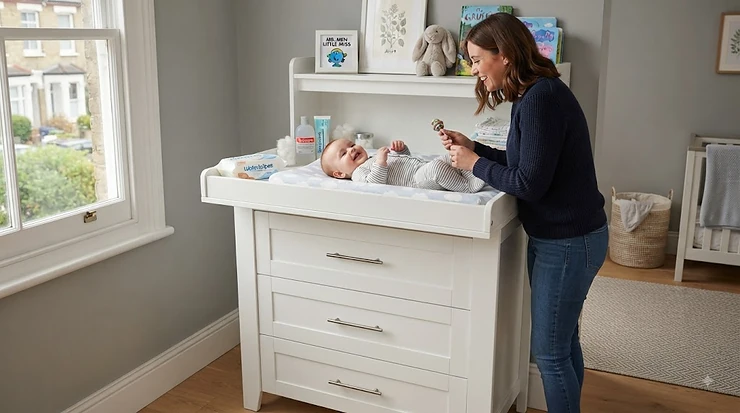
Somewhere around week thirty of pregnancy, most parents-to-be discover a strange truth: the nursery furniture aisle is basically a maze dressed up in Scandi neutrals. You came here looking for a changing table chest of drawers, and that’s a smart instinct — it’s the one piece of nursery furniture that earns its keep for years rather than months. A changing table chest of drawers is simply a standard chest of drawers with a raised, railed top section (sometimes fixed, sometimes removable) that turns it into a safe nappy-changing station, then reverts to ordinary bedroom storage once nappies are history.

Below, we’ve dug into seven genuine options sold in the UK, spanning honest budget builds through to solid wood pieces that’ll outlast the toddler years. Every spec here comes from manufacturer data and aggregated review themes, not guesswork — and every price is shown as a range, since retail pricing shifts weekly. Whether you’re weighing a convertible changing table dresser against a simple cot-top changer, or trying to work out whether a nursery chest of drawers with changer is worth the extra outlay over open shelving, you’ll find the reasoning laid out plainly here. This article contains affiliate links — full disclosure is at the bottom.
Quick Comparison Table
Before the deep dive, here’s the shape of the market at a glance. Weight limits refer to the changing-top surface only, not the drawers.
| Product | Drawers | Changing Top | Best For |
|---|---|---|---|
| Obaby Maya Changing Unit | 3 (34L each) | Removable, up to 80×46.5cm mat | Scandi-style small nurseries |
| WOLTU Baby Changing Unit | 3–4 | Fixed rail surround | Tightest budgets |
| Babymore Universal Chest Drawers | 3 | Removable | First-time buyers wanting balance |
| Ickle Bubba Snowdon Dresser | 3 | Fits 76×46cm mat | Traditional sleigh-style rooms |
| CuddleCo Clara Dresser & Changer | 3 | Fully removable | Classic curved-front look |
| Tutti Bambini Rio Chest Changer | 3 (solid wood) | Removable, rated to ~15kg | Buyers wanting real wood longevity |
| Silver Cross Westport Dresser | 3 (deep) | Integrated, soft-close | Premium, design-led nurseries |
Looking at the spread, there’s a clear line between engineered-wood units built primarily to a price point (WOLTU, Obaby Maya) and solid-wood or heavier-gauge pieces designed to be regular bedroom furniture for a decade (Tutti Bambini Rio, Silver Cross Westport). The middle tier — Babymore, Ickle Bubba, and CuddleCo — is where most UK parents actually shop, because it balances a lower up-front cost against drawers sturdy enough to survive toddlerhood. Note that a “3 drawer” count doesn’t tell you drawer depth or glide quality, which is exactly why we’ve broken each one down individually below.
💬 Just one click — help others make better buying decisions too!😊
Top 7 Changing Table Chest of Drawers: Expert Analysis
1. Obaby Maya Changing Unit — best Scandi-style pick for small rooms
The Obaby Maya Changing Unit leans hard into a clean, two-tone Scandinavian look, and it’s the standout choice if your nursery is more “capsule wardrobe” than “maximalist.” Three 34-litre drawers with recessed handles (no bulky knobs to catch on clothing) give genuinely useful storage for a unit of this footprint, and the changing top accepts mats up to roughly 80 × 46.5cm before lifting off entirely to leave a flat-top chest. Practically speaking, that removable top means the same piece of furniture works in the nursery today and the bedroom in three years — no re-buying, no landfill trip. Based on the spec comparison with similarly sized units, the Obaby Maya sits in an unusually good middle ground: it’s not the cheapest changing table chest of drawers on this list, but it’s built from more substantial board than most units at its price. Reviewers consistently note the recessed-handle drawers glide smoothly even when fully loaded with folded babygrows, and several mention the two-tone finish looking more expensive than its price tag suggests. A recurring theme in aggregated feedback is that assembly, while manageable solo, benefits from a second pair of hands for levelling the changing top securely. This is a strong pick for parents who want their nursery chest of drawers with changer to actually look designed, not just functional, and who are working with a boxier, smaller room where visual bulk matters. Expect a price in the low-to-mid £200s, and given the drawer capacity and the “grows with you” removable top, it represents solid value for money.
Pros:
- ✅ Two-tone Scandi design suits small, minimalist nurseries
- ✅ Recessed handles avoid snagging on clothing
- ✅ Changing top removes cleanly for later use as a dresser
Cons:
- ❌ Assembly is easier with two people
- ❌ Drawer depth is modest compared with solid wood rivals

2. WOLTU Baby Changing Unit — best for the tightest nursery budget
The WOLTU Baby Changing Unit is the entry point on this list, built from MDF and particleboard with a fixed rail surround rather than a removable changing top. What most buyers overlook about budget units like this is that the trade-off isn’t really about the changing function — it’s about what happens to the drawers over three or four years of daily nappy-and-clothes duty. On paper, this means you’re getting genuinely useful storage (three to four drawers depending on the variant) for a fraction of the outlay of solid-wood alternatives, which matters enormously if you’re also budgeting for a cot, pram and car seat in the same few months. Reviewers consistently flag that the unit is straightforward to assemble and does exactly what it says on the box, though a common complaint in user reviews is that the drawer runners feel less substantial than pricier units once the drawers are packed full. The white gloss-effect finish wipes clean easily, which matters more than people expect once weaning-stage mess enters the picture. For a first baby, a tight budget, or a nursery you know you’ll redecorate within a couple of years anyway, the WOLTU makes a rational case for itself: spend less here, spend more on the mattress and car seat, where safety margins matter more. Pricing typically sits under £150, making it one of the most accessible entries into the changing table chest of drawers category.
Pros:
- ✅ Lowest price point in this roundup
- ✅ Simple flat-pack assembly with clear instructions
- ✅ Wipe-clean gloss finish handles daily mess well
Cons:
- ❌ Drawer runners feel less robust under heavy loads
- ❌ Fixed changing top can’t be removed for later dresser use
3. Babymore Universal Style Chest Drawers Nursery Changing Unit — best balance of price and build
The Babymore Universal Style Chest Drawers Nursery Changing Unit is the piece most likely to satisfy parents who refuse to choose between “cheap” and “flimsy.” Three full-width drawers sit beneath a changing surface designed with raised sides for extra security during nappy changes, and the styling is deliberately neutral enough to work in a nursery decorated by anyone, whether that’s a grandparent or a design-obsessed parent. Here’s what to weigh: Babymore has built its reputation on the mid-market segment of UK nursery furniture, and this unit reflects that positioning — drawer glides that feel noticeably more confident than budget MDF units, without the price jump into solid-wood territory. Aggregated review sentiment points to easy self-assembly (most owners report under an hour) and praises the drawer capacity for cot-sized bedding as well as clothing. A theme worth flagging honestly: a handful of buyers note the white finish shows scuffs more visibly than darker woodgrain alternatives, so a soft cloth for wipe-downs is worth keeping nearby. As a straightforward nursery chest of drawers with changer, this is the one we’d point most first-time parents towards if they want dependable mid-range quality without overthinking it. Expect pricing in the £250–£300 range, which lands comfortably as one of the best value-per-drawer options on this list.
Pros:
- ✅ Full-width drawers offer genuinely deep storage
- ✅ Raised-side changing surface adds a security margin
- ✅ Assembly reported as quick even without help
Cons:
- ❌ White finish can show scuffs over time
- ❌ Not solid wood, so long-term durability trails premium picks
4. Ickle Bubba Snowdon 3-Drawer Baby Changing Unit & Dresser — best traditional sleigh-style design
If your nursery leans classic rather than contemporary, the Ickle Bubba Snowdon 3-Drawer Baby Changing Unit & Dresser answers that brief directly with its elegant sleigh-profile silhouette. The three drawers are genuinely deep, and the top is sized to fit a 76 × 46cm changing mat with enough of a lip to keep it from sliding during a squirmy change. The spec sheet won’t tell you this, but user reports suggest the curved sleigh detailing — while visually distinctive — adds a small amount of extra care needed during assembly, since the panels aren’t perfectly rectangular like budget boxy units. Reviewers consistently praise how the traditional design coordinates well with matching Ickle Bubba cot beds and wardrobes, which matters if you’re building a coordinated nursery set rather than buying pieces separately. A common thread in aggregated feedback is genuine surprise at how sturdy the finished unit feels relative to its price point — several reviewers specifically call out the drawer weight capacity as better than expected for clothing and bedding storage. Who should care about this one: parents who want a nursery chest of drawers with changer that reads as “proper furniture” rather than flat-pack utility, and who don’t mind a slightly longer assembly session in exchange for that traditional aesthetic. Pricing generally falls in the £220–£280 range, positioning it as a strong mid-tier value pick with more visual character than most competitors at the same cost.
Pros:
- ✅ Traditional sleigh design coordinates with matching sets
- ✅ Deep drawers with better-than-expected weight capacity
- ✅ Changing top fits standard 76×46cm mats securely
Cons:
- ❌ Curved panels make assembly slightly fiddlier
- ❌ Bulkier footprint than boxier minimalist alternatives
5. CuddleCo Clara 3 Drawer Dresser & Changer — best classic curved-front look
The CuddleCo Clara 3 Drawer Dresser & Changer trades sharp Scandi lines for a softer, classic curvature that CuddleCo describes as “fairy tale” styling — and reviewers do seem to respond to that gentler aesthetic in nurseries designed around a softer colour palette. Three spacious drawers handle babygrows, muslins and nappies without difficulty, and the changing station lifts off cleanly once it’s no longer needed, converting the whole piece into a standalone dresser. Based on the spec comparison with similarly priced units, the Clara distinguishes itself less through raw storage volume and more through finish quality — the white lacquer coating is reported by multiple reviewers as more resistant to yellowing over time than some competitor finishes, which matters if the nursery gets strong natural light. What most buyers overlook about dresser-changers in this price bracket is how much the drawer stop mechanism matters day to day; CuddleCo’s glides are consistently described in aggregated feedback as smooth and quiet, a genuinely useful detail during late-night changes when you don’t want a slammed drawer waking anyone. A fair honesty check: a small number of reviews mention the assembly instructions could be clearer on drawer-front alignment, so patience helps here. For parents wanting a slightly more decorative nursery chest of drawers with changer that still performs the fundamentals well, this is a genuinely strong contender. Prices typically sit in the £300–£350 bracket.
Pros:
- ✅ Classic curved styling suits softer nursery colour schemes
- ✅ Finish reported as resistant to yellowing over time
- ✅ Smooth, quiet drawer glides for night-time changes
Cons:
- ❌ Assembly instructions could be clearer on alignment
- ❌ Sits above the mid-range on price for the storage offered

6. Tutti Bambini Rio Chest Changer — best for solid wood longevity
The Tutti Bambini Rio Chest Changer is where this list moves from engineered board into genuine solid wood construction, and that shift shows up in almost every practical detail. Three large drawers sit in a Slate Grey and Oak (or all-white) finish, with soft-close mechanisms that quietly solve the “3am drawer slam” problem better-known units further down this list can’t fully address. The changing top is rated for use up to roughly 15kg, which in practice extends useful changing life well past the point most flat-top budget units become unsafe for a wriggling toddler. Here’s what to weigh: solid wood costs more upfront, but it doesn’t flex, warp or develop the slightly springy drawer-front feel that some engineered-board units acquire after two years of daily use — reviewers consistently mention the drawers still glide as smoothly at eighteen months of ownership as they did on day one. Tutti Bambini backs the Rio with a three-year guarantee, a detail worth weighing seriously since it signals real confidence in the build rather than marketing gloss. Aggregated review sentiment is notably positive on the finish quality and the sense of “this will last,” with the main honest criticism being that self-assembly, while described as straightforward with numbered parts, does take longer than a basic flat-pack unit simply because there’s more real wood to handle. For parents who see this as an investment piece that’ll serve as a proper bedroom chest for a decade, not just a nursery stopgap, the Rio earns its position near the top of this list. Expect pricing in the £280–£340 range, which is genuinely competitive for solid wood construction.
Pros:
- ✅ Genuine solid wood construction resists warping long-term
- ✅ Soft-close drawers stay smooth well beyond year one
- ✅ Backed by a 3-year manufacturer guarantee
Cons:
- ❌ Assembly takes longer than lighter flat-pack units
- ❌ Heavier overall, so repositioning the finished piece is a two-person job
7. Silver Cross Westport Dresser & Changing Table — best premium, design-led pick
The Silver Cross Westport Dresser & Changing Table sits at the top of this list, and the brand’s century-plus pedigree in British nursery goods shows in the details rather than the marketing copy. Three deep, soft-closing drawers (dimensions roughly W85 × D60 × H93cm) provide genuinely substantial storage, finished in a warm oak-effect with white detailing that reads as considerably more design-conscious than anything else on this list. The integrated changer top includes a proper safety surround for the mat, and — unlike several rivals — the whole unit is engineered as a long-term bedroom centrepiece from day one rather than a nursery-only compromise. Based on the spec comparison, what justifies the premium here isn’t the drawer count (still three, same as most budget units) but the materials and hardware: soft-close runners rated for sustained daily use, and a three-year warranty against manufacturing faults that mirrors what you’d expect from furniture at this price tier. Reviewers consistently highlight the “it doesn’t look like nursery furniture” quality — several specifically mention keeping the piece in a guest room or home office once changing days ended, which is about as strong an endorsement of longevity as a review can offer. The honest counterpoint: this is comfortably the most expensive changing table chest of drawers in this roundup, and buyers on a first-baby budget may reasonably prioritise pram or car seat spend instead. For parents who see nursery furniture as a design investment that should genuinely outlast the nursery years, the Westport is difficult to beat. Pricing generally sits between £500 and £650, positioning it firmly as the premium anchor of this list.
Pros:
- ✅ Design-led finish that outlasts the nursery years visually
- ✅ Soft-close drawers built for sustained daily use
- ✅ Backed by Silver Cross’s 3-year manufacturing warranty
Cons:
- ❌ Highest price point of any unit on this list
- ❌ Overkill if you plan to redecorate again within a couple of years
Top 7 Products: Full Spec Comparison
| Product | Material | Drawer Count | Price Range | Best For |
|---|---|---|---|---|
| Obaby Maya Changing Unit | Engineered wood | 3 | Low-to-mid £200s | Small Scandi nurseries |
| WOLTU Baby Changing Unit | MDF + particleboard | 3–4 | Under £150 | Tightest budgets |
| Babymore Universal Chest Drawers | Engineered wood | 3 | £250–£300 | Balanced value seekers |
| Ickle Bubba Snowdon Dresser | Engineered wood | 3 | £220–£280 | Traditional/sleigh styling |
| CuddleCo Clara Dresser & Changer | Engineered wood, lacquered | 3 | £300–£350 | Classic curved aesthetic |
| Tutti Bambini Rio Chest Changer | Solid wood | 3 | £280–£340 | Long-term solid wood durability |
| Silver Cross Westport Dresser | Wood/oak-effect | 3 (deep) | £500–£650 | Premium, design-first buyers |
Read across the table and a pattern emerges: material, not drawer count, is the real price driver in this category, since every single option here offers three (or occasionally four) drawers regardless of tier. If your priority is pure longevity, the jump from engineered wood to solid wood (Tutti Bambini Rio) or heavy-gauge premium build (Silver Cross Westport) is where your money buys something structurally different, not just cosmetically different. Budget buyers should note that WOLTU sacrifices drawer-runner robustness for its low price, which is a reasonable trade if you’re planning to redecorate within a couple of years anyway.
Practical Usage Guide: Setting Up Your Changing Table Chest of Drawers
Getting the unit into the room is only step one — where and how you set it up matters just as much for day-to-day safety and sanity. Position the unit against an interior wall, away from windows, radiators, and any cords from blinds or baby monitors, since the changing height puts a curious baby’s hands within easy reach of anything nearby. Fit a properly sized changing mat with raised, curved edges (see our dedicated changing mat section below) rather than assuming any flat pad will do, and always use the integrated safety strap even when you’re confident your newborn “can’t move yet” — mobility milestones arrive faster than most parents expect. During the first thirty days, the most common mistake is under-stocking the top drawer: fill it with nappies, wipes, cream and a spare outfit so you genuinely never need to step away mid-change. For maintenance, wipe the changing top surface after every use with a baby-safe antibacterial spray, and give drawer runners an occasional check for grit or fluff build-up, which is the leading cause of sticky drawers on engineered-wood units. If your unit has a removable top (most on this list do), keep the original fixing screws in a labelled bag — you’ll want them again in a year or two when it’s time to convert your nursery chest of drawers with changer back into an ordinary dresser.

Real-World Scenarios: Matching a Unit to Your Family
The first-time parents on a tight budget, small flat, London postcode. With every spare pound going toward a car seat and pram, the WOLTU Baby Changing Unit or Obaby Maya Changing Unit makes rational sense — both deliver functional drawer storage and a safe changing surface without competing with bigger-ticket safety essentials for budget.
The family expecting a second baby, wanting furniture that lasts. Parents who already know they’ll use this unit for years, potentially across multiple children, are better served by the Tutti Bambini Rio Chest Changer or CuddleCo Clara Dresser & Changer — the drawer mechanisms and finishes are built to survive a second round of daily use.
The design-conscious parents furnishing a forever home. For a nursery that’s meant to double as a guest room or home office within a few years, the Silver Cross Westport Dresser justifies its price by looking like considered furniture from day one, not a temporary nursery fixture.
Problem → Solution: Common Nursery Storage Headaches
Even the best changing table chest of drawers can’t fix everything on its own — but pairing the right unit with the right habits solves most of the recurring frustrations parents report. Problem: nappies and wipes always end up out of arm’s reach mid-change. Solution: dedicate the top drawer entirely to changing essentials and never let it double as general clothing storage. Problem: drawers become a jumbled mess within weeks. Solution: use simple fabric dividers or small baskets inside each drawer — this works especially well in the deeper drawers on the Babymore and Tutti Bambini Rio. Problem: the unit feels tight for a growing wardrobe of 0–12 month clothing. Solution: choose a wider-bodied convertible nursery storage piece like the Silver Cross Westport rather than a compact unit if you know gifted clothing volume will be high. Problem: the changing top feels unstable during an active change. Solution: check that raised safety sides are present (as on the Babymore and Ickle Bubba Snowdon) and that the mat itself has a non-slip base. Problem: worrying about what happens once nappies stop. Solution: buy specifically for a removable-top convertible changing table dresser from the outset — every unit on this list except the WOLTU converts cleanly into a standalone chest, protecting your investment for years beyond the changing stage.
✨ Don’t Miss These Exclusive Deals!
🔍 Take your nursery shopping to the next level with these carefully compared picks. Click through on any highlighted product to check current pricing and availability, and build an authentic, practical nursery your family will actually love using every single day!
How to Choose a Changing Table Chest of Drawers
Choosing the right unit comes down to weighing seven practical criteria against your specific nursery and budget, rather than chasing the prettiest photo online.
- Measure your space first. A unit like the Silver Cross Westport at roughly 85cm wide needs real floor space; a boxier unit like the Obaby Maya suits tighter rooms.
- Decide if you need a removable top. If long-term dresser use matters to you, prioritise units where the changing surface detaches cleanly, which is most options here bar the fixed-top WOLTU.
- Check the weight rating on the changing surface. Higher-rated tops, such as the Tutti Bambini Rio‘s roughly 15kg limit, extend how long you can safely use the unit for changes.
- Assess drawer depth, not just drawer count. Three deep drawers (Babymore, Silver Cross Westport) often out-store four shallow ones.
- Match the material to your budget honestly. Solid wood costs more but resists the warping and sticking that engineered board can develop after a couple of years of heavy use.
- Look for safety-rail or raised-side changing tops. This single feature meaningfully reduces roll-off risk during an active nappy change.
- Factor in assembly complexity. If you’re setting up solo before a due date, simpler flat-pack units (WOLTU, Obaby Maya) will save you time and frustration compared with heavier solid-wood pieces.
Convertible Changing Table Dresser vs Fixed Changing Table
A convertible changing table dresser — the category every product in this article belongs to — differs meaningfully from a simple fixed or freestanding changing table, and the distinction is worth understanding before you buy either. A fixed changing table (often just a cot-top changer or a basic open-shelf stand) is typically cheaper and lighter, designed purely for the changing function with little to no drawer storage. A convertible changing table dresser, by contrast, is engineered from the outset to serve two full life stages: several years of active nappy changing, followed by years more as ordinary bedroom storage once the top is removed. The financial logic tends to favour the convertible route for most UK families, since you’re essentially buying one piece of furniture that does the job of two, avoiding a second purchase (and a second delivery, and a second assembly session) once nappies are behind you. The trade-off is upfront cost and floor space — a dedicated cot-top changer like those from Obaby’s open-shelf range costs meaningfully less and takes up less room, which matters in genuinely tiny nurseries. If your priority is long-term value and you have the floor space, a nursery chest of drawers with changer like the Tutti Bambini Rio or CuddleCo Clara wins on total cost of ownership; if space or upfront cash is the binding constraint, a simple fixed unit remains a legitimate, lighter-footprint choice.
Common Mistakes When Buying a Nursery Chest of Drawers With Changer
The most frequent error we see is buying purely on aesthetics without checking the changing-top weight rating, which quietly caps how long the unit stays useful for its primary job. A second common mistake is underestimating drawer depth requirements — parents often assume “three drawers” automatically means ample storage, then discover six months in that bulky 6–12 month clothing barely fits. Third, many buyers skip checking whether the changing top is genuinely removable versus merely “designed to look flat once unused,” which matters enormously if converting the piece into standard bedroom furniture is part of your plan. Fourth, it’s easy to underestimate delivery and assembly logistics for heavier solid-wood pieces like the Tutti Bambini Rio or Silver Cross Westport — both typically arrive in multiple boxes and benefit from being assembled in the room they’ll live in, since manoeuvring a finished unit through doorways afterwards can be genuinely difficult. Finally, some parents skip anchoring the finished unit to the wall, assuming a low, wide chest of drawers doesn’t pose a tip-over risk the way a tall wardrobe might — but any furniture a toddler can climb should be secured, a point UK safety guidance consistently reinforces.
Baby Changing Unit: Features That Actually Matter (And Those That Don’t)
Marketing copy for any given baby changing unit tends to lean hard on finish colour and styling language, but several genuinely functional features deserve more attention than they usually get. Soft-close drawer mechanisms matter far more than they sound — beyond the obvious noise reduction, they meaningfully reduce pinched-finger risk once your child is mobile and curious about every drawer in the house. A raised or railed changing surface with a proper lip matters enormously for safety, more so than the mat’s colour or pattern. A weight-rated changing top matters because it directly determines how many months of active use you’ll get before you need the mat on the floor instead. Conversely, drawer handle style is almost entirely cosmetic and shouldn’t influence your decision meaningfully — recessed handles look sleeker but function identically to knobs in daily use. Similarly, the number of colour options a brand offers tells you nothing about build quality, and “solid wood veneer” language on product listings is worth reading carefully, since veneer over engineered board behaves very differently from genuine solid wood construction like that used in the Tutti Bambini Rio.
Safety, Regulations & Compliance Guide for UK Nursery Furniture
UK nursery furniture sold today sits under a genuinely protective regulatory framework, and it’s worth understanding the basics rather than assuming “it’s for sale, so it must be fine.” Upholstered nursery items fall under the Furniture and Furnishings (Fire) (Safety) Regulations, recently amended in 2025 to specifically exclude certain baby products from scope while tightening enforcement elsewhere — worth a skim if you’re buying secondhand upholstered nursery pieces, since older stock may predate current labelling rules. Beyond fire safety, general child-safety guidance is unambiguous on one point that applies directly to every product in this article: never leave a baby unattended on a raised changing surface, even for a moment, even with the safety strap fastened, a principle reinforced by NHS family health services. Falls from raised surfaces remain a leading cause of preventable injury in young children, and UK child-safety charities specifically flag cots, beds, and changing tables as risk points requiring constant supervision in their published falls-prevention guidance. Practically, that means keeping one hand on your baby throughout every single change, pre-stocking supplies within arm’s reach before you begin, and anchoring the finished chest of drawers to the wall using the fixing kit included with most units — a five-minute job that meaningfully reduces tip-over risk once your child starts pulling up on furniture to stand.
Long-Term Cost & Maintenance of Your Nursery Furniture
Thinking about a changing table chest of drawers purely in terms of purchase price misses most of the real cost picture, since good nursery furniture is designed to serve double duty across several years. Run a simple cost-per-year calculation: a £600 Silver Cross Westport used actively for eighteen months of changing, then a further eight years as bedroom storage, works out to roughly £63 a year — genuinely competitive against a £150 budget unit that needs replacing after three years because the drawer runners have failed. That said, this maths only holds if the unit is genuinely built to last, which is precisely why material and hardware quality matter more than sticker price alone. Maintenance costs stay low across every option on this list: an occasional wipe-down, tightening loose drawer-front screws every year or so, and keeping runners free of dust are the main ongoing tasks. Solid wood pieces like the Tutti Bambini Rio may benefit from an occasional application of furniture wax to the exposed wood edges, while lacquered or engineered-wood finishes like the CuddleCo Clara need nothing beyond a damp cloth. The genuine long-term cost trap to avoid is buying a fixed-top unit like the entry-level WOLTU with the mistaken assumption it’ll convert to standard furniture later — check removability before you buy if resale or repurposing value matters to your household budget.
Choosing the Right Baby Changing Mat for Your Unit
A baby changing mat is arguably the single most-used nursery accessory, and pairing the right one with your chosen unit matters more than most buying guides acknowledge. Measure your changing top’s rail dimensions before buying a mat — most units in this roundup accept mats in the 70–80cm length range, but a mat that’s too small can shift dangerously during an active change, while one that’s oversized won’t sit flush within the safety rails. Look for a mat with genuinely raised, curved edges rather than a flat foam pad, since the curve is what actually helps prevent rolling, alongside always using the integrated strap. Wipe-clean vinyl or PU-coated mats remain the practical default for daily nappy changes, since fabric-covered alternatives, while softer, absorb moisture and odour over time in a way that’s harder to keep genuinely hygienic. If your chosen unit — such as the Ickle Bubba Snowdon or Tutti Bambini Rio — specifies a particular mat size in its listing, buying to that exact spec avoids the fiddly experience of a mat that constantly slides on a surface it wasn’t designed for.
Convertible Nursery Storage: Getting More Life From One Purchase
The broader idea of convertible nursery storage — furniture engineered to serve multiple life stages rather than a single narrow purpose — is where genuine long-term value in this category comes from. Every unit on this list except the fixed-top WOLTU follows this convertible logic: changing station first, standard chest of drawers second, with zero structural changes required beyond unscrewing the top rail. This matters financially in a way that’s easy to underweight when you’re deep in first-trimester nursery planning and every purchase feels urgent. A single £300 convertible piece that serves eighteen months of active changing duty and then a further decade as bedroom storage genuinely outperforms buying a cheap dedicated changing table now and a separate chest of drawers in three years’ time, both in raw cost and in the hassle of a second delivery and disposal of the first item. When comparing convertible nursery storage options, prioritise units — like the Babymore Universal Chest Drawers or CuddleCo Clara — where the manufacturer explicitly confirms tool-free or simple-tool top removal, since some budget listings use “convertible” language loosely without a genuinely clean conversion process.
FAQ
❓ What age do you stop using a changing table chest of drawers?
❓ Is a changing table chest of drawers worth it over a simple cot-top changer?
❓ Can you use any changing mat on a nursery chest of drawers with changer?
❓ Do I need to anchor a baby changing unit to the wall?
❓ What's the difference between a convertible changing table dresser and a normal dresser?
Conclusion
There’s no single “best” changing table chest of drawers — only the best match for your nursery’s size, your budget, and how long you want the piece to serve your family. If you’re working with a genuinely tight budget and a small first nursery, the WOLTU Baby Changing Unit or Obaby Maya Changing Unit get the fundamentals right without overspending. Parents wanting dependable mid-range quality with room to grow should look hard at the Babymore Universal Chest Drawers, Ickle Bubba Snowdon Dresser, or CuddleCo Clara Dresser & Changer — all three balance price and build sensibly. And for households treating this as genuine long-term furniture rather than a temporary nursery fixture, the Tutti Bambini Rio Chest Changer brings real solid-wood durability at a surprisingly reasonable price, while the Silver Cross Westport Dresser sits at the top for parents who want design-led furniture that quietly outlasts the nursery years entirely. Whichever nursery chest of drawers with changer you land on, prioritise a proper weight-rated changing top, genuinely removable design if longevity matters to you, and always anchor the finished piece to the wall. Nappy days are famously short — good furniture shouldn’t be.
Recommended for You
- Smart Bedroom Chest with Wireless Charging: 7 Real UK Picks
- Backlit Mirror Chest of Drawers: 7 Best Illuminated Picks 2026
- 7 Best Storage Bench with Drawers for Bedroom Picks
Disclaimer: This article contains affiliate links. As an Amazon Associate, I earn from qualifying purchases. If you purchase products through these links, we may earn a small commission at no additional cost to you.
✨ Found this helpful? Share it with your friends! 💬🤗
