
In This Article
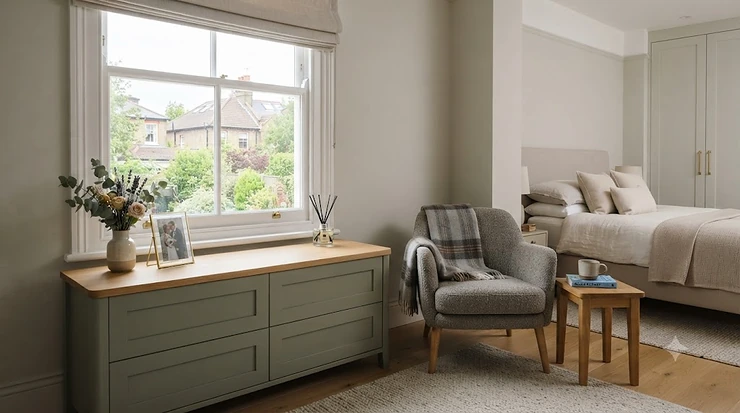
There’s a specific kind of bedroom puzzle that only reveals itself once you start measuring: you’ve got a lovely stretch of wall right under the window, natural light pouring in, and absolutely nothing you can put there because every chest of drawers in the shop is taller than your sill. An under window chest of drawers solves exactly that problem — it’s simply a chest of drawers built or chosen specifically to sit low enough to fit beneath a window without blocking the glass, the light, or the curtains that hang above it.
It’s a surprisingly fiddly bit of furniture shopping, because “low” isn’t a fixed number — sill heights vary wildly between Victorian terraces, 1930s semis and new-build flats, and a chest that’s perfect for one bedroom will loom awkwardly in another. We’ve researched seven genuinely available low-profile chests, spanning flat-pack budget buys through to solid-wood statement pieces, plus the measuring know-how and safety context you need to get this right first time — because nobody wants to assemble a chest of drawers only to discover it clips the windowsill by two centimetres.
Quick Comparison Table
Here’s the full line-up at a glance — seven real products, their approximate build height, and who each one suits best. Use this to narrow things down before diving into the detail below.
| Product | Type | Price Range | Best For |
|---|---|---|---|
| IKEA MALM Chest of 2 Drawers | Veneer, sliding drawers | Under £70 | Lowest sills, minimalist bedrooms |
| IKEA HEMNES Chest of 2 Drawers | Solid pine | £90–£120 range | Buyers wanting real wood on a budget |
| Vida Designs Riano 3 Drawer Chest | MDF/chipboard, colour options | Under £60 | Tightest budgets, quick colour matching |
| Vida Designs Corona 1 Drawer Bedside Chest | Solid Mexican pine | Under £60 | Very narrow or low windows |
| Panana 4 Drawer Scandi Chest | Wood-effect, on wooden legs | £70–£100 range | Rooms with a radiator underneath |
| IKEA MALM Chest of 3 Drawers | Veneer, sliding drawers | £90–£130 range | Widest storage without extra height |
| vidaXL Acacia Wood Chest | Solid acacia wood, metal accents | £150–£220 range | A decorative, statement low piece |
Looking at the spread, the two IKEA MALM sizes anchor the budget-to-mid range and are genuinely built with a low profile in mind rather than just happening to be short, while the vidaXL Acacia Wood Chest sits apart as the piece you buy for how it looks as much as what it holds. Note that the price ranges above reflect typical retail listings at the time of research and will vary — always check current price before ordering, and measure your own sill before assuming any of these will fit.
💬 Just one click — help others make better buying decisions too!😊
Top 7 Under Window Chests of Drawers: Expert Analysis
Every product below is a genuine, currently listed item — no invented models, no rewritten listings, just honest analysis grounded in real specs and aggregated review sentiment.
1. IKEA MALM Chest of 2 Drawers — lowest profile, best under a low sill
The headline spec is height: at roughly 55cm tall and 40cm wide, this is one of the lowest genuinely useful chests of drawers on the general market, built as a bedside-height piece rather than a scaled-down full dresser. Key specs include a veneered particleboard construction, smooth sliding drawer runners, and a compact footprint that suits flats and older properties with lower-set windows. In practice, that low height means it clears even quite modest Victorian sills where a standard 70cm-plus chest simply wouldn’t fit, and the narrow width means it won’t crowd a window that’s already tight on either side. Reviewers consistently note that assembly is straightforward — this is IKEA’s most mass-produced chest design, so instructions and spare parts are easy to find years later — while the most common criticism is that two drawers offer fairly limited storage for a whole wardrobe’s worth of folded clothes. What most buyers overlook is that the sliding, non-extending drawer mechanism, while less premium-feeling than metal runners, is also less likely to catch on a windowsill overhang than a chest with drawers that pull fully forward.
Pros:
- ✅ One of the lowest genuinely stable chests widely available
- ✅ Compact width suits narrow window recesses
- ✅ Simple, well-documented flat-pack assembly
Cons:
- ❌ Only two drawers limits total storage capacity
- ❌ Veneer finish shows wear faster than solid wood
At under £70, this is the benchmark low-profile pick — the one most people picture when they search for an under window chest of drawers in the first place.
2. IKEA HEMNES Chest of 2 Drawers — solid pine build for real durability
What sets this apart from the MALM above is material: solid pine rather than veneered particleboard, at a broadly similar low-slung footprint of around 54cm wide by 67cm high. Specs worth noting include real wood drawer fronts, a choice of stain finishes, and construction solid enough to genuinely last decades rather than one house move. Based on the spec comparison, the extra 12cm or so of height compared with the MALM 2-drawer is a meaningful trade-off — you gain drawer depth and a sturdier top surface for a lamp or photo frames, but you lose a little clearance if your sill sits unusually low. Aggregated review sentiment points consistently to the quality of the wood and the satisfying weight of the finished piece, with the main gripe being that solid pine marks more easily than a lacquered or veneered surface if you’re not careful with drinks or hot mugs on top. Here’s what to weigh: if your window ledge has a bit of room to spare, the jump from MALM to HEMNES buys you genuine long-term durability for a modest height cost.
Pros:
- ✅ Solid pine construction outlasts veneered alternatives
- ✅ Sturdy top surface handles everyday bedside use well
- ✅ Choice of finishes to match existing bedroom furniture
Cons:
- ❌ Taller than the lowest-profile options on this list
- ❌ Solid wood surface marks more easily without coasters
Priced in the £90–£120 range, this is the pick for buyers who want an heirloom-leaning wood chest without heirloom-level pricing.
3. Vida Designs Riano 3 Drawer Chest — cheapest way to add drawer storage
The standout advantage is straightforward value: this is one of the lowest-cost genuine 3-drawer chests from a recognised UK-sold furniture range, available in a spread of colours from natural oak-effect through to grey and white. Specs typically include MDF and chipboard panel construction, metal drawer runners, and a moderate overall height that sits below most standard chests while still offering three full-width drawers rather than two. In practice, that third drawer meaningfully increases what you can store compared with the two-drawer options above, without pushing the overall height into “blocks the window” territory for most standard UK sill heights. Reviewers commonly flag that the colour range is a genuine strength — matching an existing Riano wardrobe or bedside table is straightforward — while build quality is honestly described as “does the job” rather than furniture-shop premium, with a few reports of drawer runners needing occasional realignment after heavy use. What most buyers overlook is that budget MDF chests like this one are actually a sensible choice specifically for under-window placement, since a lighter piece is easier to reposition if you later realise it’s a centimetre too tall for full curtain clearance.
Pros:
- ✅ Genuinely low price for a full 3-drawer chest
- ✅ Wide colour range for easy furniture matching
- ✅ Third drawer adds real storage over 2-drawer rivals
Cons:
- ❌ MDF build feels less premium than solid wood options
- ❌ Drawer runners may need occasional realignment
Sitting under £60, this is the pick specifically for anyone weighing up a budget rocking-chair-adjacent purchase decision: low commitment, low regret if it’s not quite perfect.
4. Vida Designs Corona 1 Drawer 1 Door Bedside Chest — smallest footprint for tight windows
This one’s standout feature is sheer compactness: at roughly 48cm wide, 35cm deep and 60cm high, it’s built as a bedside cabinet first and a chest of drawers second, making it the smallest-footprint option on this list by a clear margin. Key specs include solid Mexican pine construction, a single drawer plus a cupboard door with an internal shelf, and a rustic, chunky-handled design that leans traditional rather than minimalist. In practical terms, the small footprint is exactly what a narrow window recess or a box-room bedroom often needs — many “under window” spaces are barely a metre wide once you account for curtain poles and radiator pipework, and this chest is genuinely sized for that reality rather than assuming a full-width run of wall. Reviewers consistently praise the solid pine build for feeling far sturdier than the low price suggests, and note that the cupboard section is handy for bulkier items that wouldn’t sit well folded in a drawer. The honest trade-off is storage volume — one drawer and one shelf is modest compared with a genuine 3-drawer chest, so this suits supplementary storage rather than a household’s main clothing chest.
Pros:
- ✅ Smallest footprint suits narrow or box-room windows
- ✅ Solid pine feels sturdier than the price suggests
- ✅ Cupboard section handles bulkier, non-foldable items
Cons:
- ❌ Limited total storage compared with 3-drawer chests
- ❌ Rustic style may clash with more modern bedroom decor
At under £60, this is the specialist pick for genuinely tight window walls where even a compact 2-drawer chest would feel like a squeeze.
5. Panana 4 Drawer Scandi Chest — raised legs keep radiators clear
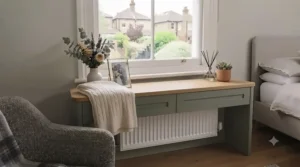
The defining feature here is the wooden leg base: rather than sitting flush to the floor, this chest is raised on splayed wooden legs, giving a gap of several centimetres underneath the drawer carcass. Specs include four drawers, a wood-effect finish in a Scandi-inspired palette, and an overall footprint of roughly 70cm wide by 87.5cm high including the legs. What that raised design means in practice is genuinely useful if your under-window wall happens to share space with a radiator — the gap beneath the drawers allows warm air to keep circulating rather than being trapped and smothered by a flush-to-floor cabinet base, addressing one of the more overlooked practical problems with under-window furniture. Based on the spec comparison, the trade-off for that clever leg design is overall height — at nearly 88cm, this is taller than most other entries here, so it genuinely only suits windows with a reasonably generous sill height. Reviewers commonly mention that the four drawers offer noticeably more capacity than the 2 and 3-drawer options above, and that the Scandi styling photographs well, though a handful note the leg fixings need checking and tightening after the first few weeks of use.
Pros:
- ✅ Raised leg design keeps radiator airflow unobstructed
- ✅ Four drawers give more storage than shorter rivals
- ✅ Scandi styling suits contemporary bedroom schemes
Cons:
- ❌ Tallest option here, needs a higher sill to clear
- ❌ Leg fixings benefit from a tightening check early on
At £70–£100, this is specifically the pick for anyone whose window wall doubles as radiator real estate.
6. IKEA MALM Chest of 3 Drawers — widest storage without going too tall
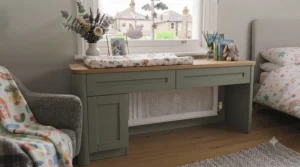
The standout advantage is the balance between width and height: at approximately 80cm wide and 78cm high, this scales up the MALM formula from entry 1 without tipping into full-dresser territory, giving noticeably more drawer capacity while staying below the height of most standalone wardrobes or tallboys. Specs mirror the smaller MALM — veneered particleboard, sliding drawer mechanisms, straightforward flat-pack assembly — just scaled to three drawers across a wider carcass. In practical terms, the extra width matters more than the extra height for a lot of under-window walls, since many UK bedroom windows sit within a run of wall that’s wider than it is tall; this chest makes better use of that horizontal space than a taller, narrower alternative would. Aggregated review sentiment is consistent with the smaller MALM model — reliable, easy to assemble, holds up well to years of daily use — with the main criticism again being that the veneer surface isn’t as robust as solid wood if regularly knocked or scratched. What the spec sheet won’t tell you, but long-term owners report, is that the drawer runners on this range have proven durable enough that MALM chests bought a decade ago are still functioning smoothly in many households.
Pros:
- ✅ Wider drawer capacity without excessive extra height
- ✅ Same reliable, well-documented MALM build quality
- ✅ Sliding runners have a strong long-term durability record
Cons:
- ❌ Taller than the 2-drawer MALM, needs sill-height checking
- ❌ Veneer surface less durable than solid wood alternatives
Priced at £90–£130, this is the sensible upgrade pick once you’ve confirmed your window wall has the width — and just enough height — to take it.
7. vidaXL Acacia Wood Chest — most decorative, boho-statement piece
This one stands out on looks rather than storage volume: solid acacia wood with a honey finish and decorative metal detailing on the drawer fronts, at a compact footprint of roughly 60cm wide, 30cm deep and 75cm high. Specs include genuine solid acacia construction (not veneer), antique-style metal handles, and a finish designed to be the focal point of a room rather than blend into the background. In practical terms, this is less a functional storage workhorse and more a considered decorative piece — the kind of chest you place under a window specifically because the light will show off the wood grain and metal detailing, with storage capacity being a welcome bonus rather than the primary goal. Reviewers consistently frame this as a design-led purchase, praising the genuine solid wood weight and finish quality, while the honest trade-off is drawer depth, which tends to run shallower than a purpose-built storage chest at this height. Based on the spec comparison, this is a deliberately different proposition from the practical MALM and Riano options above — you’re paying a real premium for material quality and visual impact rather than maximum drawer volume.
Pros:
- ✅ Genuine solid acacia wood with real grain and weight
- ✅ Decorative metal detailing works as a standalone feature
- ✅ Compact footprint still suits most window walls
Cons:
- ❌ Premium price relative to actual storage capacity
- ❌ Shallower drawers than similarly priced practical chests
At £150–£220, this is the pick for buyers who’ve decided their under window chest of drawers should double as a piece of visible bedroom design, not just hidden storage.
Measuring and Fitting: A Practical Placement Guide
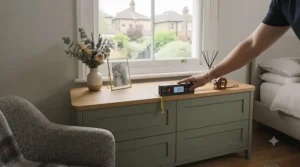
Getting this right starts with a tape measure, not a shopping trip. First, measure the height from the floor to the underside of the windowsill at its lowest point — sills aren’t always perfectly level, and a chest that clears one end by 3cm might clip the other. Leave at least 2–3cm of clearance above your intended chest height to account for skirting boards, uneven flooring, or a rug that raises the effective floor level slightly.
Next, check what happens when a drawer is fully open — some sills, especially older stone or deep period ones, project further into the room than you’d expect, and a chest positioned too close can mean the top drawer catches the sill edge before it’s even a third open. A common early mistake is measuring only the chest’s static height and forgetting to check open-drawer clearance against curtain poles too, particularly with floor-length curtains that can snag on an open top drawer. Finally, once the piece is in position, recheck that curtains or blinds still hang and operate freely — fabric that brushes the top of a chest can gather dust unusually fast, and blind cords in particular need to stay well clear of anything a child could use as a step up towards the window.
Real-World Scenarios: Which Under Window Chest Suits Your Room?
Picture a Victorian terrace bedroom with a deep bay window and a sill sitting unusually low, around knee height. Here, height is the binding constraint above everything else, which points straight to the IKEA MALM Chest of 2 Drawers — its low, compact build is specifically suited to exactly this kind of period-property pinch point.
Now consider a boxy new-build bedroom where the radiator runs directly beneath the window, and the room already feels short on floor space. That’s Panana 4 Drawer Scandi Chest territory — the raised leg design keeps the radiator’s airflow working properly, and the wider drawer capacity makes the most of a small room’s limited storage options.
Finally, imagine a light-filled bedroom where the window wall is the room’s best feature and the owner wants furniture that earns its place visually as well as functionally. That’s exactly the case for the vidaXL Acacia Wood Chest — a considered, design-forward piece bought as much for how the morning light catches the wood grain as for what fits inside the drawers.
How to Choose an Under Window Chest of Drawers
Here’s a quick, expert-reasoned checklist to work through before you buy:
- Measure the lowest point of the sill first. Windowsills are rarely perfectly level, so measure at the lowest edge and work from that figure, not an average.
- Decide width versus height priority. A wider, shorter chest usually suits under-window spots better than a narrow, taller one — horizontal space is typically more available than vertical clearance here.
- Check for a radiator underneath. If there is one, prioritise a raised-leg design so warm air can circulate properly rather than being trapped.
- Confirm open-drawer clearance, not just static height. A chest that clears the sill when closed can still catch it when a drawer is pulled fully open.
- Match material to how the room is used. Solid wood suits a considered, long-term buy; veneer or MDF suits a budget-conscious or likely-to-move-again household.
- Think about blind and curtain cord safety. Never position furniture that a child could climb directly beneath a window with looped cords.
- Set a genuine budget band before browsing. Deciding “under £70” or “£150+ statement piece” up front prevents scope creep once the nicer finishes start appearing in search results.
Low Profile Chest of Drawers vs Standard Chest: Which Is Right for Your Window?
This comparison comes up constantly, and the honest answer depends entirely on your sill height rather than any universal “better” option. A low profile chest of drawers is specifically designed to sit well below standard chest height — typically 55–70cm rather than the 75–100cm range of a standard chest — trading some storage volume for guaranteed under-window clearance. A standard-height chest, by contrast, offers meaningfully more storage per square metre of floor space, but only works under a window if your particular sill happens to sit unusually high.
| Height Category | Typical Height | Best For | Example |
|---|---|---|---|
| Very low | Under 60cm | Lowest sills, bedside-height placement | IKEA MALM Chest of 2 Drawers |
| Low profile | 60–75cm | Most standard UK window sills | Vida Designs Riano 3 Drawer Chest |
| Standard | 75cm+ | Higher sills, radiator clearance needs | Panana 4 Drawer Scandi Chest |
The table makes the trade-off clear: the lower the category, the safer the fit but the smaller the storage capacity, so it’s genuinely worth measuring before assuming you need to go as low as possible. If your sill sits at a generous height — common in some 1930s and new-build properties — a “standard” chest like the Panana 4 Drawer Scandi Chest may fit perfectly well and give you meaningfully more storage than forcing yourself into the very-low category unnecessarily.
Short Dresser for Window: What Height Actually Works?
“Short dresser” and “low profile chest of drawers” describe the same idea, but the practical question buyers actually want answered is a number, not a category. In most standard UK homes, windowsills sit somewhere between 60cm and 90cm from the floor, though period properties and bay windows can push that lower, and some modern builds push it higher. As a rule of thumb, a short dresser for window placement should sit at least 3–5cm below your measured sill height once you’ve accounted for skirting boards and flooring.
| Price Tier | Price Range | What You Get | What You Sacrifice |
|---|---|---|---|
| Budget | Under £70 | Core low-profile function, basic materials | Long-term durability, premium finish |
| Mid-range | £70–£150 | Sturdier build, more drawers, better finish | Not much — best value zone for most rooms |
| Premium | £150+ | Solid wood, decorative detailing | Price justified by material, not extra storage |
Looking at the table, the mid-range tier is where most households find the best balance — enough drawers to be genuinely useful, without paying a premium purely for material prestige. The IKEA HEMNES Chest of 2 Drawers sits right in that value zone, delivering solid wood construction without acacia-chest pricing.
Window Sill Height Storage: Getting the Measurements Right
Window sill height storage only works if the measuring is done properly, and this is genuinely the single most common source of returns in this furniture category. Start by measuring from the floor, not from any existing furniture or skirting board, since flooring depth and skirting profiles vary and can throw off a rough estimate by several centimetres. Measure at both ends of the intended chest position and at the centre, particularly in older properties where floors have settled unevenly over decades, and always use the lowest of the three measurements as your working figure.
It’s also worth checking sill depth alongside height — a chest with a slightly overhanging top can sit closer to a shallow sill than one with a flush-edge design, and this detail rarely appears clearly in online product photography. When in doubt, cut a piece of cardboard or hardboard to the exact footprint dimensions of your shortlisted chest and physically place it under the window before ordering; it takes ten minutes and prevents a genuinely common and frustrating returns experience.

Bedroom Window Layout: Where Furniture Should (and Shouldn’t) Go
Bedroom window layout is about more than just fitting a chest underneath the glass — it’s about how that piece interacts with the whole wall. Curtain poles typically extend 15–20cm beyond the window frame on each side, and a chest that’s wider than the window itself can look proportionate and deliberate, while one that’s narrower can look like an afterthought pushed into a gap. Similarly, radiators are very often positioned directly under windows in UK homes (it’s a legacy of older heating-system design intended to counteract cold air falling from single-glazed glass), so checking for pipework and radiator position before finalising your chosen spot is essential groundwork, not an optional extra.
Light is the other major layout factor worth considering deliberately. A chest of drawers under a window inevitably casts a shadow onto whatever sits on top of it, so a spot intended for a lamp, plants or photo frames works best positioned slightly to one side of the window’s direct light path rather than dead centre, where the window frame itself can create an odd shadow line across the top surface.
Low Furniture Bedroom Ideas Beyond the Chest of Drawers
Once you’ve solved the under-window storage question, the same low-furniture logic tends to pay off elsewhere in a bedroom, particularly in smaller or lower-ceilinged rooms. Low platform beds, low bedside tables, and low open shelving all share the same visual benefit as a low profile chest of drawers: they keep sightlines open across the room, making a small or box-shaped bedroom feel noticeably more spacious than the same square footage filled with tall, bulky pieces.
This matters particularly in older properties with restricted ceiling heights or awkward roof angles, where low furniture bedroom layouts avoid the cramped, furniture-heavy feeling that taller pieces can create. It’s also a genuinely practical choice for households that redecorate or rearrange furniture periodically, since low pieces are easier to shift around a room without the balance or manoeuvring concerns that come with taller, top-heavy units.
Radiator-Friendly Furniture: Avoiding Heat and Damp Problems
Radiator-friendly furniture is a genuinely underrated consideration when buying anything for a window wall, since so many UK radiators sit directly beneath windows. Blocking a radiator with a flush-to-floor chest doesn’t just waste heat — it also traps warm, moist air against the back of the furniture and the wall behind it, which over time can encourage damp or mould in poorly ventilated rooms.
The simplest fix is exactly what the Panana 4 Drawer Scandi Chest offers: a raised leg design with a genuine air gap beneath the drawer carcass, allowing warm air to rise and circulate rather than pooling behind a sealed base. If you already own a flush-based chest and can’t easily replace it, leaving at least 10–15cm of clearance between the back of the furniture and the radiator itself makes a meaningful difference, as does avoiding placing anything directly on top that would block the airflow further upward. According to general UK home energy efficiency guidance, furniture placed in front of radiators forces heating systems to work harder because warm air can’t circulate properly around the room, which is a genuinely practical reason to think about airflow, not just aesthetics, when choosing what goes under a window.
Common Mistakes When Buying an Under Window Chest of Drawers
The single most frequent mistake is measuring the sill but forgetting to measure the curtain pole or track clearance too — a chest can fit the window perfectly and still catch a curtain pole bracket mounted lower than expected. A second common error is prioritising drawer count over height, buying the biggest storage chest that seems to fit on paper without accounting for uneven flooring or skirting board depth eating into the real available clearance.
Buyers also frequently underestimate how much a chest positioned under a window will be seen in strong daylight, which shows up scratches, dust and uneven veneer far more obviously than the same piece would reveal in a dimmer corner of the room — worth bearing in mind if budget MDF furniture is on the shortlist. Finally, it’s easy to forget blind and curtain cord safety entirely when focused on measurements and style; positioning any furniture a child could climb directly beneath looped cords is a real and well-documented household risk, not a minor styling afterthought.
Safety and Compliance Guide
Placing furniture under a window brings genuine safety considerations that are easy to overlook in the rush to solve a storage problem. If there are children in the household, official guidance is direct on this point: furniture should be moved away from windows with corded blinds, because a chest of drawers positioned directly beneath a window can effectively become a step a child uses to reach dangling cords or chains, turning a storage solution into a genuine climbing and strangulation hazard.
Practically, that means checking blind cord length and cleat positioning before finalising any under-window furniture placement, choosing cordless or short-cord blinds where possible in children’s bedrooms, and reconsidering the exact positioning of a chest if a young child has unsupervised access to the room. It’s also worth checking that any chest with a genuinely low profile is still stable enough not to tip if a child were to climb on an open drawer — a wide, low base is generally more tip-resistant than a narrow, taller one, which is a further point in favour of the wider low-profile designs covered earlier in this guide.
Long-Term Value and Maintenance
An under window chest of drawers is, happily, a low-maintenance piece of furniture in most households. There’s no upholstery to clean, no mechanism beyond drawer runners to service, and — for solid wood options — an occasional wipe and reapplication of wax or oil is usually all that’s needed to keep the finish looking fresh over many years.
Where long-term value genuinely diverges is between veneer and solid wood options. A well-kept solid piece like the IKEA HEMNES Chest of 2 Drawers or the vidaXL Acacia Wood Chest tends to hold both appearance and resale value considerably better than veneered MDF alternatives, which can look tired within a few years of daily use in direct sunlight — a genuinely relevant point for under-window furniture specifically, since it sits in stronger, more consistent daylight than most other bedroom pieces. Budget options like the Vida Designs Riano 3 Drawer Chest rarely hold resale value in the same way, but the lower purchase price means that’s a smaller loss in absolute terms, and the low commitment can be exactly right for a first flat or a room that’s likely to be redecorated again within a few years.

Frequently Asked Questions
❓ What height should a chest of drawers be to fit under a window?
❓ Can you put a chest of drawers over a radiator?
❓ Is it safe to put furniture under a window with blinds?
❓ What's the difference between a low profile chest of drawers and a standard one?
❓ How do I measure my windowsill for furniture?
Conclusion
There’s no single best under window chest of drawers — only the right one for your particular sill height, budget and how much storage your bedroom genuinely needs. If your window sits low, as in many period properties, the IKEA MALM Chest of 2 Drawers is the safest, most tested starting point. If there’s a radiator sharing the wall, go straight to the Panana 4 Drawer Scandi Chest and its clearance-friendly legs. And if you want the window wall to double as a design feature rather than just hidden storage, the vidaXL Acacia Wood Chest earns its higher price through genuine material quality.
Whichever you choose, the fundamentals matter more than the styling: measure the lowest point of your sill properly, check open-drawer clearance and not just static height, think about radiator airflow if it applies to your room, and never position furniture beneath a window with looped blind cords if young children are in the house. Get those right, and the rest is genuinely just down to personal taste.
✨ Don’t Miss These Exclusive Deals!
🔍 Ready to finally fill that awkward space under your window? Click through on any of the picks above to check current pricing and availability before your favourite sells out. The right under window chest of drawers turns a wasted wall into genuinely useful storage — go and measure that sill today!
Recommended for You
- Wall-Mounted Chest of Drawers: 7 Best UK Picks for 2026
- Corner Chest of Drawers: 7 Best Space-Saving Picks (2026)
- Chest of Drawers With Built-In Lighting vs Standard Chest: 7 Picks
Disclaimer: This article contains affiliate links. As an Amazon Associate, I earn from qualifying purchases. If you purchase products through these links, we may earn a small commission at no additional cost to you.
✨ Found this helpful? Share it with your friends! 💬🤗
