
In This Article
A sliding door chest of drawers is one of those pieces of furniture nobody thinks about until they’ve whacked their shin on a wardrobe door for the third time this week. Then, suddenly, it’s all anyone can talk about. If you’ve ever tried to squeeze a traditional hinged-door dresser into a boxy bedroom, a narrow hallway, or a flat where the previous owner apparently designed the layout for hobbits, you already know the problem: outward-swinging doors eat space you don’t have.

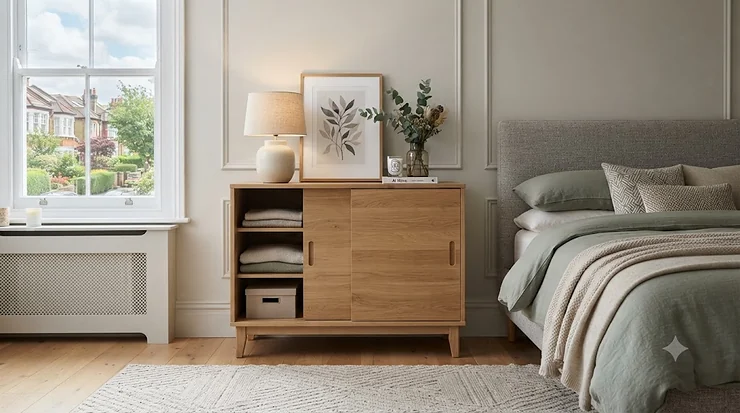
A sliding door chest of drawers solves that by swapping hinges for a track. The panel glides sideways instead of swinging out, which means you can push the unit right up against a bed, a radiator, or a wall without losing access to what’s inside. It’s a small mechanical shift with a genuinely large impact on how a room feels to live in, and it’s why searches for a sliding door chest of drawers have been climbing steadily as UK homes get smaller and renovation budgets get tighter. According to the general reference entry on the piece of furniture itself, a chest of drawers is essentially a cabinet built around multiple parallel, horizontal drawers stacked one above another, a design that’s barely changed in centuries — it’s the doors, tracks, and finishes wrapped around that core idea that have evolved. You can read more about the furniture’s long design history on Wikipedia.
This guide walks through seven real, currently available options sold in the UK, ranging from budget-friendly steel-frame units to solid-wood vintage-style pieces, and explains what actually matters when you’re choosing between them — not just spec sheets, but real-world trade-offs like clearance, weight capacity, and how they hold up after eighteen months of daily use.
Quick Comparison Table: Sliding Door Chest of Drawers at a Glance
| Product | Best For | Price Range | Material |
|---|---|---|---|
| URBNLIVING 2-Door Sliding Chest Cabinet | Best all-rounder for bedroom or hallway | £90-£130 range | Engineered wood, metal legs |
| VASAGLE Sideboard LSC081B01 | Best industrial-style living room piece | £120-£170 range | Steel frame, engineered wood |
| Beliani Selah 6-Drawer Chest | Best light-wood Scandi look | £250-£330 range | MDF, particleboard, pine legs |
| VEVOR 6-Drawer Sliding Dresser | Best budget minimalist option | Under £100 | MDF, steel frame |
| Canterbury CHTCAN5DW 5-Drawer Chest | Best vintage/character piece | £150-£220 range | Solid wood, painted finish |
| Panana 5-Drawer Chest on Wheels | Best for renters who move often | Under £90 | MDF honeycomb board, castors |
| Home Source Sideboard 3-Drawer 2-Door | Best hallway sideboard-style unit | £110-£160 range | Engineered wood |
Looking at the spread above, the VEVOR 6-Drawer Sliding Dresser and the Panana 5-Drawer Chest on Wheels dominate the sub-£100 bracket for anyone furnishing a first flat or student room, while the Beliani Selah 6-Drawer Chest and the Canterbury CHTCAN5DW 5-Drawer Chest sit at the premium end where solid construction and finish quality become the priority. The VASAGLE Sideboard and Home Source Sideboard occupy a useful middle ground — sturdy enough for daily family use without the price tag of solid timber.
💬 Just one click — help others make better buying decisions too!😊
Top 7 Sliding Door Chest of Drawers: Expert Analysis
Choosing between these seven means weighing drawer count against door mechanism against how much floor space you can actually spare. Below, each pick gets an honest look at what the spec sheet says and what that translates to once the thing is sitting in your bedroom.
1. URBNLIVING 2-Door Sliding Chest Cabinet — sleek hidden storage for tight bedrooms
The standout here is how much the URBNLIVING 2-Door Sliding Chest Cabinet manages to hide behind a genuinely compact footprint. It’s built as a sideboard-style cabinet with two full-width sliding doors and raised metal legs, so the storage volume inside isn’t chopped up by individual drawer runners the way a conventional chest is.
Behind the sliding panels you get open shelving rather than pull-out drawers, which means more usable depth for bulkier items like folded jumpers, spare bedding, or shoe boxes. The metal legs lift the whole unit slightly off the floor, which matters more than it sounds — it makes vacuuming underneath possible and gives the piece a lighter visual presence in a small room rather than looking like a solid block against the wall.
Based on the spec comparison with drawer-based alternatives, this design suits people who store things in stacks or bins rather than folded individually into drawers. Reviewers consistently note that the sliding action stays smooth for the first year or so, though a few mention the doors can start to catch slightly on the track if the unit isn’t kept level — worth checking with a spirit level during assembly rather than assuming your floor is flat.
Pros:
- ✅ Two-door sliding design hides mess completely from view
- ✅ Raised metal legs make cleaning underneath easy
- ✅ Sleek, low-profile look suits bedrooms, halls or living rooms
Cons:
- ❌ Open shelving inside, not individual pull-out drawers
- ❌ Doors can catch on track if not assembled dead level
At around £90-£130, this sits firmly in the mid-budget bracket, and it earns that price through versatility rather than luxury materials — a solid pick if you want one unit that works in more than one room.

2. VASAGLE Sideboard LSC081B01 — industrial styling with genuine load capacity
What most buyers overlook about the VASAGLE Sideboard LSC081B01 is that it wasn’t designed purely as a bedroom chest — it’s marketed as a kitchen and living-room sideboard first, chest of drawers second, and that dual identity is exactly what gives it an edge. The steel frame construction means it carries considerably more weight than an MDF-only unit before you see any sag or wobble.
The louvred sliding doors run on a steel-frame track rather than a plastic one, which is the detail that most explains why this unit tends to outlast cheaper alternatives. On paper this means a heavier upfront lift during assembly; in practice it means the sliding mechanism doesn’t develop the play and rattle that plastic-tracked units often do within the first year.
Aggregated review sentiment for VASAGLE’s sliding-door range is generally positive on sturdiness and assembly clarity, with the most common complaint being that the rustic brown and black colourway photographs slightly darker than it appears once assembled — a minor styling mismatch rather than a functional one.
Pros:
- ✅ Steel frame handles heavier loads than MDF-only units
- ✅ Track-mounted sliding doors resist rattle over time
- ✅ Doubles as sideboard, chest, or hallway cabinet
Cons:
- ❌ Industrial look won’t suit every bedroom style
- ❌ Colourway can appear darker in person than in photos
Priced in the £120-£170 range, it’s a strong mid-range choice if durability under regular use matters more to you than a soft, bedroom-specific aesthetic.
3. Beliani Selah 6-Drawer Chest with 2 Sliding Doors — the premium Scandi-light pick
The Beliani Selah 6-Drawer Chest stands out immediately for combining actual pull-out drawers with sliding door coverage — a hybrid layout that a lot of competitors don’t attempt. Six full drawers sit behind two sliding doors, so you get the organisational benefit of individual compartments plus the space-saving benefit of a door that doesn’t swing out.
Constructed from MDF and particleboard with genuine pine wood legs, this is a step up in material honesty from all-MDF competitors — solid pine legs bear the actual structural load rather than just decorating the base. The light wood finish leans into the Scandinavian-modern trend that’s dominated UK bedroom furniture for the past few years, and it’s likely to age better stylistically than heavily trend-driven finishes.
Here’s what to weigh: six individual drawers behind sliding doors means more moving parts than a simple open-shelf design, so smooth operation depends more heavily on correct assembly. Reviewers consistently note the drawers glide well when the frame is squared up properly during build, with occasional sticking reported when corners are rushed.
Pros:
- ✅ Six real drawers, not just open shelving behind doors
- ✅ Solid pine legs, not just decorative MDF
- ✅ Scandi-light finish likely to stay stylish long-term
Cons:
- ❌ Dispatch can take 5-6 working days
- ❌ More moving parts means assembly accuracy matters more
At around £250-£330, this is the premium pick on this list, and the extra spend buys you drawer functionality that most sliding-door competitors simply don’t offer.
4. VEVOR 6-Drawer Sliding Dresser — the budget-conscious minimalist’s option
The VEVOR 6-Drawer Sliding Dresser earns its spot through sheer value density: six drawers, a modern minimalist frame, and a built-in anti-tip device, all landing under the £100 mark. For anyone furnishing a first home on a tight budget, that combination is hard to beat on paper.
The anti-tip device is worth calling out specifically because it’s not a given at this price point — many budget dressers skip it entirely, which becomes a genuine safety issue in households with young children or pets who might climb open drawers. VEVOR building it in as standard is a meaningful practical advantage, not just a marketing bullet point.
What the spec sheet won’t tell you, but user reports suggest, is that the sliding mechanism on entry-level dressers like this one tends to feel noticeably smoother in the first few months than after a year or two of daily use — a normal characteristic of budget-tier steel-and-MDF construction rather than a fault specific to this model. Reviewers broadly describe assembly as straightforward for one person, with the honeycomb-structured drawer fronts noted as lighter than solid wood but adequately sturdy for clothing storage.
Pros:
- ✅ Anti-tip device included as standard, not an add-on
- ✅ Six drawers for under £100 is genuinely competitive
- ✅ Straightforward single-person assembly
Cons:
- ❌ Sliding action may feel less smooth after a year of use
- ❌ Lighter honeycomb board, not solid wood
If budget is the primary constraint and you need drawer volume fast, this is one of the most sensible starting points on the market right now.
5. Canterbury CHTCAN5DW 5-Drawer Chest — the vintage-style character piece
For anyone who wants their sliding door chest of drawers to look like furniture rather than flat-pack storage, the Canterbury CHTCAN5DW 5-Drawer Chest takes a different route entirely. Solid wood construction with a painted, vintage-leaning finish, and — notably for this list — a listed sliding door mechanism rather than the conventional hinged front you’d expect from a period-style piece.
Based on the spec comparison with the MDF-heavy alternatives above, solid wood construction changes the calculation on longevity. Where engineered board units are essentially disposable once the surface chips or the track fails, solid timber can be sanded, repainted, and repaired — a genuinely different ownership proposition, particularly for buyers who move house and want furniture that survives the process.
Reviewers consistently note the wooden runners feel different from metal-tracked competitors — a touch heavier to slide, but with a reassuring solidity that plastic and light steel tracks don’t replicate. This is honest trade-off territory: smoother-but-flimsier versus firmer-but-more-effort, and which one you prefer will depend on whether you value glide feel or long-term durability more.
Pros:
- ✅ Solid wood construction, not engineered board
- ✅ Can be sanded and repainted rather than replaced
- ✅ Genuine vintage character, not a printed wood-effect finish
Cons:
- ❌ Slide action heavier than metal-tracked alternatives
- ❌ Premium price for the drawer count offered
Priced around £150-£220, it costs more per drawer than the budget options on this list, but the honest trade is longevity and repairability versus initial glide smoothness.

6. Panana 5-Drawer Chest on Wheels — the mobile option for renters
The Panana 5-Drawer Chest on Wheels solves a problem none of the other six units address directly: what happens when you move flats every twelve months, as so many UK renters do. Castor wheels mean the whole unit can be rolled rather than lifted, which matters considerably more than it sounds once you’ve tried to carry a loaded chest of drawers down three flights of stairs.
Constructed from MDF honeycomb board, the build prioritises light weight over raw strength, which is precisely the right trade-off for a piece designed to be moved regularly rather than to sit permanently in one spot for a decade. Reviewers consistently frame this unit as ideal for shared houses and student accommodation, where furniture needs to survive several moves rather than a single lifetime placement.
The single door panel gives you a place to tuck away items you don’t want on permanent display, though — to be transparent — publicly available listings for this model are less specific about whether the door mechanism is a true sliding track or a simpler pivot-and-lock design, so it’s worth checking current listing photos and the manufacturer’s own description before buying if the sliding action specifically is your priority.
Pros:
- ✅ Castor wheels make relocating the unit genuinely easy
- ✅ Lightweight honeycomb board suits frequent moves
- ✅ Budget-friendly for renters furnishing short-term lets
Cons:
- ❌ Honeycomb board less robust than solid MDF or wood
- ❌ Door mechanism specifics vary by listing — check before buying
Under £90 typically, this is less about premium construction and more about practical flexibility for a genuinely transient lifestyle.
7. Home Source Sideboard 3-Drawer 2-Door Unit — the hallway all-rounder
Rounding out the list, the Home Source Sideboard 3-Drawer 2-Door Unit is built explicitly with hallway and living-room placement in mind rather than purely as bedroom furniture, and that’s reflected in its wider, lower-profile proportions. Three drawers sit alongside two front-facing door compartments, giving a genuine mix of storage types in one footprint.
That mixed layout is the real selling point: drawers for smaller items you want quick access to, and enclosed door storage for bulkier things like shoes, umbrellas, or spare linens that don’t need frequent handling. Based on the spec comparison with pure chest-style units, this hybrid approach suits entryways and hallways better than bedrooms, where uniform drawer stacks tend to make more sense.
Home Source, as a UK-focused furniture brand, tends to update door mechanisms across model refreshes, so it’s worth double-checking the current listing to confirm whether your specific colourway ships with sliding or hinged doors before finalising a purchase — a small but important verification step given how much this guide has emphasised the space-saving benefit of the sliding mechanism specifically.
Pros:
- ✅ Mixed drawer-and-door layout suits varied hallway items
- ✅ Wider, lower proportions fit awkward hallway spaces
- ✅ UK-based brand with accessible customer support
Cons:
- ❌ Door mechanism can vary between listing refreshes — verify first
- ❌ Less drawer volume than dedicated chest-style units
At around £110-£160, it’s a sensible pick specifically for hallway storage furniture roles rather than as a primary bedroom dresser.
Practical Usage Guide: Setting Up and Maintaining a Sliding Door Chest of Drawers
Getting the sliding mechanism right during setup matters more than almost any other assembly step, because a track that’s fractionally out of alignment on day one will only get worse with daily use. Start by assembling the frame on a flat, hard surface rather than carpet — even a thick rug can throw the base out of square by a few millimetres, which is enough to make a sliding door catch.
Once assembled, check the unit sits perfectly level against the wall using a spirit level, adjusting any floor-levelling feet before you load a single item inside. During the first thirty days, avoid overloading one side of open-shelf units like the URBNLIVING 2-Door Sliding Chest Cabinet — uneven weight distribution is one of the most common reasons sliding doors start to bind prematurely.
For ongoing maintenance, a light silicone-based lubricant applied to the track every six months keeps most steel and plastic mechanisms running smoothly; avoid oil-based lubricants, which attract dust and can gum up over time. Wipe drawer runners with a dry cloth monthly rather than a wet one, since damp cloths on MDF-based units like the VEVOR 6-Drawer Sliding Dresser can encourage the board to swell slightly at the edges. If you notice a door or drawer beginning to stick, check for a build-up of dust or fluff on the track first — it’s the cause in the vast majority of cases, and it’s a five-minute fix rather than a structural fault.
Real-World Scenarios: Who Actually Needs a Sliding Door Chest of Drawers
The box-room student. If you’re a student commuting between a nine-square-metre halls room and lecture theatres, floor space is the single scarcest resource you own. A compact, budget-friendly sliding drawer unit like the VEVOR 6-Drawer Sliding Dresser or the Panana 5-Drawer Chest on Wheels solves the immediate problem — six drawers of storage without a swinging door eating into the two feet of clearance between your bed and desk — while staying affordable enough to abandon or sell on without financial regret at the end of the tenancy.
The growing family with a tight landing. For a family converting an awkward landing or box room into extra storage, hallway storage furniture that combines drawers and doors, like the Home Source Sideboard 3-Drawer 2-Door Unit, tends to work harder than a single-purpose chest. It absorbs shoes, coats, and school bags in the door section while keeping smaller items — gloves, keys, dog leads — accessible in the drawers, all without a door that swings into a walkway used multiple times a day.
The downsizing couple prioritising quality. If you’re moving from a larger house into a smaller flat and want furniture that will genuinely last rather than get replaced in three years, the solid-wood Canterbury CHTCAN5DW 5-Drawer Chest or the pine-legged Beliani Selah 6-Drawer Chest justify their higher price through repairability and finish quality — an investment that makes more sense when you’re furnishing what you intend to be a long-term home rather than a stopgap.
What is a Sliding Door Chest of Drawers?
A sliding door chest of drawers is a storage unit — typically for a bedroom, hallway, or living room — where one or more front panels slide sideways along a track rather than swinging outward on hinges. This design saves the floor clearance a hinged door would otherwise require, making it particularly suited to small rooms, tight bedside gaps, or anywhere furniture sits close to a wall, bed, or doorway.
How to Choose a Sliding Door Chest of Drawers
- Measure your clearance gap first, not last. Work out the exact width you have between obstacles before shortlisting products — a sliding door still needs its own width of wall space to travel into, even though it doesn’t swing outward.
- Decide between drawers, open shelving, or a hybrid. Pure drawer units like the Beliani Selah 6-Drawer Chest suit clothing storage; open-shelf sliding cabinets like the URBNLIVING 2-Door Sliding Chest Cabinet suit bulkier, less-folded items.
- Check the door track material. Steel tracks, as used on the VASAGLE Sideboard LSC081B01, generally outlast plastic ones under daily use — worth confirming in the listing specifications.
- Match material to how often you’ll move it. Solid wood units age better in place; lightweight MDF or honeycomb-board options like the Panana 5-Drawer Chest on Wheels suit renters who relocate often.
- Factor in assembly complexity. More drawers behind sliding doors, as with the Beliani Selah, generally means a longer build and a greater need for a perfectly squared frame.
- Look for anti-tip hardware as standard. This matters especially in households with children or pets — the VEVOR 6-Drawer Sliding Dresser includes it by default, which isn’t universal at this price point.
- Read aggregated review sentiment for door longevity, not just day-one appearance. Photos never show how a track performs after a year of use — real owner feedback does.

Sliding Door vs Traditional Hinged-Door Chests of Drawers
| Factor | Sliding Door Chest | Hinged-Door Chest |
|---|---|---|
| Clearance needed | Track width only, no outward swing | Full door width, swings 90°+ |
| Best For | Tight bedrooms, hallways, bedside gaps | Larger rooms with open floor space |
| Access to full interior | Partial — one side covered while other open | Full width open at once |
| Mechanism longevity | Depends on track material and levelling | Hinges generally simpler, fewer failure points |
| Typical style | Modern, minimalist, industrial | Classic, traditional, period |
The core trade-off in the table above is access versus footprint: a hinged door swings fully open and gives you the entire interior at once, while a sliding door only ever exposes half the cabinet width at a time because the other panel is covering it. For most bedroom and hallway uses that’s a fair exchange, since you rarely need the entire width open simultaneously, but it’s worth knowing before you buy if you’re used to swinging wardrobe doors and expect the same full-width access.
✨ Don’t Miss These Exclusive Deals!
🔍 Take your bedroom storage to the next level with these carefully selected sliding door chest of drawers picks. Click on any highlighted item to check current pricing and availability. These practical, space-saving pieces will help you create an organised home your family will actually enjoy living in!
Common Mistakes When Buying a Sliding Door Chest of Drawers
The single most frequent error is measuring the chest’s width but forgetting to measure the track clearance the sliding panel needs on either side — a door that slides three inches into empty air on the left needs that three inches of wall space free, even though nothing physically swings into the room. Skip this check and you can end up with a unit that technically fits the footprint but can’t actually open.
A second common mistake is prioritising drawer count over track quality. A cheap sliding drawer unit with eight drawers on a flimsy plastic track will frustrate you within months, while a six-drawer unit on a steel track, like the VASAGLE Sideboard LSC081B01, will likely still glide smoothly years later. More drawers isn’t automatically better value if the mechanism underneath can’t sustain daily use.
Buyers also frequently underestimate assembly time for hybrid drawer-and-door units. The Beliani Selah 6-Drawer Chest, with six individual drawers behind two sliding doors, has considerably more components to align than a simple open-shelf sliding cabinet — budget an afternoon, not twenty minutes, and enlist a second pair of hands for squaring the frame.
Sliding Door Chests for Tight Clearance Furniture Needs
Tight clearance furniture is its own category of buying problem, and it deserves its own section because the maths genuinely changes once your available gap drops below roughly 60cm. In these situations, a sliding drawer unit with a narrow overall footprint — rather than simply a sliding door on a standard-width chest — becomes the priority. The VEVOR 6-Drawer Sliding Dresser and Panana 5-Drawer Chest on Wheels both suit narrower alcoves better than the wider sideboard-style units on this list, since their proportions were designed with compact bedrooms in mind from the outset.
When shopping specifically for tight clearance furniture, always check both width and depth, not just width. A shallow-depth chest that’s slightly wider can sometimes fit an awkward space better than a narrow but deep one, particularly beside a bed where the depth eats into walking room every single day rather than just occasionally.
Space-Saving Sliding Storage for Hallways and Small Rooms
Space-saving sliding storage earns its keep most obviously in hallways, where a swinging door on any piece of furniture is a genuine trip hazard in a space people walk through constantly, often in a hurry, often carrying something. This is exactly the use case the Home Source Sideboard 3-Drawer 2-Door Unit was designed around, with proportions wider and lower than a typical bedroom chest so it reads as hallway storage furniture rather than an obviously relocated bedroom piece.
Beyond hallways, small rooms in general benefit from the same logic. A box room used as a home office, nursery, or guest room rarely has spare floor space to dedicate to a swinging door’s arc, and sliding mechanisms reclaim that dead space entirely. It’s a modest-sounding change on paper, but in a genuinely small room it can be the difference between a walkway that feels comfortable and one that feels like an obstacle course.
Japanese-Inspired Sliding Storage: Style Notes
The sliding door mechanism itself has a lineage worth knowing about if you’re drawn to minimalist storage design: it descends conceptually from traditional Japanese-style storage using shōji and fusuma panels, sliding screens that have shaped interior space-saving design for centuries. As one general reference on sliding doors notes, the sliding glass door’s own design predecessor is the sliding shōji and fusuma panel door found in traditional Japanese architecture, and that same principle — a flat panel gliding within a frame rather than swinging on a hinge — is precisely what modern sliding door chest of drawers designs borrow, whether or not the manufacturer explicitly markets it that way. You can read more about the origins of shōji panel design here.
If you want your chest of drawers to lean explicitly into this aesthetic, look for clean, unadorned door panels without ornate handles, natural or muted wood tones, and low-profile proportions — the Beliani Selah 6-Drawer Chest, with its light pine legs and understated Scandi-adjacent finish, sits closest to this look among the seven picks here, even though it isn’t marketed specifically as Japanese-style storage.

Long-Term Cost & Maintenance
Total cost of ownership on a sliding door chest of drawers isn’t just the sticker price — it’s the sticker price plus the likelihood of track repair or replacement over five to ten years of use. Budget MDF-and-plastic-track units like the VEVOR 6-Drawer Sliding Dresser or Panana 5-Drawer Chest on Wheels typically cost less upfront but carry a higher probability of needing a track replacement or full unit swap within three to five years of daily use.
By contrast, steel-tracked units like the VASAGLE Sideboard LSC081B01 and solid-wood pieces like the Canterbury CHTCAN5DW 5-Drawer Chest cost more initially but spread that cost over a genuinely longer useful life — the wood chest, in particular, can be refinished rather than discarded if the surface eventually shows wear, which budget engineered-board units generally can’t. If you’re calculating cost-per-year rather than cost-per-purchase, the premium options frequently work out cheaper across a decade of ownership, even though the upfront outlay is two to three times higher.
Features That Actually Matter (And Those That Don’t)
Track material matters enormously; decorative handle finishes matter very little. A steel or reinforced-composite track will outlast a plastic one by years under identical use, while the difference between a brushed-metal and a plastic handle is almost entirely cosmetic and rarely affects how the unit performs day to day.
Anti-tip hardware matters, especially with children or pets in the house — it’s a genuine safety feature, not a marketing add-on, and it’s worth actively checking for rather than assuming it’s included. Drawer depth matters more than drawer count for most people’s actual storage needs; five genuinely deep drawers frequently hold more usable clothing volume than eight shallow ones, despite the higher number looking more impressive on a spec sheet.
What matters comparatively little is the exact shade of a wood-effect finish, since lighting and camera settings in product photos vary so much between listings that the real-world colour is often a surprise regardless of the unit you choose — checking a handful of independent customer photos, rather than relying purely on the manufacturer’s own images, is the more reliable way to judge true colour.
Safety, Regulations & UK Compliance Guide
Furniture sold in the UK, including sliding door chest of drawers models, needs to meet general product safety requirements before it can legally reach the market, and manufacturers selling into Great Britain increasingly need to demonstrate conformity through UKCA marking rather than the EU’s CE marking alone, following the UK’s post-Brexit regulatory framework. Government guidance describes the UKCA marking as the new product marking used for goods being placed on the market in Great Britain, covering a wide range of manufactured products. You can find the full UKCA marking guidance on GOV.UK if you want to understand exactly what compliance a listing should be able to demonstrate.
Beyond formal certification, a few practical safety checks are worth doing yourself regardless of what a listing claims: confirm the unit includes anti-tip wall-anchoring hardware, check the stated maximum load per drawer before storing anything unusually heavy, and always fully insert wall-fixing screws rather than treating them as optional — particularly in households with children who may be tempted to climb open drawers as makeshift steps.
Problem → Solution: Fixing Common Sliding Door Chest Issues
Problem: the sliding door has started sticking or catching. This is almost always caused by dust build-up in the track or a slightly unlevel base rather than a manufacturing fault. Vacuum the track with a narrow nozzle attachment, then re-check the unit with a spirit level and adjust the feet if needed.
Problem: a drawer won’t glide smoothly anymore. Overloading one side of a drawer, particularly with heavier folded items pushed to one corner, is the most common cause. Redistribute the contents evenly and apply a small amount of dry lubricant, such as candle wax or a silicone spray, to the runners.
Problem: the unit wobbles slightly against the wall. Check that all four (or more) feet are making even contact with the floor — even a slightly warped laminate or carpet pile underneath one corner can introduce a rock. Adjustable feet, where fitted, should be turned until the wobble disappears rather than compensated for with folded cardboard, which tends to worsen over time.
Problem: the interior smells slightly of chemicals after unboxing. This is common with new MDF and particleboard furniture and typically fades within one to two weeks if the unit is left with drawers or doors open in a ventilated room before you store clothing inside.
Problem: you’re not sure the door mechanism is genuinely sliding rather than hinged, based on listing photos alone. As flagged with the Panana 5-Drawer Chest on Wheels and Home Source Sideboard entries above, always check the most recent customer photos and the manufacturer’s own product video, where available, rather than relying purely on the main listing image, since door mechanisms can change between model refreshes.
Buyer’s Decision Framework
If your available floor clearance is under 60cm, choose a narrow-footprint sliding drawer unit like the VEVOR 6-Drawer Sliding Dresser, because standard-width sideboard-style chests won’t physically fit the gap. If you’re furnishing a hallway that doubles as a busy walkway, choose a hybrid drawer-and-door unit like the Home Source Sideboard 3-Drawer 2-Door Unit, because the mixed storage suits varied items better than uniform drawers. If you’re planning to stay in the same home for a decade or more, choose solid wood over engineered board — the Canterbury CHTCAN5DW 5-Drawer Chest — because repairability beats initial cost over that time horizon. If you move flats annually, choose a lightweight, castor-mounted option like the Panana 5-Drawer Chest on Wheels, because mobility matters more than long-term durability in that scenario. And if you simply want the most balanced option without a specific constraint pushing you one way, the URBNLIVING 2-Door Sliding Chest Cabinet or VASAGLE Sideboard LSC081B01 both cover the middle ground competently.

FAQ
❓ Do sliding door chests of drawers save more space than normal wardrobes?
❓ Are sliding door chests of drawers harder to assemble than normal ones?
❓ Can I fit a sliding door chest of drawers next to a bed?
❓ What's the average price range for a sliding door chest of drawers in the UK?
❓ Do sliding doors wear out faster than hinges?
Conclusion
Choosing a sliding door chest of drawers ultimately comes down to matching the mechanism to your actual constraints rather than chasing the highest drawer count or the lowest price alone. If floor clearance is your biggest headache, prioritise a compact, narrow-footprint unit; if longevity matters most, spend more on steel tracks or solid wood; and if you move house often, lightweight and castor-mounted beats heavy and permanent every time.
Across the seven real UK-available options covered here — from the budget-friendly VEVOR 6-Drawer Sliding Dresser to the solid-wood Canterbury CHTCAN5DW 5-Drawer Chest — there’s a genuinely sensible pick for most bedroom, hallway, and small-room storage problems. The common thread across every honest review and spec comparison in this guide is that track quality, not drawer count or finish, is what determines whether you’re happy with the purchase in year one or still happy with it in year five.
Whichever direction you go, measure your clearance gap twice, check for anti-tip hardware, and read recent owner feedback on door longevity before committing — that combination will get you further than any single spec sheet ever could.
Recommended for You
- Under Window Chest of Drawers: 7 Best Low Picks for 2026
- Wall-Mounted Chest of Drawers: 7 Best UK Picks for 2026
- Corner Chest of Drawers: 7 Best Space-Saving Picks (2026)
Disclaimer: This article contains affiliate links. As an Amazon Associate, I earn from qualifying purchases. If you purchase products through these links, we may earn a small commission at no additional cost to you.
✨ Found this helpful? Share it with your friends! 💬🤗
