
In This Article
Most of us don’t own a dressing room. We own a bedroom, a wardrobe that stopped closing properly years ago, and a chair that has quietly become a second wardrobe. That’s why walk-in wardrobe systems have taken off. They promise boutique-style storage without a renovation bill that looks like a deposit on a flat.
There’s a catch. The phrase covers everything from a wheeled rail that costs less than a pizza night to a bespoke carpentry project that costs more than a second-hand car. Product pages rarely say which is which. This guide sorts the genuinely useful from the merely photogenic.
I’ve researched seven real, widely listed options on Amazon UK: fabric, steel, freestanding and wall-mounted. Each one gets a spec-sheet reality check, an honest read of the aggregated review chatter, and some common sense. You’ll also find a modular walk-in wardrobe system explainer, a practical DIY walk-in wardrobe system guide, and proper advice on dressing room design. After all, a walk-in wardrobe, which Wikipedia notes is also called a dressing room, is only as good as its layout.
One honest note. I haven’t tested any of these products, so you’ll get spec-based analysis and clearly labelled review themes rather than invented anecdotes. Prices are ranges only and move constantly, so always check the current price before you buy.
Quick Comparison: Top 7 Walk-In Wardrobe Systems at a Glance
| Product | Type | Best For |
|---|---|---|
| SONGMICS SPF03G | Freestanding fabric wardrobe | Tight budgets and trial layouts |
| SONGMICS HSR134 | Wheeled, extendable rail | Overflow and seasonal rotation |
| VASAGLE RGR112K01 | Steel A-frame rack with shelves | Industrial-look bedrooms |
| SONGMICS LGR411B02 | Rail, shelves and fabric drawers | Folded-clothes lovers |
| WOLTU Donkey | Heavy-duty open wardrobe | Heavier loads on a budget |
| Multigot Organiser | Wall-mounted rails and shelves | Reconfigurable modular layouts |
| COSTWAY Closet System | Wall-mounted 4-rod kit | Larger, more custom spaces |
Looking at the comparison above, the SONGMICS SPF03G and SONGMICS HSR134 are the cheapest ways in. The Multigot Organiser and COSTWAY Closet System come closest to a true modular walk-in wardrobe system, because they mount to the wall and can be repositioned. If you own heavy coats, the WOLTU Donkey and VASAGLE RGR112K01 list higher load ratings. Renters should remember that wall-mounted kits mean drilling.
💬 Just one click — help others make better buying decisions too!😊
Top 7 Walk-In Wardrobe Systems: Expert Analysis
Every pick below is a real product, assessed on its specs and the review themes I could verify. Where I couldn’t verify something, I say so rather than guess.
1. SONGMICS Fabric Wardrobe SPF03G — best cheap starter for a trial dressing room
This is the “try before you commit” option: light, quick to build and kind to a tight budget. It measures roughly 150 x 45 x 175 cm and has 12 compartments, a 16 mm metal frame and a rail set at about 132 cm, which is tall enough for coats and longer dresses.
The rail is rated to roughly 15 kg. That covers a normal rotation of shirts, dresses and light jackets, but a row of wool overcoats will test it. Based on the spec comparison, it suits renters, students and anyone planning a layout before investing in a permanent walk-in wardrobe system. The fabric cover keeps dust off, but it also traps air, so leave it ajar in damp rooms.
Reviewers on retailer pages describe it as spacious, simple to build and excellent value. The recurring caveat is that the frame is light: fine for everyday clothes, not for heavy items, and best left where you build it once it’s loaded.
Pros:
- ✅ Genuinely low cost for 12 compartments
- ✅ Tool-light assembly, no wall drilling
- ✅ Tall 132 cm rail suits coats
Cons:
- ❌ Light frame limits heavy garments
- ❌ Fabric finish looks less premium than wood
Expect to pay around £25-£40. Strong value for temporary or secondary storage, but not a forever solution.

2. SONGMICS Extendable Clothes Rail HSR134 — best flexible add-on rail on wheels
Think of this as the Swiss Army knife of rails. It’s the piece you add to an existing wardrobe setup to make it more adaptable, not a complete dressing room on its own.
It measures 40 x (83-120) x 156 cm, and each end pulls out by about 18.5 cm to widen the rail. Total load is quoted at 45 kg. Two lower bars create a shelf zone for boxes or baskets, sitting about 14 cm off the floor so shoes (and a robot vacuum) fit underneath. Four 360° castors, two with brakes, make it a mobile unit.
The analysis is simple. Roll it into the light to plan outfits, then park it against the wall. Inside a larger walk-in, it works brilliantly as a seasonal overflow rail. Because the whole thing weighs under 3 kg, though, overloading one side invites wobbling.
Deal-site listings showed about 4.4/5 from a few hundred ratings. Reviewers praise the smooth castors, brakes that hold and the telescopic width.
Pros:
- ✅ Extendable width suits awkward spaces
- ✅ Brakes hold the rack firmly in place
- ✅ Very affordable and easy to move
Cons:
- ❌ Single rail limits total capacity
- ❌ Lightweight build dislikes lopsided loading
Typically under £25. Outstanding value as an accessory, rather than a core system.
3. VASAGLE Clothes Rack RGR112K01 — industrial A-frame that doubles as décor
Where fabric wardrobes hide your clothes, this one shows them off. It pairs a steel frame with particleboard shelves for a loft-style look.
It measures about 100 x 45 x 160 cm, with a hanging rail, two lower shelves and six S-shaped side hooks. Quoted load limits vary between listings, from roughly 114 kg on the rail to around 190 kg in total, so check the figure on the listing you’re buying from. The A-frame is designed to resist wobble.
At just 160 cm tall, with shelves below, the drop for hanging is limited. Full-length dresses and long coats will pinch. It shines for shirts, jackets and folded-over trousers, which makes it a good fit for a mixed-use walk-in wardrobe system where one bay is for everyday tops.
I couldn’t verify enough detailed review themes to summarise them honestly, so I’d read the current reviews before buying.
Pros:
- ✅ Sturdy A-frame with high quoted load rating
- ✅ Stylish industrial look, no cover needed
- ✅ Side hooks handle bags and scarves
Cons:
- ❌ 160 cm height limits long hanging garments
- ❌ Particleboard shelves dislike damp conditions
Expect around £30-£45. Good value if looks matter as much as capacity.
4. SONGMICS Freestanding Clothes Rack LGR411B02 — drawers, shelf and rail in one footprint
Hanging space is only half the story, because jumpers, tees and underwear need somewhere to sit. This rack combines a rail with a mesh shelf, two extra shelves and two large fabric drawers.
Eight hooks add space for hats, belts and bags. Together, that gives you hanging, folding and “stuff” storage in one footprint, a layout that borrows from the zoning logic of real dressing rooms. Fabric drawers are lighter and cheaper than wooden ones, but they won’t match the rigidity of a proper drawer unit.
Deal-site snapshots showed an average of around 4.3/5 from roughly 500 reviews. I couldn’t confirm detailed review themes beyond that, so treat the rating as a reassuring signal rather than a full verdict.
Practically, this suits anyone whose clothes are mostly folded. If you have a lot of dresses or longer coats, look elsewhere.
Pros:
- ✅ Rail, shelves and drawers in one unit
- ✅ Eight hooks for accessories
- ✅ Freestanding, so no drilling needed
Cons:
- ❌ Fabric drawers lack the rigidity of wood
- ❌ Single rail restricts hanging capacity
Roughly £30-£45. Smart value for a compact all-rounder.
5. WOLTU Donkey — heavy-duty steel with a fabric drawer
The WOLTU Donkey is a heavy-duty open wardrobe aimed at people who find flimsy fabric frames unconvincing.
From the Amazon UK listing, it has a metal frame, two hanging bars, three shelves and one fabric drawer, with a quoted load of 150 kg. I couldn’t verify exact dimensions here, so check them against your space before ordering. Two bars suggest a “short hang over long hang” split. That’s useful for shirts above and trousers below.
On paper, the metal frame and the higher load rating make this a better home for denim stacks and winter knitwear than the lightest fabric options. The caveat is that I couldn’t verify reliable review themes or a stable price, so read current reviews and check the price.
Pros:
- ✅ Steel frame with a 150 kg quoted load
- ✅ Two hanging bars split long and short
- ✅ Includes a fabric drawer for small items
Cons:
- ❌ Review themes and pricing weren’t verifiable
- ❌ Only one drawer for folded storage
Check the current price. Promising for heavier loads, but do your own review check first.
6. Multigot Organiser — best-selling wall-mounted modular system
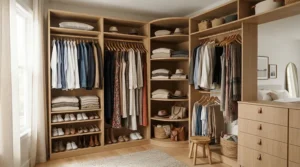
This is the closest of the seven to a true modular walk-in wardrobe system. The Multigot Organiser is a wall-mounted metal garment rail kit with three hanging rods and eight shelves, listed in grey and flagged as a Best Seller in Bedroom Wardrobes on Amazon UK at the time of research.
Wall mounting frees the floor, so cleaning is easier and a small room feels larger. The adjustable layout also means a modular walk-in wardrobe system that can change as your wardrobe does: more hanging this year, more shelves next.
There’s a price to pay in setup. Everything depends on proper wall fixings, so locate studs, level carefully and use anchors suited to your wall type. Plasterboard is not forgiving.
A Best Seller badge tells you something about popularity but not necessarily quality, and I couldn’t verify detailed review themes. Read current reviews, especially on weight capacity.
Pros:
- ✅ Wall-mounted layout frees up floor space
- ✅ Three rods and eight shelves reconfigure easily
- ✅ Popular enough to earn a Best Seller badge
Cons:
- ❌ Needs careful, correct wall installation
- ❌ Capacity details need checking per listing
Check the current price. A strong modular option if you’re happy to drill.
7. COSTWAY Closet System — most customisable wall-mounted kit
For larger spaces, this is the most ambitious option here. The COSTWAY Closet System is a steel, wall-mounted adjustable kit with four hanging rods and six storage shelves.
The retailer listing details a thorough hardware pack: wall strips, brackets, hang tracks, 19 anchors and 22 screws. Net weight is about 13 kg, and each shelf and rod is rated to about 10 kg. That per-rod rating is the number to respect. It’s fine for light shirts and blouses, but not a heavy-coat solution.
One reviewer on a retailer page complained that shelves become unusable beneath the top rail, so plan your layout before you drill. Check that the supplied anchors suit your wall type, and confirm availability on Amazon UK, since it can vary.
Pros:
- ✅ Four rods and six shelves for flexible layouts
- ✅ Comprehensive fixings in the box
- ✅ Wall-mounted, so floor stays clear
Cons:
- ❌ 10 kg per rod limits heavy garments
- ❌ Top-rail layout can block shelf use
Around £120-£160 on the listing I found. Good for planners, less so for impulse buyers.
✨ Don’t Miss These Exclusive Deals!
🔍 Take your wardrobe to the next level with these carefully selected walk-in wardrobe systems.Click on any highlighted product name to check current pricing and availability, and build a dressing space you’ll actually enjoy using!
What Are Walk-In Wardrobe Systems?
Walk-in wardrobe systems are modular storage kits made of rails, shelves, drawers and brackets that let you build a dressing-room-style wardrobe in a spare room, alcove or large closet. They can be freestanding or wall-mounted, and you can reconfigure or expand them over time without carpentry.
Three broad families exist. Freestanding frames, such as the SONGMICS SPF03G or VASAGLE RGR112K01, need no drilling and move with you. Wall-mounted track systems, like the Multigot Organiser and COSTWAY Closet System, use the wall for support and keep the floor clear. Bespoke fitted work sits above both, with built-to-measure carpentry.
Most people assume a walk-in wardrobe needs a huge room. One Italian design guide suggests a minimum depth of around 120 cm, roughly 60 cm for the storage and 60 cm for standing, which is smaller than most people expect. That makes a modest box room a serious contender.
How to Choose Walk-In Wardrobe Systems
- Measure first, shop second. Record width, depth, ceiling height and any sloping ceilings or radiators. A system that wins on paper can fail by 5 cm.
- Audit what you actually own. Count long coats, dresses, shirts and folded items. A London fitted-wardrobe firm suggests roughly 70% of space for hanging, a useful starting ratio.
- Pick your mounting style. Renters generally want freestanding. Owners who want a permanent, floor-clear layout should consider wall-mounted.
- Check load ratings honestly. A 10 kg rod is not a coat rail. Compare per-rod and per-shelf limits, not just the “total” headline.
- Prioritise adjustability. The ability to move rails and shelves is what makes a walk-in wardrobe system modular.
- Budget for extras. Hangers, lighting, mirrors and drawer dividers often cost as much as the frame.
Walk-In Wardrobe System with Shelving: Getting the Balance Right
A walk-in wardrobe system with shelving is only useful if the shelves match your folding habits. Too few and your jumpers end up on the floor, too many and you’ve sacrificed hanging space you actually need.
Start with depth. Shallow shelves, around 30-45 cm, keep folded items visible and avoid the “black hole” at the back. Check load per shelf too: the COSTWAY Closet System, for instance, lists about 10 kg per shelf, which suits tees and knits but not stacked books or shoe boxes.
Mesh and wire shelves, like the one on the SONGMICS LGR411B02, allow air circulation, which helps with musty smells. Solid shelves feel more premium and protect delicate fabrics from snagging.
Position heavy items low and light items high. Shoes and boxed items go near the floor. Hats and out-of-season bags go on top. Done properly, a walk-in wardrobe system with shelving works like a small boutique, where everything is visible and nothing is buried.
Modular Walk-In Wardrobe System: Freestanding vs Wall-Mounted
A modular walk-in wardrobe system lets you rebuild the layout as your life changes. Both mounting styles can achieve that, but in different ways.
| Product | Mounting | Key Spec | Typical Price Band | Best For |
|---|---|---|---|---|
| SONGMICS SPF03G | Freestanding | 12 compartments, ~15 kg rail | £25-£40 | Trial layouts |
| SONGMICS HSR134 | Freestanding, wheeled | 45 kg total load | Under £25 | Overflow rail |
| VASAGLE RGR112K01 | Freestanding | Up to ~190 kg quoted | £30-£45 | Style-led spaces |
| SONGMICS LGR411B02 | Freestanding | Rail, shelves, two drawers | £30-£45 | Folded storage |
| WOLTU Donkey | Freestanding | 150 kg quoted load | Check price | Heavier loads |
| Multigot Organiser | Wall-mounted | 3 rods, 8 shelves | Check price | Reconfigurable layouts |
| COSTWAY Closet System | Wall-mounted | 4 rods, ~10 kg each | £120-£160 | Larger spaces |
The table shows a clear split. Freestanding units cost less, move with you and need no drilling, but they take up floor space and sit at the mercy of the shelf layout the manufacturer chose. Wall-mounted kits like the Multigot Organiser and COSTWAY Closet System cost more and demand correct fixings, but they free the floor and reposition far more easily. For a genuinely modular walk-in wardrobe system, wall-mounted wins on flexibility. For rental flats, freestanding wins on common sense.
🔧 Ready to build? Start with the room you have, not the room you wish you had, and choose the system that fits it!
DIY Walk-In Wardrobe System: A Step-by-Step Practical Guide
A DIY walk-in wardrobe system is very achievable over a weekend, provided you plan before you drill. Here’s a process that avoids the common mistakes.
Step 1: Empty and edit. Take everything out and sort it into keep, donate and store. Organising clothes you’ll never wear is the quickest way to waste a good system.
Step 2: Sketch zones. Draw the walls and mark hanging, folded and shoe zones. Long hang needs roughly 120-150 cm of vertical drop, while short hang needs about half that.
Step 3: Find your fixings. For wall-mounted kits, locate studs with a detector and match anchors to the wall type. Plasterboard needs proper heavy-duty fixings, and the kit’s included anchors may not suit every wall.
Step 4: Install top-down. Mount the highest rail first, check it’s level, then work downwards. A spirit level costs a few pounds and saves a lot of rage.
Step 5: Load smart. Heavy items low, light items high, and leave a small gap on each rail for growth.
Mistakes to avoid in your first 30 days: overloading a single rod, forgetting the anti-tip hardware on freestanding units, and skipping lighting. A DIY walk-in wardrobe system that looks great but sits in the dark is just a fancy cupboard.
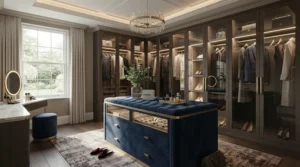
Dressing Room Design: Layout, Lighting and Mirrors
Good dressing room design starts with movement. If you can’t turn around without knocking a rail, the layout is wrong, however pretty the frame.
For layouts, a parallel (galley) arrangement works well in a narrow room, while an L-shape suits a corner. In a square room, using two or three sides is common. Keep a clear walking zone of around 60 cm or more in front of the storage.
Lighting is where most DIY schemes fall down. Overhead light alone casts shadows into rails. Add warm LED strips or spots at rail height. LEDs also make financial sense: Energy Saving Trust figures quoted by John Lewis put lighting at roughly 11% of average UK household electricity use, and LEDs use far less power than older bulbs.
Mirrors matter too. A full-length mirror near the window makes colour judgement easier, and a mirror opposite a light source doubles brightness. Good dressing room design is less about spending money and more about letting you see what you own.
Modular Shelving Systems and Wardrobe Organisation Systems That Work
The best modular shelving systems share one trait: they’re boringly adjustable. Look for holes, slots or tracks that let you move shelves in small increments. That’s the difference between a system that evolves and one that sits there being slightly wrong.
Wardrobe organisation systems come after the hardware. Ideal Home’s wardrobe organising guide rightly stresses decluttering before buying anything, and organising by type and colour so you can see your options at a glance. Drawer dividers also stop piles collapsing into each other.
A few practical wardrobe organisation systems habits are worth stealing:
- Group by category, then by colour or length within each category.
- Use matching slim hangers to save rail space.
- Keep a “one in, one out” rule so the system doesn’t quietly overflow.
- Store out-of-season clothes on high shelves or in lidded boxes.
Pair these habits with adjustable modular shelving systems and even a budget set-up like the SONGMICS LGR411B02 feels organised.
Real-World Scenarios: Which System Fits Which Life?
Specs mean little until they meet a real life. Here are three profiles with matched recommendations.
The renter in a one-bed flat (budget: under £50). She has a box room, a landlord who frowns on drilling, and about 20 shirts and 10 dresses. The SONGMICS SPF03G gives hanging and shelves for very little, and the SONGMICS HSR134 adds a rolling overflow rail. Neither needs a drill.
The family with a growing wardrobe (budget: £100-£200). Two adults share a spare room and want room to grow. The Multigot Organiser on one wall and the COSTWAY Closet System on another create adjustable bays. Wall mounting keeps the floor clear for laundry baskets, but everything must be fixed properly.
The style-first professional (budget: £50-£100). He wants a look, not just storage. The VASAGLE RGR112K01 supplies an industrial rail, while the WOLTU Donkey adds a steel-framed bay for heavier coats and knitwear. Check dimensions and load ratings carefully before ordering.
The common thread is honesty about what you own. Match the system to your actual clothes, not your aspirational ones.
Walk-In Wardrobe Systems vs Fitted Wardrobes
Fitted wardrobes look wonderful, but they come with a different price tag and a different level of commitment.
| Feature | DIY Walk-In Wardrobe Systems | Bespoke Fitted Wardrobes | Best For |
|---|---|---|---|
| Cost | Tens to low hundreds of pounds | Commonly thousands of pounds | Budget-conscious buyers |
| Install | Weekend DIY | Professional install | People who want a finished look |
| Flexibility | Easy to reconfigure | Fixed once built | Changing wardrobes |
| Portability | Freestanding units move with you | Stays with the house | Renters and movers |
The takeaway is that walk-in wardrobe systems trade polish for flexibility and cost. If you own your home, plan to stay and want a seamless look, bespoke work is hard to beat. For everyone else, especially renters and people whose wardrobes change often, a modular kit offers far better value per pound and far less regret.
Long-Term Cost and Maintenance of Walk-In Wardrobe Systems
Cheap frames often need more attention. Retighten connectors every few months, especially on fabric and plastic-jointed units like the SONGMICS SPF03G and SONGMICS HSR134. Wall-mounted kits should be checked for loose screws after the first month.
| Tier | Typical Budget | What You Get | Best For |
|---|---|---|---|
| Entry | Under £50 | Fabric or rail units, such as SONGMICS SPF03G | Trials and renters |
| Mid | £50-£150 | Steel or wall-mounted kits, such as WOLTU Donkey or Multigot Organiser | Growing wardrobes |
| Higher | £120-£160+ | Larger kits, such as COSTWAY Closet System | Planned dressing spaces |
Cost per year of use is the useful lens. A £30 rack used for five years costs about £6 per year, while a bespoke build costs far more upfront but may last decades. The cheapest option isn’t always the best value, and the priciest isn’t always the smartest.
Safety Guide: Anchoring, Load Limits and Fixings
Tall storage must be secured. The Royal Children’s Hospital Melbourne’s furniture tip-over guidance notes that unstable furniture is a real hazard to young children. It recommends fixing tall furniture to walls or floors with proper anchoring devices. The advice comes from Australia, but the physics is the same in the UK.
In practice:
- Use any supplied anti-tip kit, as some freestanding units, such as certain SONGMICS racks, ship with one.
- Respect rated loads per rod and per shelf, not just headline totals.
- Match anchors to your wall type, and ask a professional if you’re unsure.
- Keep heavy items low and discourage children from climbing.
Always check the product manual and listing for current safety instructions, because these can vary by model.

FAQ
❓ How much do walk-in wardrobe systems cost in the UK?
❓ Can I use a modular walk-in wardrobe system in a rented flat?
❓ Do fabric wardrobes work in walk-in wardrobe systems?
❓ How do I stop clothes creasing on a crowded rail?
❓ Can I expand a DIY walk-in wardrobe system later?
Conclusion
Walk-in wardrobe systems aren’t magic, but they are one of the smartest ways to turn chaos into calm without a renovation budget. The right pick depends on three things: your space, your clothes and your tolerance for drilling.
If you’re renting or testing a layout, the SONGMICS SPF03G and SONGMICS HSR134 are low-risk starters. The SONGMICS LGR411B02 suits folders, the VASAGLE RGR112K01 suits the style-led, and the WOLTU Donkey is a promising option for heavier loads once you’ve checked the reviews. For a truly adaptable modular walk-in wardrobe system, the Multigot Organiser and COSTWAY Closet System offer the most flexibility, provided you install them properly.
Whatever you choose, declutter first, plan your zones, light the space well and anchor anything tall. A DIY walk-in wardrobe system is a project that rewards patience and punishes shortcuts. Get the basics right, and every morning gets a little easier.
Recommended for You
- Mirrored Wardrobe For Small Flat: 7 Best Picks You’ll Love (2026)
- Mirrored Wardrobe With Drawers: 7 Best Picks For UK Bedrooms (2026)
- Sliding Wardrobe For Small Flat: 7 Space-Saving Picks (2026)
Disclaimer: This article contains affiliate links. As an Amazon Associate, I earn from qualifying purchases. If you purchase products through these links, we may earn a small commission at no additional cost to you.
✨ Found this helpful? Share it with your friends! 💬🤗
