
In This Article
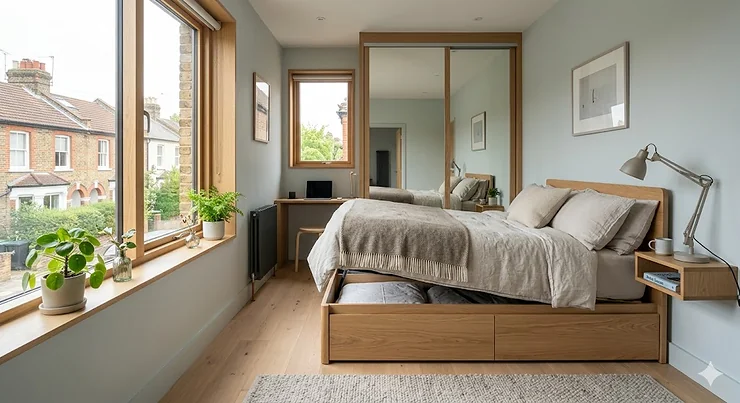
If you’ve ever stood in your British bedroom wondering where on earth to put your winter coat collection whilst simultaneously trying to avoid stubbing your toe on the wardrobe corner, you’re not alone. The truth is, UK bedrooms are getting smaller—the average new-build double bedroom now measures a rather modest 2.8 by 3 metres according to UK government space standards—whilst our belongings seem to multiply overnight like rabbits in springtime.
I’ve spent the past two years reviewing space saving bedroom furniture specifically for UK homes, not American houses with walk-in wardrobes the size of our entire flats. What most British homeowners overlook is that height is free whilst width is not—a tallboy chest of drawers uses roughly half the floor area of a standard wide chest for the same storage capacity. This singular principle transforms how you approach bedroom storage.
Whether you’re living in a Victorian terrace with awkward chimney breasts, a new-build where the “master” bedroom barely fits a king bed, or a box room that estate agents optimistically call a “third bedroom,” this guide reveals the furniture solutions that actually work in real UK homes. We’re talking about products available on Amazon.co.uk, built for British homes, and designed to handle the daily chaos of wet coats, endless shoes, and bedding that needs somewhere to live when you’re not using it.
Quick Comparison: Top 7 Space Saving Solutions at a Glance
| Solution | Floor Space Saved | Storage Capacity | Best For | Price Range (£) |
|---|---|---|---|---|
| Ottoman Storage Bed | 100% under-bed area | High (150-400L) | Bedding, seasonal clothes | £200-£600 |
| Tall Narrow Wardrobe | 50% vs standard | Medium-High | Alcoves, narrow walls | £80-£300 |
| Floating Bedside Shelves | Full floor footprint | Low-Medium | Compact bedrooms, rentals | £15-£60 |
| Under-Bed Storage Boxes | 70% under-bed | Medium | Off-season items, shoes | £15-£40 |
| Over-Door Organisers | Zero floor space | Medium | Accessories, daily essentials | £10-£30 |
| Murphy Wall Bed | 90% floor recovery | Transforms room | Multi-use spaces, studios | £400-£1,200+ |
| Modular Drawer Units | 40% vs traditional | High | Bespoke alcove fitting | £100-£350 |
What this comparison reveals is that ottoman beds and Murphy beds offer the highest space recovery, whilst vertical solutions like tall wardrobes and over-door organisers maximise capacity without stealing floor area. The sweet spot for most British bedrooms? Combining two or three solutions rather than relying on a single fix. An ottoman bed paired with floating shelves and a tall wardrobe transforms even a cramped box room into a functional sanctuary.
💬 Just one click — help others make better buying decisions too! 😊
✨ Don’t Miss These Exclusive Deals!
🔍 Take your bedroom organisation to the next level with these carefully selected products. Click on any highlighted item to check current pricing and availability on Amazon.co.uk. These picks will help you find exactly what you need!
Top 7 Space Saving Bedroom Furniture: Expert Analysis
1. Ottoman Storage Beds — The Heavy Lifter
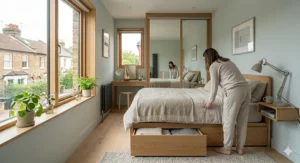
Ottoman storage beds have become the darling of British interior designers, and for rather good reason. Unlike drawer beds that limit you to a few compartments, an ottoman bed lifts the entire mattress to reveal cavernous storage underneath—we’re talking 150 to 400 litres depending on bed size and depth.
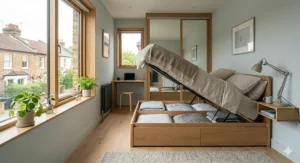
The mechanism relies on gas-powered hydraulic pistons, similar to those in car boot lids. You grab the handle, give a gentle tug, and the bed frame rises smoothly to around 90 degrees. Most ottoman storage beds feature gas-powered hydraulic systems that make lifting the mattress effortless, with some opening from the end whilst others open from the side for extra convenience. This matters more than you’d think—in a narrow British bedroom where one side of the bed sits against a wall, a side-lift ottoman becomes impossible to use.
What strikes me most about ottoman beds available on Amazon.co.uk is the sheer variety in depth. Budget models offer around 20 cm of storage clearance, whilst premium versions provide up to 40 cm. For context, that deeper storage easily swallows suitcases, winter duvets, or an entire season’s wardrobe. UK buyers should note that most ottoman beds work with mattresses up to 30-32 cm thick—any thicker and you risk the mattress squishing against the headboard when opened.
Pros:
✅ Massive storage capacity without occupying extra floor space
✅ Easy access to items stored underneath
✅ Available in all standard UK bed sizes from single to super king
Cons:
❌ Requires space beside or at foot of bed to open
❌ Heavier initial lifting if hydraulics aren’t top quality
Price Range: Around £200-£600 for a double ottoman bed frame on Amazon.co.uk, with Prime members typically getting free next-day delivery.
Expert Take: Ottoman beds shine brightest in compact master bedrooms where you need the storage but can’t sacrifice floor space for a chest of drawers. They’re particularly brilliant for storing bulky items you don’t access daily—think winter coats in summer, spare bedding, or luggage. UK customers consistently praise models from brands like Vida Designs and Happy Beds for reliability and straightforward assembly.
2. Tall Narrow Wardrobes — Vertical Brilliance
Here’s a furniture truth that feels obvious once you see it: in a small bedroom, a wardrobe that’s 180 cm tall and 45 cm wide uses half the floor space of one that’s 120 cm tall and 80 cm wide, yet stores roughly the same amount of clothing. Tall, narrow furniture makes rooms feel bigger because you can see more floor—your brain reads visible flooring as extra space.
The tall narrow wardrobes available on Amazon.co.uk typically measure 40-50 cm wide, 30-40 cm deep, and anywhere from 170-190 cm tall. This specific footprint is perfect for alcoves created by chimney breasts in Victorian and Edwardian homes—a typical chimney breast alcove measures 35-50 cm wide and 30-40 cm deep. Slot a tallboy wardrobe into that recess and it sits nearly flush with the chimney breast, using dead space rather than encroaching on the room.
What separates a brilliant tall wardrobe from a frustrating one is internal configuration. The best models include a hanging rail in the upper two-thirds (ideal for dresses, shirts, and coats) plus two or three drawers at the bottom for folded items. Avoid wardrobes with only shelving—pulling jumpers from a shelf 170 cm above floor level becomes tedious quickly.
Pros:
✅ Maximises vertical space whilst minimising floor footprint
✅ Perfect for alcoves and chimney breast recesses
✅ Visually less imposing than wide, bulky wardrobes
Cons:
❌ Hanging rail might be too high for children or shorter adults
❌ Can feel top-heavy if not secured to wall
Price Range: Expect to pay £80-£300 for a quality tall narrow wardrobe on Amazon.co.uk, depending on finish and internal fittings.
Expert Take: If your bedroom has a chimney breast, measuring those alcoves before buying anything else should be your first move. A tall wardrobe that fits snugly into that recess delivers storage capacity without the room feeling cluttered. British buyers with period properties should check that doors can open fully—older homes sometimes have uneven floors or skirting boards that interfere with door swing.
3. Floating Bedside Shelves — The Floor-Saver
Traditional bedside tables occupy around 40 x 40 cm of floor space per side—in a small bedroom, that’s 0.32 square metres permanently blocked. Floating bedside shelves eliminate that footprint entirely whilst still providing somewhere for your phone, book, and morning cuppa.
The models popular on Amazon.co.uk come in two main styles: simple floating shelves (basically a plank with hidden brackets) and floating drawers (a small cabinet mounted to the wall). The drawer versions cost more but offer concealed storage for items you’d rather not display—charging cables, medications, reading glasses, the usual bedside clutter.
Installation requires drilling into the wall, which rules them out for many renters unless you’re willing to patch holes when moving. However, the visual transformation is remarkable. Floating furniture creates space in your room because you can see more floor beneath it, and there are plenty of different options including floating side tables, bookcases, or desks. In a cramped bedroom, that visible floor beneath the shelf makes the entire space feel less congested.
One practical consideration for UK homes: many British bedrooms have skirting boards 10-15 cm tall, which means your floating shelf needs to mount high enough to clear them. Most floating bedside shelves sit around 50-70 cm above floor level—perfect height for reaching from bed but also safely above that chunky Victorian skirting.
Pros:
✅ Zero floor footprint—room feels instantly less cluttered
✅ Easy to clean underneath (no dust bunnies hiding behind furniture legs)
✅ Modern, minimalist aesthetic
Cons:
❌ Requires wall mounting—not suitable for all rentals
❌ Limited weight capacity compared to traditional tables
Price Range: Simple floating shelves start around £15-£30, whilst floating drawer units range from £40-£60 on Amazon.co.uk.
Expert Take: Floating shelves work brilliantly in bedrooms where you’re genuinely tight on floor space—think narrow rooms where a traditional bedside table would block the wardrobe door. They’re also ideal for rental properties where you want a contemporary look without investing in heavy furniture you’ll eventually need to move. Ensure you’re mounting into a solid wall, not plasterboard, for maximum stability.
4. Under-Bed Storage Boxes — The Invisible Solution
Under-bed storage boxes are the unsung heroes of British bedroom organisation. Many beds now come with built-in drawers, but you can also use various boxes and baskets to conceal belongings if yours doesn’t, taking advantage of under-bed storage space. The challenge lies in choosing the right type—British beds typically sit 20-35 cm off the floor, and not all storage boxes fit that clearance.
The most popular options on Amazon.co.uk include clear plastic boxes with wheels (brilliant for shoes and accessories), fabric boxes with lids (ideal for seasonal clothing), and slimline vacuum storage bags (best for bulky bedding). The wheeled versions prove particularly useful in UK homes where beds sit against walls—you simply roll the box out, grab what you need, and slide it back.
What most buyers don’t consider until it’s too late is dust accumulation. Under-bed areas in British homes—especially those with carpets—become dust magnets. Lidded boxes solve this problem whilst keeping contents visible through clear panels. The Really Useful Box brand dominates British households for good reason—their sizes are specifically designed to maximise under-bed space whilst remaining easy to manoeuvre.
Pros:
✅ Affordable solution (most boxes cost under £20-£40)
✅ Fits under existing beds without requiring new furniture
✅ Wheeled versions make access effortless
Cons:
❌ Dust builds up if boxes aren’t sealed
❌ Low-quality plastic cracks over time
Price Range: Individual boxes range from £15-£40 depending on size and material, available with free UK delivery over £25 on Amazon.co.uk.
Expert Take: Measure your bed height before ordering—there’s nothing more frustrating than receiving a storage box that’s 2 cm too tall to slide underneath. For British homes with damp issues (and let’s face it, our climate practically guarantees some level of dampness), avoid cardboard boxes under beds. Stick to breathable fabric or sealed plastic to prevent mould on stored clothing during those long, wet winters.
5. Over-Door Hanging Organisers — The Secret Weapon
Over-door organisers are perhaps the most underutilised space-saving tool in British bedrooms. They hook over the top of your bedroom door, using vertical space that otherwise goes completely to waste. With four pockets measuring 12 x 33.5 x 17 cm, hanging storage organisers make full use of the back of doors, adding extra storage when space is limited, perfect for organising nappies in nurseries, toiletries in bathrooms, socks and underwear in bedrooms.
The models available on Amazon.co.uk fall into two categories: fabric organisers with multiple pockets (brilliant for accessories, scarves, and small items) and metal rack versions with adjustable baskets (better for heavier items like shoes or toiletries). Both styles work on standard UK internal doors, which typically measure 1,981 mm tall and 762 mm wide.
One practical consideration for British homes: our internal doors often open into the bedroom rather than outward. This means the over-door organiser hangs inside the room, visible when the door is open. Choose neutral colours like grey or beige rather than bright patterns if you prefer a calmer aesthetic. The metal versions tend to be more durable but also heavier—check that your door hinges can support the weight when fully loaded.
Pros:
✅ Uses completely wasted vertical space
✅ No installation required—simply hook over door
✅ Portable and removable for rentals
Cons:
❌ Can interfere with door closing if overloaded
❌ Fabric versions may sag over time
Price Range: Fabric organisers start around £10-£20, whilst metal rack versions cost £20-£30 on Amazon.co.uk.
Expert Take: Over-door organisers excel at storing daily-use items you want accessible but not cluttering surfaces—think watches, jewellery, belts, hair accessories. In children’s bedrooms, they’re brilliant for corralling small toys, art supplies, or school accessories. The key to success is not overloading them—distribute weight evenly across pockets to prevent the organiser tilting or the door becoming difficult to close.
6. Murphy Wall Beds — The Room Transformer
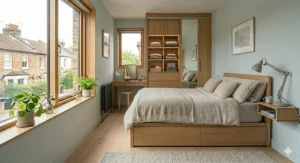
Murphy beds (also called wall beds or fold-down beds) represent the ultimate space-saving solution for British homes, though they require a more significant investment than other options. When folded up against the wall, a Murphy bed recovers virtually the entire floor space occupied by a traditional bed—we’re talking about transforming a single-use bedroom into a genuine multi-purpose room.
Wall beds blend functionality with aesthetic appeal, folding up when not in use to maximise bedroom space, especially in snug rooms, serving as remarkable storage solutions and beautiful additions to any bedroom. The mechanism relies on a spring-loaded or gas-piston system that counterbalances the mattress weight. Quality Murphy beds require minimal effort to raise or lower—a gentle pull brings the bed down, a slight push sends it back up.
The models available in the UK (many via Amazon.co.uk though also specialist retailers) come in two main orientations: vertical (mattress stores upright, footboard at floor level) and horizontal (mattress stores sideways). Vertical Murphy beds work best in rooms with high ceilings and limited width, whilst horizontal versions suit wider walls with lower ceilings. A typical vertical Murphy bed requires around 230 cm of wall height and 95-140 cm of width depending on mattress size.
Installation isn’t trivial—these beds must anchor securely into wall studs or solid masonry to safely support the weight. Professional installation costs £100-£300 in most UK areas, though capable DIYers can tackle it themselves following manufacturer instructions. Most Murphy beds also require a specific mattress thickness (typically 15-30 cm) to ensure proper counterbalancing.
Pros:
✅ Recovers up to 90% of floor space when folded
✅ Transforms bedroom into office, gym, or playroom
✅ Modern designs integrate seamlessly with décor
Cons:
❌ Significant upfront cost
❌ Requires professional installation in most cases
❌ Not suitable for rental properties
Price Range: Murphy bed frames start around £400-£600 for single sizes, with double and king sizes ranging £800-£1,200+ on Amazon.co.uk. Cabinet Murphy beds (bed folds into a wardrobe-style unit) cost £1,500-£3,000.
Expert Take: Murphy beds make financial and practical sense primarily in studio flats or homes where you need a guest bedroom that also functions as an office, craft room, or gym. They’re less practical as primary bedroom solutions unless you’re genuinely committed to making and unmaking the bed daily. British buyers should verify their wall construction—solid brick or block walls handle Murphy beds brilliantly, whilst stud walls may require reinforcement. The best models feature German-made gas pistons with lifetime warranties for reliable, quiet operation.
7. Modular Drawer Units — The Alcove Masters
Modular drawer units deserve recognition as the flexible solution for British homes with awkward spaces. Unlike standard furniture that comes in fixed widths, modular systems allow you to configure drawers to fit your exact requirements—particularly useful in Victorian and Edwardian homes where rooms feature odd-shaped alcoves, chimney breasts, and sloped ceilings.
The concept is straightforward: individual drawer modules (typically 40-50 cm wide) stack vertically and sit side-by-side to create custom storage arrangements. You might use three narrow modules stacked in a tight alcove, or arrange four modules in an L-shape to fit around a radiator. This flexibility proves invaluable in older British homes where standardised furniture simply doesn’t fit properly.
Most modular systems on Amazon.co.uk use engineered wood construction with either painted or wood-effect finishes. The better-quality units feature metal drawer runners rather than plastic—worth the extra £20-£40 for longevity, especially in the damp British climate where plastic components deteriorate faster. Assembly typically requires 30-60 minutes per module depending on complexity.
One consideration for UK homes: modular units often arrive flat-packed, which means navigating them through narrow Victorian staircases or into upper-floor bedrooms. Measure your stairwell width and any tight corners before ordering—there’s nothing quite as frustrating as having furniture delivered that won’t physically fit upstairs.
Pros:
✅ Customisable to fit awkward British room shapes
✅ Expandable—add more modules as storage needs grow
✅ Easy to transport if moving house
Cons:
❌ Requires assembly (though most are straightforward)
❌ Less sturdy than solid wood equivalents
Price Range: Individual drawer modules cost around £30-£80, with complete alcove-filling setups ranging £100-£350 on Amazon.co.uk.
Expert Take: Modular drawer units work brilliantly for renters and homeowners alike because you can reconfigure them when moving to a different property. They’re also excellent for children’s bedrooms where storage needs evolve—swap drawer modules for open cubbies as kids grow from toys to textbooks. British buyers should look for units with anti-tip straps included, particularly important in homes with young children or uneven period flooring.
How to Choose Space Saving Bedroom Furniture for Your UK Home
Selecting the right space saving bedroom furniture requires understanding your specific constraints and priorities. Start by measuring your room accurately—and I mean properly measuring, not estimating. You need wall lengths, ceiling height, radiator positions, window locations, and door swing clearance. Most UK box rooms measure 1.8-2.4 m wide and 2.1-3 m long, roughly 4-7 square metres of floor space—enough for a single bed and one piece of storage furniture but not much more.
Consider Your Wall Construction
British homes vary wildly in wall type. Victorian and Edwardian properties typically feature solid brick or stone walls that easily support floating shelves and Murphy beds. Post-war homes often use cavity walls with concrete blocks. Modern builds increasingly use timber stud walls with plasterboard cladding—these require specialist fixings for wall-mounted furniture. Before ordering floating furniture or wall beds, knock on your walls. Solid walls sound dull and dense; stud walls sound hollow. If in doubt, use a stud finder or consult a builder.
Factor in British Climate Realities
Our damp British climate affects furniture longevity more than most buyers realise. Cheap particle board swells and deteriorates rapidly in humid bedrooms, particularly those in older properties without modern ventilation. Look for furniture with moisture-resistant finishes or solid wood construction. If storing clothing under beds or in Ottoman storage, ensure adequate air circulation—vacuum storage bags work brilliantly for this purpose.
Assess Your Access Requirements
How often will you need to reach stored items? Daily-use items belong in easily accessible drawer units or over-door organisers. Seasonal clothing and spare bedding can live in ottoman beds or high shelving. The standard advice to use under-bed storage is technically correct but doesn’t solve the problem if you can’t easily pull boxes out because the bed sits against a wall. Choose wheeled storage boxes if bed access is limited.
Calculate Total Cost of Ownership in Pounds
Space saving furniture often costs more upfront than standard pieces, but the value proposition changes when you factor in the space recovered. A £500 ottoman bed that eliminates the need for a £200 chest of drawers actually costs £300 net. Murphy beds look expensive until you realise they transform a bedroom into a usable home office—saving the £1,000+ annual cost of renting dedicated office space in British cities. Always calculate cost-per-square-metre of space recovered.
Check UK Delivery Logistics
Amazon.co.uk typically offers free delivery on orders over £25, with Prime members receiving next-day delivery in most postcodes. However, large furniture items may incur additional delivery charges to certain areas including London congestion zones and remote postcodes (AB, CA, DD, IV, KW, PA, PH, and parts of Scotland). Verify delivery costs and timescales before purchasing, especially if you need furniture by a specific date.
Verify UK Safety Standards
Look for furniture displaying UKCA marking (UK Conformity Assessed), which replaced CE marking post-Brexit for products sold in Great Britain. This certification ensures furniture meets British safety and quality standards. For children’s bedroom furniture, check for anti-tip straps and ensure drawer units can’t topple if a child climbs them. The UK government’s technical housing standards also specify minimum bedroom sizes—useful context when planning furniture layouts.
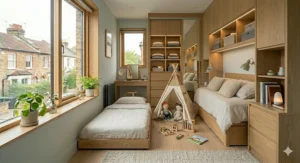
Real-World Space Saving: Three British Bedroom Transformations
Scenario 1: The Victorian Terrace Couple (Birmingham)
Challenge: Master bedroom 3.2 m x 2.9 m with chimney breast eating 50 cm from one wall, creating two awkward alcoves either side.
Solution: Positioned a king-size ottoman bed (£450) along the longest wall for maximum storage of winter bedding and luggage. Fitted two tall narrow wardrobes (£95 each) into the chimney breast alcoves—one for each person’s clothing. Added floating bedside shelves (£25 each) rather than traditional tables to maintain floor clearance. Installed an over-door organiser (£18) on the back of the bedroom door for accessories.
Result: Recovered approximately 0.6 square metres of usable floor space compared to traditional furniture layout. The room feels noticeably less cluttered, and the couple can now walk around the bed without turning sideways. Total investment: £688. Storage capacity increased by roughly 30% whilst floor space occupied decreased by 40%.
Scenario 2: The Box Room Student (Manchester)
Challenge: Third bedroom measuring just 2.1 m x 2.4 m (5 square metres) functioning as bedroom and study space.
Solution: Installed a single Murphy bed (£520) that folds vertically against the wall during daytime, creating floor space for a small desk and chair. Added four modular drawer units (£35 each) stacked in the corner for clothing storage. Mounted floating shelves (£15 for set of two) above the desk for textbooks and study materials. Used under-bed storage boxes (£18 for set of three) when bed is down for shoes and gym kit.
Result: Room functions as bedroom at night and study space during day—effectively doubling the usable space in a property where separate bedroom and study weren’t possible. Student reports significant improvement in work focus now that desk doesn’t face the bed. Total investment: £691. Room flexibility increased from single-use to dual-purpose.
Scenario 3: The New-Build Family (Milton Keynes)
Challenge: Two children sharing a 3 m x 2.8 m bedroom in a modern development. Limited floor space for two beds plus adequate storage for clothing and toys.
Solution: Purchased two single ottoman beds (£185 each) positioned along opposite walls, creating a central play space. Each bed stores that child’s seasonal clothing and spare bedding. Added tall narrow wardrobe (£110) at room end for hanging clothes. Installed two over-door organisers (£15 each)—one on bedroom door, one on wardrobe door—for daily accessories and school items. Mounted floating shelves (£20 for set of four) at child-height for books and toys.
Result: Children gained functional bedroom with clear floor space for playing, plus designated storage zones that helped them maintain organisation (with parental encouragement). Parents report reduced morning chaos now that school uniform items live in accessible door organisers. Total investment: £545. Storage capacity doubled whilst preserving 2 square metres of floor space for activities.
Common Mistakes When Buying Space Saving Bedroom Furniture in the UK
Mistake 1: Forgetting to Measure Doorways and Staircases
British homes, particularly Victorian terraces and period properties, feature notoriously narrow staircases and doorways. A tallboy wardrobe that’s 180 cm tall might not pivot around that tight landing corner even if it fits through the doorway. Measure your narrowest access point and factor in the furniture’s diagonal dimension when tilted—this catches people out repeatedly.
Mistake 2: Choosing Furniture That Requires Unavailable Wall Space
Murphy beds and large floating shelves need continuous, unobstructed wall space—but British bedrooms are riddled with radiators, windows, skirting boards, and light switches. Map these obstacles before selecting wall-mounted furniture. That lovely wall bed you’ve found might be perfect except your double radiator sits exactly where the bed needs to fold down.
Mistake 3: Underestimating British Damp and Humidity
Cheap particle board furniture deteriorates rapidly in damp British bedrooms, particularly in older properties without adequate ventilation. What looks acceptable when new swells, warps, and eventually falls apart within 18-24 months. Spend the extra £40-£80 for furniture with moisture-resistant finishes or solid wood construction—it’s considerably cheaper than replacing everything in two years.
Mistake 4: Ignoring Weight Ratings on Wall-Mounted Furniture
Fabric over-door organisers and floating shelves have specific weight capacities—typically 5-10 kg for budget models. Exceed these limits and you risk shelves tearing from walls or organisers sagging beyond repair. Always check weight ratings and factor in a 25% safety margin. That floating bedside shelf might hold your book and phone, but add a heavy lamp and you’re courting disaster.
Mistake 5: Buying American-Sized Furniture for UK Rooms
Amazon.co.uk sells internationally, which means you’ll encounter furniture designed for American homes with larger room dimensions. A “compact” chest of drawers from a US brand might measure 90 cm wide—perfectly standard in America but overwhelmingly large in a 2.4 m wide British box room. Always check dimensions in centimetres, not just product descriptions.
Mistake 6: Overlooking Post-Brexit Import Duties on EU Products
Some products sold via Amazon.co.uk ship from EU warehouses, potentially incurring import duties and VAT adjustments post-Brexit. Check the seller location and whether prices include UK VAT. Products fulfilled by Amazon.co.uk typically handle VAT correctly, but third-party sellers may add unexpected charges at checkout.
Mistake 7: Failing to Secure Tall Furniture to Walls
Tall, narrow furniture has a higher centre of gravity than wide, squat pieces—making it prone to tipping if a child climbs drawers or if weight distributes unevenly. British building regulations now recommend anti-tip straps for any furniture taller than 76 cm in children’s rooms. Most quality furniture includes these straps; use them regardless of whether children are present. Older British homes with uneven floors increase tipping risk significantly.
Long-Term Costs and Maintenance: What British Buyers Should Know
Initial Investment vs Ongoing Value
Space saving bedroom furniture typically costs 20-40% more than equivalent standard furniture. A basic double bed frame costs £150-£250 on Amazon.co.uk; an ottoman storage bed runs £300-£600. That £250 premium might seem steep until you factor in the £200-£300 chest of drawers you no longer need. Run the numbers honestly—what furniture can you eliminate by choosing space-saving alternatives?
Maintenance Requirements in British Climate
Our wonderful British weather (translation: damp, with occasional sunshine) affects furniture longevity more than many buyers anticipate. Hydraulic ottoman beds require periodic lubrication of pistons—typically once annually with silicone spray. Ignore this and those smooth-opening mechanisms become creaky and stiff within 18-24 months. Murphy bed mechanisms need similar attention, though better-quality German pistons (common in UK-market Murphy beds) prove considerably more resistant to deterioration.
Wooden furniture in British bedrooms benefits from occasional treatment with furniture wax or polish containing moisture-resistant properties. This matters particularly in older homes lacking modern damp-proof courses. A £15 tin of quality furniture wax extends wooden drawer unit lifespan by years.
Replacement Parts Availability
Consider parts availability before purchasing, particularly for complex furniture like Murphy beds or ottoman mechanisms. European and British brands typically stock replacement parts for 7-10 years. Budget Asian imports? Good luck finding a replacement gas piston in three years when the original fails. This isn’t xenophobia; it’s practical economics. Spending an extra £100 upfront for a UK or EU-made ottoman bed becomes remarkably good value when you’re still using it a decade later rather than replacing a failed budget model.
Energy Cost Implications
This sounds odd, but bear with me. Space saving furniture that creates more usable floor space often means you’re heating that additional area in winter. In British homes with expensive heating costs (particularly those using electric heating or oil), recovering 2 square metres of bedroom floor space adds roughly £30-£50 to annual heating bills. Factor this into your decision-making if choosing between a Murphy bed (which recovers lots of floor space) versus simpler solutions.
Conversely, well-fitted alcove furniture and floor-to-ceiling storage actually improves insulation by reducing cold wall surface area exposure. Filling those Victorian chimney breast alcoves with tall wardrobes creates a small but measurable reduction in heat loss through the wall behind.
Maximising Storage in British Bedrooms: A Room-by-Room Strategy
For Victorian and Edwardian Terraces
These properties feature high ceilings (often 2.7-3 m), chimney breasts creating alcoves, and bay windows. Your strategy:
Exploit Vertical Space: Tall furniture works brilliantly with 3 m ceilings. A 180 cm wardrobe that feels imposing in a 2.4 m ceiling modern bedroom sits perfectly in a Victorian space. Install picture rails or crown moulding shelving at 2.5 m height for rarely-accessed storage.
Fill Alcoves Precisely: Chimney breast alcoves typically measure 35-50 cm wide and 30-40 cm deep—exactly right for tall narrow wardrobes or custom shelving units. Measure both alcoves carefully; they’re rarely identical widths despite appearing symmetrical.
Address Damp Proactively: Older properties suffer from rising damp and poor ventilation. Keep furniture 2-3 cm from external walls to allow air circulation. Use dehumidifiers in bedrooms prone to condensation.
For Modern New-Build Homes
New developments cram bedrooms into minimal space whilst maximising developer profit. Your strategy:
Measure Everything Twice: New-build double bedrooms now average just 2.8 x 3 metres—verify actual dimensions as estate agent floor plans notoriously exaggerate room sizes. That “master” bedroom might barely fit a king bed plus storage.
Utilise Low Ceilings: Modern homes typically feature 2.4 m ceilings—too low for excessively tall furniture but perfect for modular systems and built-in solutions. Murphy beds work brilliantly in these spaces.
Exploit Fitted Wardrobes: Many new builds include fitted wardrobes. Before ripping them out for “better” furniture, assess whether they actually maximise the space more efficiently than free-standing alternatives. Often they do.
For Rental Properties
Can’t drill holes, can’t permanently alter the property, and you’ll eventually need to transport everything. Your strategy:
Prioritise Portable Solutions: Ottoman beds, modular drawer units, and over-door organisers move easily between properties. Avoid Murphy beds and extensive floating shelves unless you’re committed long-term.
Choose Damage-Free Mounting: Command strips (rated for heavier loads) mount lightweight floating shelves without drilling. They won’t support major weight but work for books and decorative storage.
Document Everything: Photograph rooms before adding furniture and keep all packaging/instructions. Makes exit inspections considerably smoother when you can demonstrate furniture caused no damage.
FAQ: Your Space Saving Bedroom Furniture Questions Answered
❓ Will an ottoman bed fit through a standard UK doorway?
❓ Do Murphy beds require special mattresses available in the UK?
❓ Are over-door organisers suitable for hollow British internal doors?
❓ How much assembly time should I expect for flat-pack bedroom furniture?
❓ Can I install floating shelves on plasterboard walls typical in UK new builds?
Conclusion: Transforming Your British Bedroom
Space saving bedroom furniture isn’t about cramming more stuff into tiny rooms—it’s about intelligently organising the belongings you already own whilst creating breathing space in your home. The principles are straightforward: exploit vertical space through tall narrow furniture, recover wasted areas like under-bed and over-door zones, and choose pieces that serve multiple purposes.
Whether you’re navigating a Victorian terrace’s awkward alcoves, maximising a modern new-build’s minimal dimensions, or simply trying to bring order to bedroom chaos, the solutions reviewed here deliver genuine improvements. Start with your most pressing storage pain point—is it clothing overflowing wardrobes? Bedding without a home? Accessories cluttering surfaces? Match that problem to the appropriate solution: ottoman beds for bulky items, tall wardrobes for clothing, over-door organisers for daily accessories.
Remember that British homes present unique challenges: damp climate affecting furniture longevity, narrow staircases complicating delivery, period property quirks requiring custom solutions. Factor these realities into your purchasing decisions rather than simply copying American bedroom storage advice that assumes different room dimensions and construction methods.
The furniture landscape on Amazon.co.uk offers remarkable choice specifically suited to UK homes, from budget-friendly modular solutions through to premium Murphy beds. Invest thoughtfully, measure accurately, and prioritise quality over absolute cheapness—your bedroom storage should last years, not months.
Most importantly, space saving bedroom furniture should reduce stress rather than create it. If a solution requires daily effort you’ll realistically not maintain, choose something simpler. The best storage system is the one you’ll actually use six months from now when the novelty has worn off and you’re simply trying to get dressed on a rainy Tuesday morning.
✨ Don’t Miss These Exclusive Deals!
🔍 Take your bedroom organisation to the next level with these carefully selected products. Click on any highlighted item to check current pricing and availability on Amazon.co.uk. These picks will help you find exactly what you need!
Recommended for You
- 7 Best Solid Oak Bedroom Storage UK 2026
- 7 Best Bedroom Storage With Soft Close Drawers UK 2026
- Tall vs Wide Chest of Drawers: 7 Best Options UK 2026
Disclaimer: This article contains affiliate links. As an Amazon Associate, I earn from qualifying purchases. If you purchase products through these links, we may earn a small commission at no additional cost to you.
✨ Found this helpful? Share it with your mates! 💬🤗
